
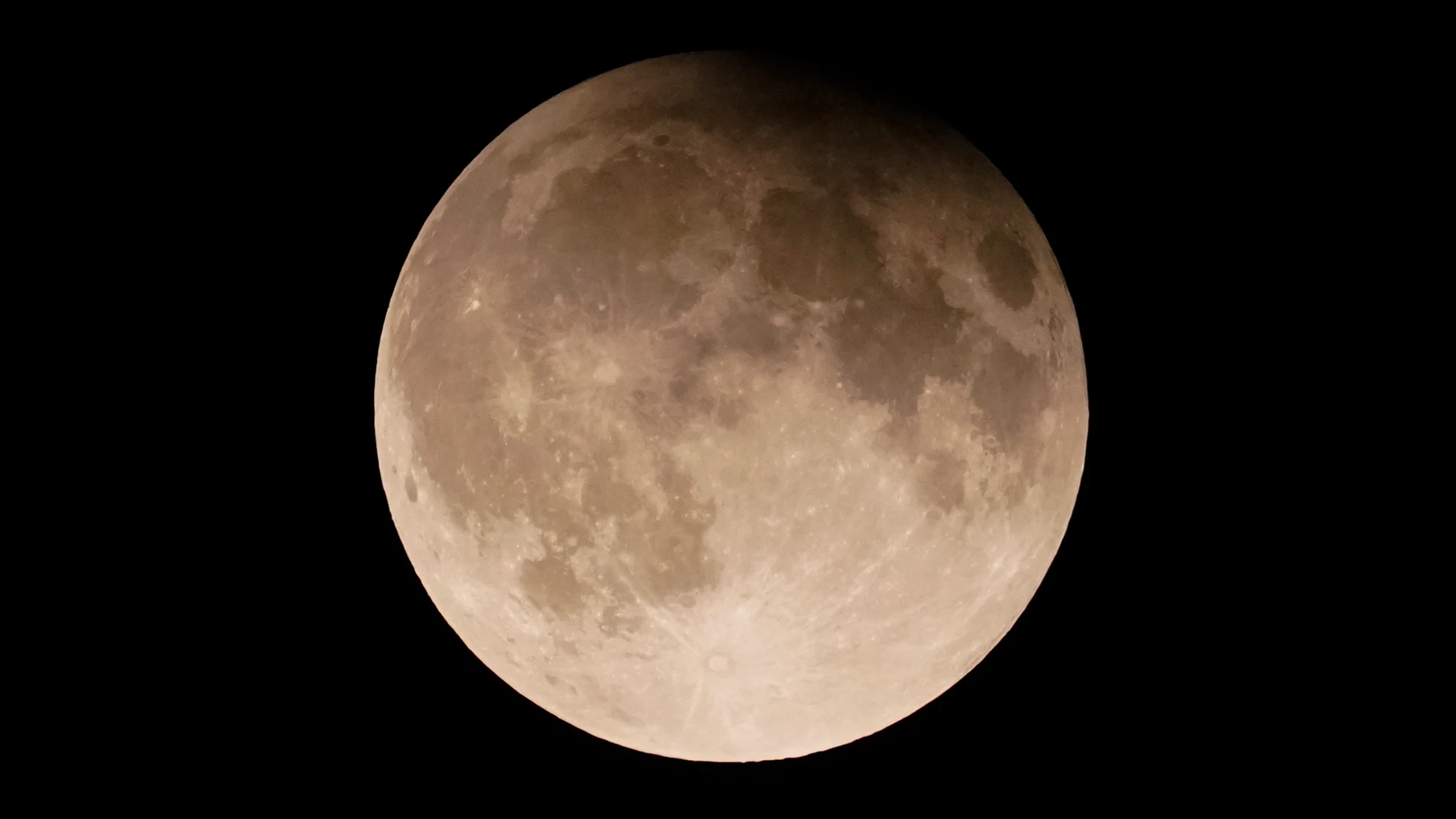
Extremadura will be one of the places in Spain from which you can practically follow the entire partial lunar eclipse on August 28. The phenomenon will occur during the early morning hours and will reach its peak shortly after six in the morning, when the Earth’s shadow will cover a large part of the lunar disk.
He eclipse will have a magnitude of 0.93 and will be visible, at least in some of its phases, from the western Asia, Europe, Africa and America. In Spain, the partial phase can be observed throughout the territory, although conditions will vary depending on location. In the center and east of the peninsula, as well as in the Balearic Islands, the Moon will set before this phase concludes. In Extremadura, however, will remain on the horizon practically until the end.
At what time will the lunar eclipse be seen in Extremadura?
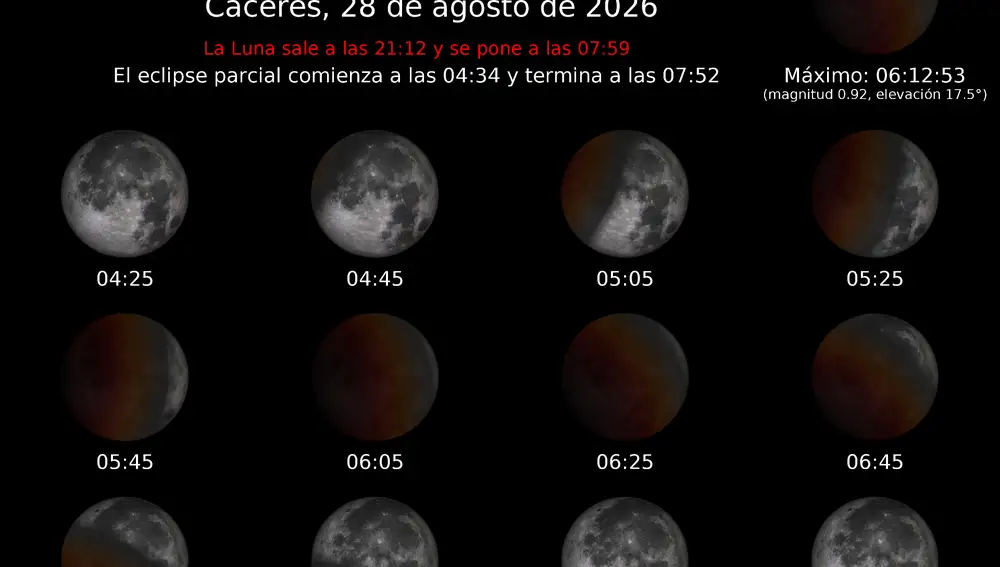
The partial phase will begin at 04:34 hours on Friday, August 28. From that moment on, the Earth’s shadow will progressively advance over the surface of the Moon.
The most anticipated moment will arrive at 06:12 hourswhen the eclipse reaches its maximum. It will, therefore, be the best time in the early morning to observe the phenomenon in Extremadura. Afterwards, the shadow will begin to retreat until the partial phase ends at 07:52 hours.
The conditions will be very similar in the two Extremaduran capitals. In Caceresthe Moon will set at 07:59 hours and during the maximum of the eclipse it will be at about 17.5 degrees of elevation. In Badajozlaying will take place slightly later, at 08:02 hourswhile at the moment of maximum occultation it will be about 18.2 degrees above the horizon.
The best time to observe it from Cáceres and Badajoz
Those who want to contemplate the most striking phase will not need to be awake during the entire eclipse. The interval around 06:00 and 06:30 hours will concentrate the moments in which a greater part of the Moon will be covered by the Earth’s shadow, with the maximum predicted exactly at 06:12:53.
The proximity of dawn does make it necessary to choose the observation site correctly. The recommendation is to look for an area with the western horizon clearwithout buildings, trees or geographical features that hide the Moon when it loses height.