
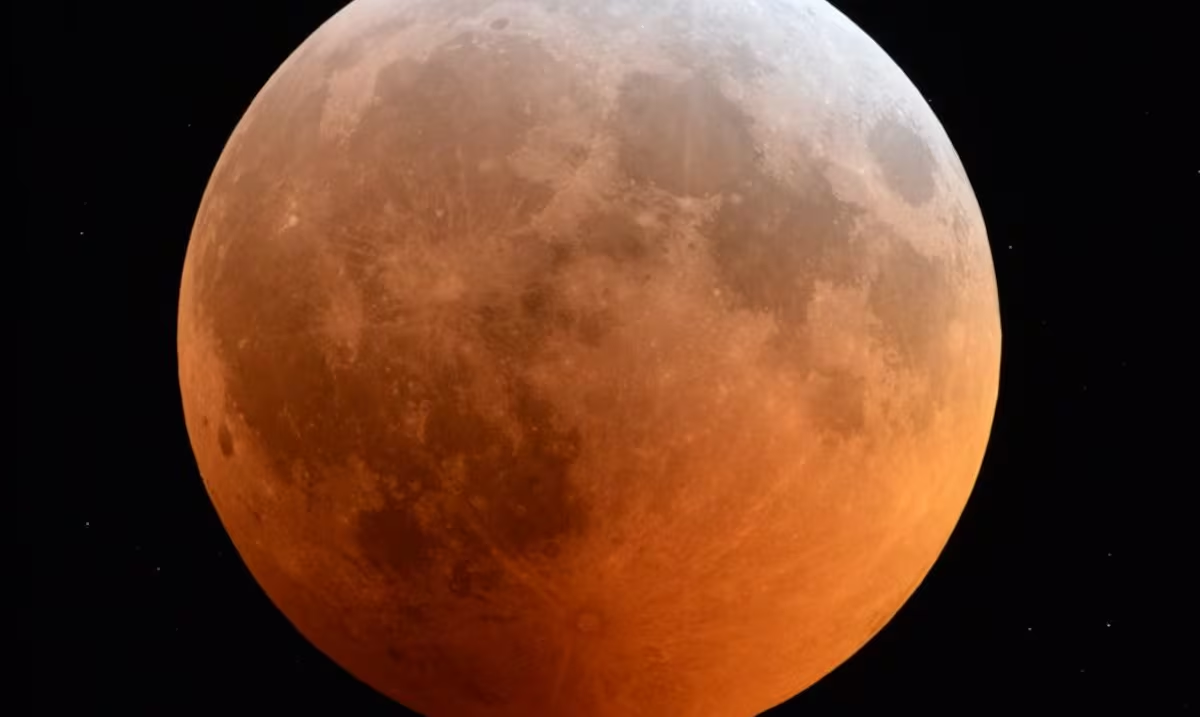
Those who look at the sky late on Thursday night will be able to see how the Moon little by little it loses its brightness until it is almost covered by the shadow of the Earth, in the middle of a partial lunar eclipse which will be visible from Puerto Rico.
The Caribbean Astronomy Society (SAC) explained that, although technically it will be a partial eclipse, 96% of the Moon will be within the umbra, the darkest part of the shadow cast by the Earthduring the peak of the phenomenon.
For that reason, its appearance will be very similar to that of a total eclipse.
According to the SAC, the moment of greatest intensity will occur at 12:12 am on Friday, August 28when only a small portion of the satellite will remain illuminated.
“It will be an eclipse so intense that only a tiny part of the upper right edge of the Moon will be slightly illuminated”highlighted the organization.
1 / 15 | In images: this is how the lunar eclipse was seen in Puerto Rico and around the world. This is what it looked like from Ponce. – Luis Bracero, SAC
The partial eclipse will begin at 10:33 pm on Thursday and will last until 1:51 am on Friday, although the SAC anticipated that the most notable stage can be seen between the 11:52 pm and 12:32 am
In addition to getting darker, the Moon could take on orange or reddish hues due to the magnitude of the eclipse.
The SAC explained that this color is produced when light from the Sun passes and is refracted through the Earth’s atmosphere before reaching the lunar surface.
To observe the event from Puerto Rico, the organization recommended locating in a place with good visibility to the south. As the Moon will be elevated at about 61 degrees above the horizon, the entity suggested using a reclining chair to avoid neck discomfort during observation.
The night could also offer another attraction for those who remain attentive to the sky.. Near the position of the Moon will be the radiants of a pair of meteor showers slight, so it is not ruled out that some meteor may be observed during the eclipse.
1 / 22 | 📷 In images: this is how they captured the solar eclipse in different parts of the world. Between clouds and during a solar eclipse, the International Space Station crossed in front of the Sun in this image captured near Hodgdon, Maine. -Joel Kowsky
A lunar eclipse occurs when the Sun, Earth and Moon are almost alignedcausing the planet to block much of the sunlight that normally illuminates the satellite.
According to the SAC, this eclipse is related to the total solar eclipse observed in Spain on August 12, because both phenomena can occur a few weeks apart when orbital conditions favor new alignments between the three celestial bodies.
Thursday’s lunar eclipse will be visible in much of the planet, except in Asia, Australia and parts of the western Pacific. However, the Caribbean, Latin America and the eastern half of the United States will be among the privileged regions, since from those areas it will be possible to see it from beginning to end.
The SAC indicated that, after this event, the next total lunar eclipse visible from Puerto Rico will occur on the night of June 25, 2029.