
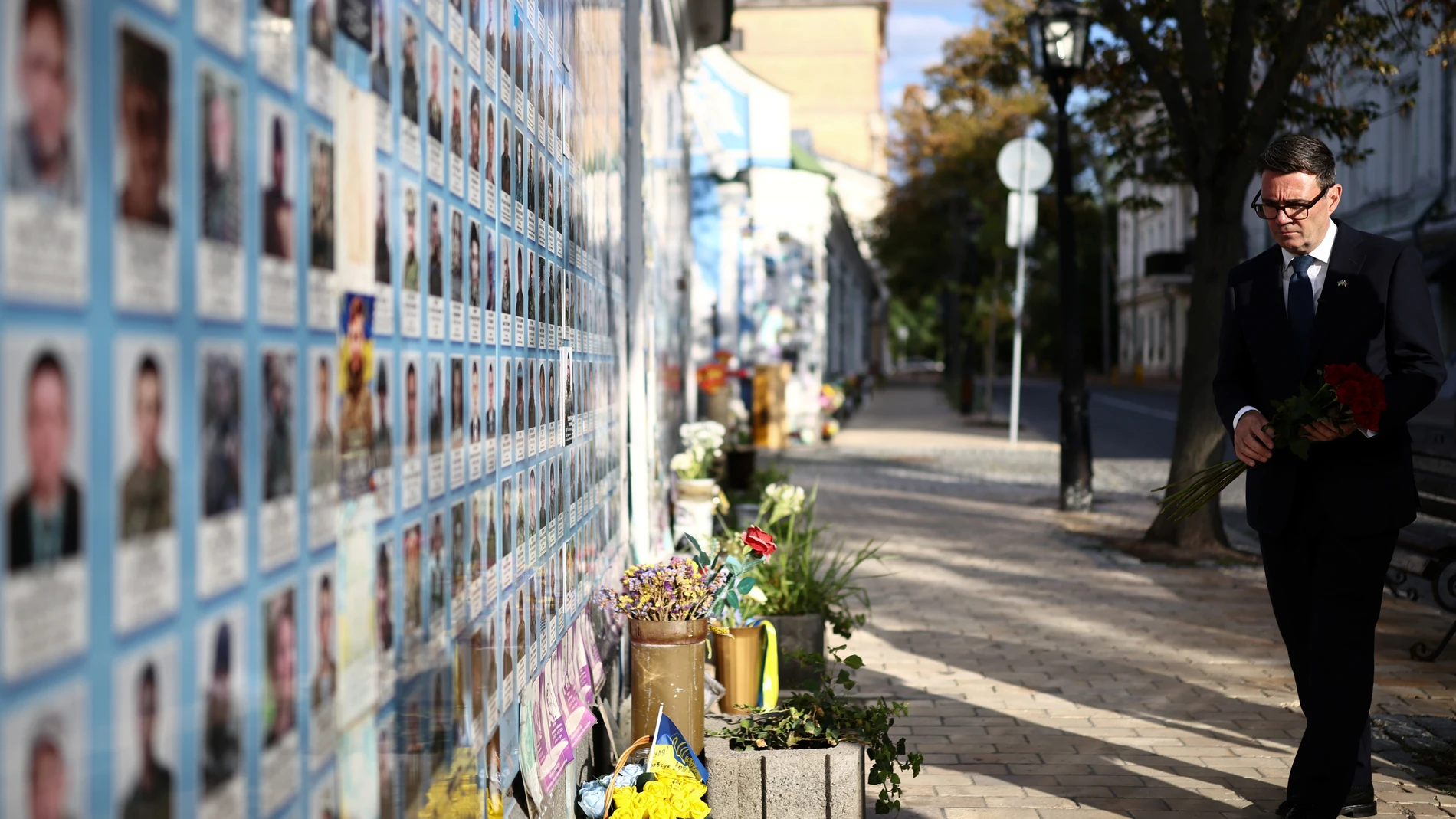
Two days before the celebration of Independence Day, Przemyśl, a Polish city located a few kilometers from the border with Ukraine, becomes the center of European politics. Vehicles with police escort arrive non-stop at the central station.
For the second year in a row, Kyiv invites its friends to the National Prayer Breakfast, a gathering that goes beyond the scope of a religious ceremony and becomes a kind of diplomatic forum: a place where Ukraine reminds the world that the war continues. The meetings begin already on the night train. In recent years, the Ukrainian railway has become the scene of unexpected meetings and conversations.
“I think he likes me,” Irish Senator Aubrey suddenly says from the open door of my compartment, referring to the conductor, who a few minutes before had sternly reminded the passengers of the rules of use of the carriage.
Our conversation gradually drifts towards politics. Aubrey is concerned that Ukraine is losing space on the European political and information agenda.
I hear talk of this shift of the European focus of attention already in Warsaw. And nowhere is this more evident than in Poland, one of Ukraine’s most constant allies, where support for Kyiv increasingly coexists with the historical wounds of World War II and the growing rejection of immigration.
Among the guests at the prayer breakfast are the President of Lithuania, Gitanas Nausėda, and the Prime Minister of Estonia, Kristen Michal. For countries that share a border with Russia, the importance of supporting Ukraine has another, almost physical, dimension.
This year’s celebration is loaded with symbols, from the guests’ clothing to the smallest details of the organization. Not only Ukrainian politicians, but also representatives of European parliaments and diplomatic structures wear traditional Ukrainian clothing. Some wear vyshyvankas, the traditional embroidered shirts; others, suits in the colors of the Ukrainian flag.
At the exit of the train I congratulate a man with glasses on his extraordinary vyshyvanka. He carries a tactical backpack on his shoulder. Ron from New Zealand, who is introduced later, was his country’s defense minister. Before the Russian invasion it had hardly any ties with Ukraine. Now he is one of its most active defenders. My old acquaintance, Senator Aubrey, meanwhile regrets having forgotten this time all the Ukrainian symbology that he wanted to take with him.
In the act, however, there is no shortage of symbols. On the tables there are wheat seeds in small glass tubes. Next to it, an inscription: from these seeds independence will sprout.
Among the guests are members of the Ukrainian military intelligence, chaplains dressed in military uniforms, celebrities and religious leaders. Sister Lucía Caram, one of the well-known friends of Ukraine, traveled from Spain, who since the beginning of the large-scale invasion has participated in several humanitarian missions.
There is also Keith Kellogg, Trump’s former special envoy for Ukraine, whom Ukrainians jokingly call “the best anti-aircraft defense”: when he visits Kyiv, Russian bombing of the capital usually stops.
In the center of the room is an empty table: for all those whom this war has taken.
The main sponsor of the meeting is Vyriy, a drone manufacturer. Guests are given patches with a message: God is against war, but technology helps save lives.
President Volodymyr Zelensky says the current war is also about Russia’s attempts to turn faith into a permit issue.
Each person, says Zelensky, has the right to talk to God in the way he chooses and wherever he decides to do so.
“This, by the way, is also what Ukraine is fighting for,” he says.
A friendly, almost festive atmosphere reigns inside the room. People talk, laugh, exchange phones and business cards.
But it is enough to leave the room and talk to the inhabitants of the capital for that story to take on a much less solemn tone.
“They bombard us constantly (…) Sometimes I don’t even have time to get to the bathroom,” a neighbor tells me, exhausted.
Then I get into a taxi.
The driver is an older man.
—You know, I still believe that Ukraine is going to win. They will no longer be able to return us to that communism.
He remains silent for a moment and adds:
– We have changed during these years of war. We have become more indomitable. We are no longer going to hand over what is ours just like that.