
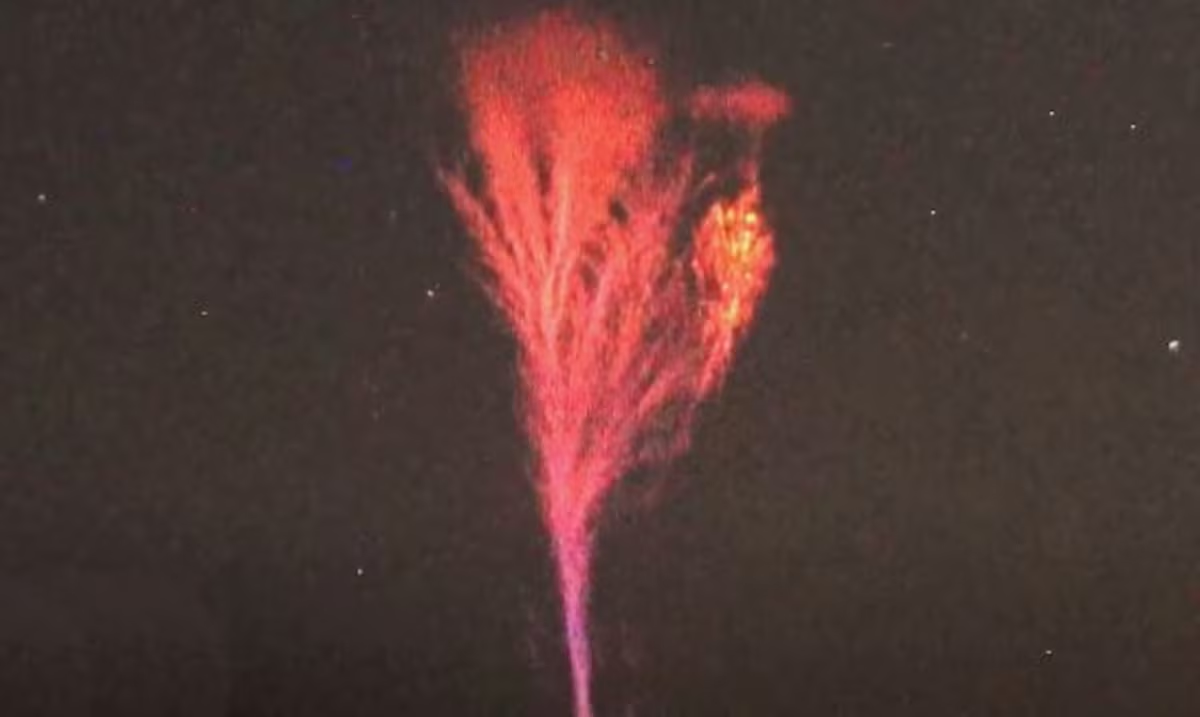
If you were one of those who witnessed the rare, sudden and powerful flash that illuminated the sky of Red Cape Yesterday, Thursday, know that you witnessed a rare atmospheric phenomenon known as a giant lightning bolt, or “giant jet lighting”.
The videographer and researcher of transient light events, Frankie Lucenacaptured the moment in a video published by The Weather Channel. The phenomenon occurs at the top of a thunderstorm and rises into the upper atmosphere, sometimes reaching the ionosphere.
However, the media explained that, although the flash seen yesterday in Puerto Rico was red, the giant jets can also be seen white or blue.
The meteorologist of National Weather Service, Cecile Villanueva Birrielconfirmed to The New Day that it was a giant lightning bolt.
“It is a natural phenomenon that occurs when there are very strong thunderstorms that occur high in the atmosphere, between 31 and 55 miles high. They are unusual, but where they are most frequent are in the Cabo Rojo area because that is where strong thunderstorms occur in the afternoon.“explained Villanueva Birriel.
“They are divided by scales according to the distance at which they occur in the atmosphere, but it is something very natural. It does not happen all the time with all thunderstorms, but it has happened in the past in Puerto Rico,” he added.
As explained, the giant lightning bolts are part of the super-atmospheric flashes or super-atmospheric discharges.a family of sudden electrical phenomena that occur at altitudes above normal flash altitudes.
According to the portal of the National Aeronautics and Space Administration (NASA), these phenomena are a powerful type of electrical discharge that extends from the top of a thunderstorm to the upper atmosphere.
“They are usually observed by chance, often by airplane passengers or involuntarily captured by ground cameras that focus on other phenomena. Giant lightning bolts appear when turbulent conditions at the tops of towering thunderstorms allow lightning bolts to escape the storm, propagating into space. They create an electrical bridge between the top of the clouds (about 12 miles) and the upper atmosphere (about 62 miles), depositing a significant amount of electrical charge,” NASA emphasized in the writing.