
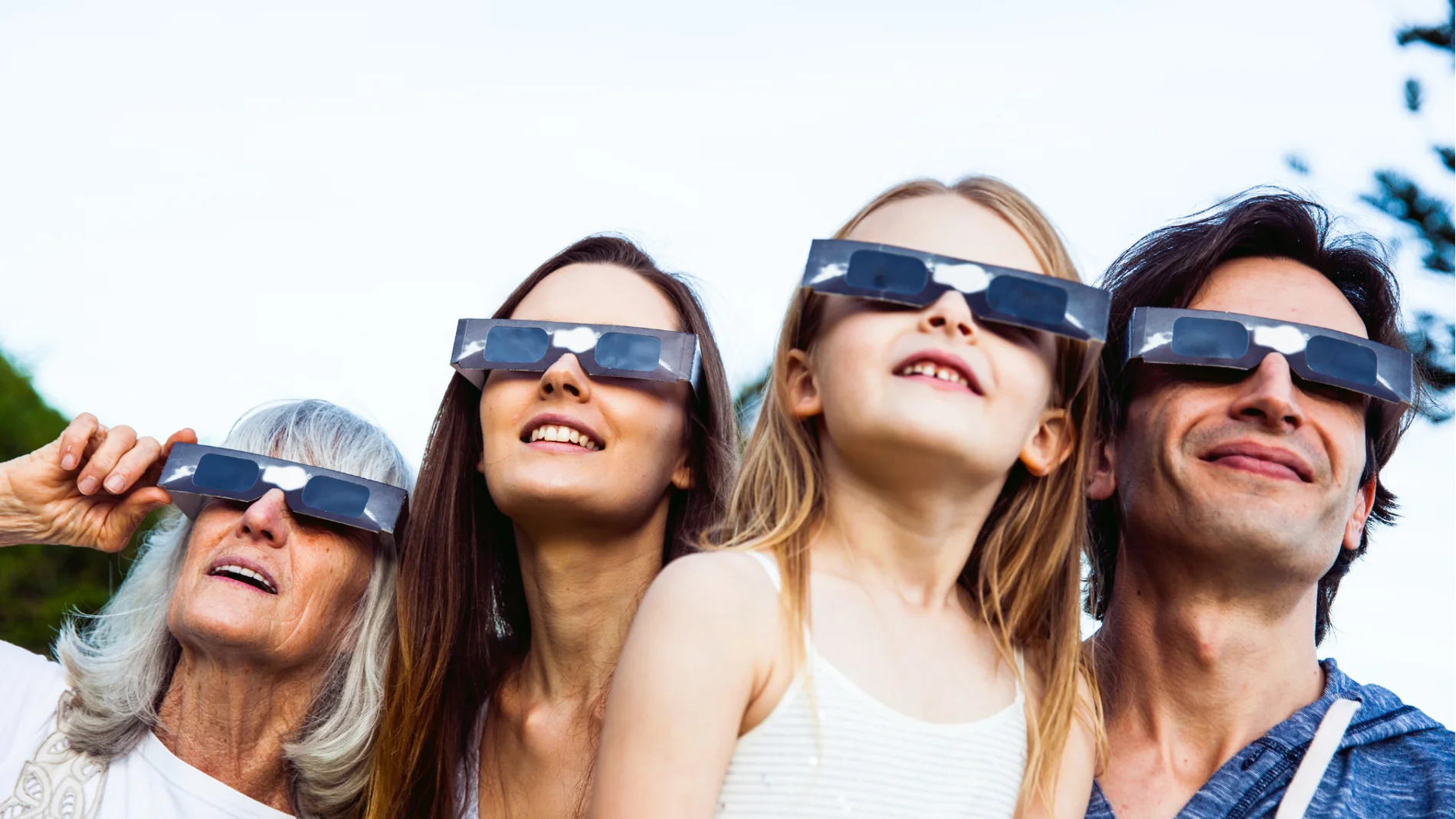
He total solar eclipse that will take place next August 12 It is a unique astronomical event that can be seen in its entirety from 40% of the peninsular territory. The last observable from Spain took place in 1912and although another one awaits us next summer, the event has aroused great interest that should not make us forget the precautions that must be taken if you want to look at the sun while it takes place.
Goggles used for protection must incorporate solar filters capable of reducing radiation to safe levels and meet the international standard ISO 12312-2. Conventional sunglasses do not offer that protection, even if they are opaque.
The risk of looking directly at the Sun
Looking directly at the Sun with an inadequate filter can cause solar retinopathy. Intense radiation damages retinal cells, especially the maculawhich allows you to distinguish the details in the center of the visual field.
The affected person may suffer blurred vision, dark spots, distortion of images or alterations in the perception of colors. The injury does not always cause pain and its effects can be permanent. There is also no specific treatment that repairs the damage suffered.
What is ISO 12312-2 and what requirements does it have?
The current version is ISO 12312-2:2015published in 2015 and confirmed in 2020. The International Organization for Standardization A second edition is being prepared, although it is still in the approval phase. The current standard applies to non-magnified glasses and scopes intended for looking directly at the Sun. It does not cover filters for cameras, binoculars or telescopes.
The main requirement is limit the amount of ultraviolet, visible and infrared radiation that passes through the filter. Safe glasses should obscure the Sun until it can be seen as a clearly defined disk with a comfortable brightness. They must also block invisible radiation and offer sufficiently uniform light transmission across its entire surface.
Manufacturing must avoid perforations, scratches, cracks and defects capable of allowing concentrated radiation to pass through. The filter must be attached to the frame, cover both eyes and have no edges or materials that could cause injuries. The product must also include instructions for use, warnings and recommendations on conservation, cleaning and replacement.
Beware of fakes
The problem for the buyer is that an inscription with the words ‘ISO 12312-2:2015’ does not in itself prove that glasses are safe. ISO writes standards, but does not test products or issue certificates to manufacturers. Any seller can print the reference on the frame or packaging and even use the name of an accredited company without permission..
The most prudent way to avoid counterfeiting is to Buy directly from the manufacturer or one of its authorized distributors. You can also consult Eclipse Safea Spanish initiative that reviews test reports and checks that they correspond to the marketed model. It is advisable to be wary of advertisements without manufacturer information, sellers that are difficult to identify and offers without traceability. He National Geographic Institute recommends looking for the reference EN ISO 12312-2:2015 together with the marking EC and Do not look directly at the Sun for more than a minute.
Before using the glasses you must check that filters are not scratched, punctured, broken or separated from the mount. When you put them on in a normal room, practically nothing should be seen, except for some very intense and attenuated light source. This check can detect defective glassesbut it does not replace laboratory tests because the eye cannot know if they correctly block ultraviolet and infrared radiation.
Eclipse glasses are only suitable for direct observation without magnifying optical instruments. Looking through binoculars, a telescope, or a camera while wearing them can concentrate so much energy that the filter deteriorates.. During the partial phases they must be kept on at all times, even when a minimum fraction of the solar disk is visible. They can only be removed during totality of the eclipseonly when the Moon has completely covered the Sun.