
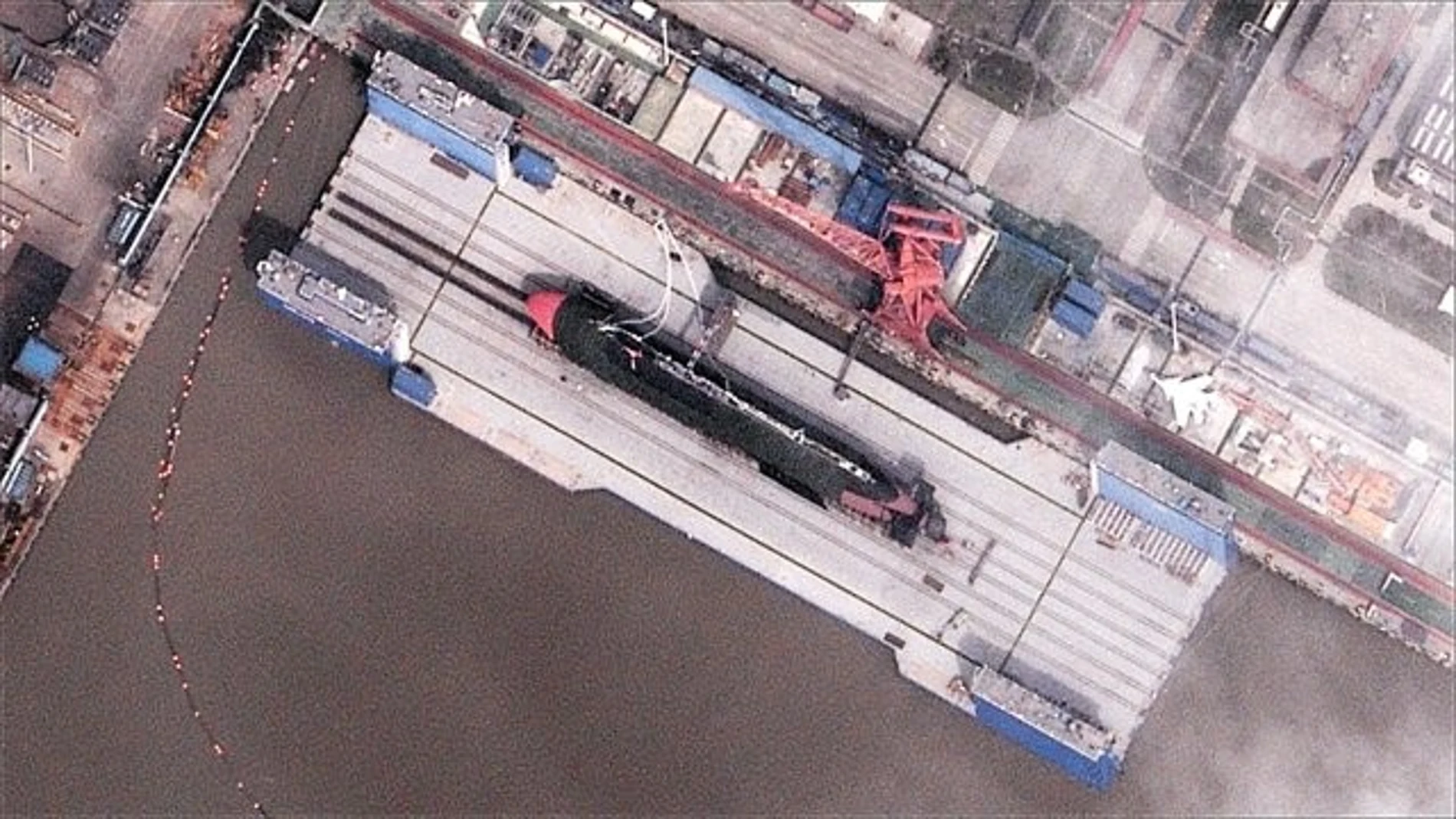
China could be building a new class of attack submarine with a design designed for reduce the noise produced underwater. The ship was photographed on May 29 by the American company BlackSky while on a floating dock at the shipyard Jiangnan in Shanghai. China has not confirmed its existence nor has it revealed its name, its propulsion system or the purpose for which it was developed.
The naval analyst HI Sutton was the first to report its appearance in Naval News last month. Subsequently, more images have been published and analyzed by media such as The War Zone and the Japanese Asahi Shimbun. Some specialists believe it belongs to a completely new class, while others consider it an evolution of the Type 093 ‘Shang’the main Chinese family of nuclear attack submarines currently in service.
The estimates made from the images place its length at about 120 meters and his sleeve between 10 and 11 meters. This would do approximately Ten meters longer than known Type 093 variantsalthough it would retain a similar width. Its size points towards a nuclear submarinebut a photograph taken from space does not allow us to verify which reactor, engines or internal systems it incorporates. Nor is it enough to ensure that it is a variant of the Type 093 and not a different design.
Courtesy of this Japanese media report we have a previously (publicly) unseen satellite image of the Type 09X in Jiangnan, when it was launched beginning of June. The boat is still on the launch barge, which moved it from the assembly hall to the fitting out berth. https://t.co/bcRuXFKPyY pic.twitter.com/lS4IajH6aN
— Alex Luck (@AlexLuck9) July 23, 2026
The most striking feature is its very small sail. The sail is the structure that protrudes above the hull and is usually accommodate periscopes, communications antennas and other extendable masts. It also provides an elevated observation post when the submarine navigates on the surface. Sutton initially described the ship as a submarine without a sail, but corrected that assessment after new images showed a small protrusion on the hull.
Reducing this structure has important advantages underwater, since the sail alters the flow through the hull, generates turbulence and increases both drag and hydrodynamic noise. A smaller sail may make the submarine require less energy to maintain its speed and make it more difficult to locate using passive sonar.which detect sounds produced by other vessels without emitting their own signal.
But the changes in sail, by themselves, do not make the submarine much quieter. The acoustic signature also depends on the reactor, turbines, pumps, vibration transmission to the hull and propulsion system. The defense media Army Recognition considers it likely that the redesign will be accompanied by better insulation, anechoic coatings and less noisy internal equipment. These coatings absorb or scatter some of the sonar waves and reduce the echo that returns to the system trying to detect the submarine.
The images also appear to show aft rudders arranged in an X shape and a faired propeller that could be of the type ‘pump-jet’. X rudders can improve maneuverability, efficiency and safety over the traditional cross configuration. The ‘pump-jet’ encloses the blades within a duct and can reduce noise at certain speeds, although the available resolution does not allow us to confirm that the new ship uses this system.
Type 093 is a nuclear attack submarine designed to pursue other submarines and surface ships. Its known versions have about 108 or 110 meters in length and have received successive improvements to the hull, sonar systems and noise reduction. The most recent variant, called Type 093B or ‘Shang III’ by the United States, has vertical launch for anti-ship cruise and strike missiles against ground targets.
The larger size of the photographed submarine could allow additional equipment or a vertical launch system with larger diameter missiles. Sutton has also noted that they seem forward-facing torpedo tubes can be seenas in the Type 093. None of these possibilities can be confirmed by satellite images. For now, the only thing that can be stated is that China has a submarine of unknown design and with a sail much smaller than usual.