
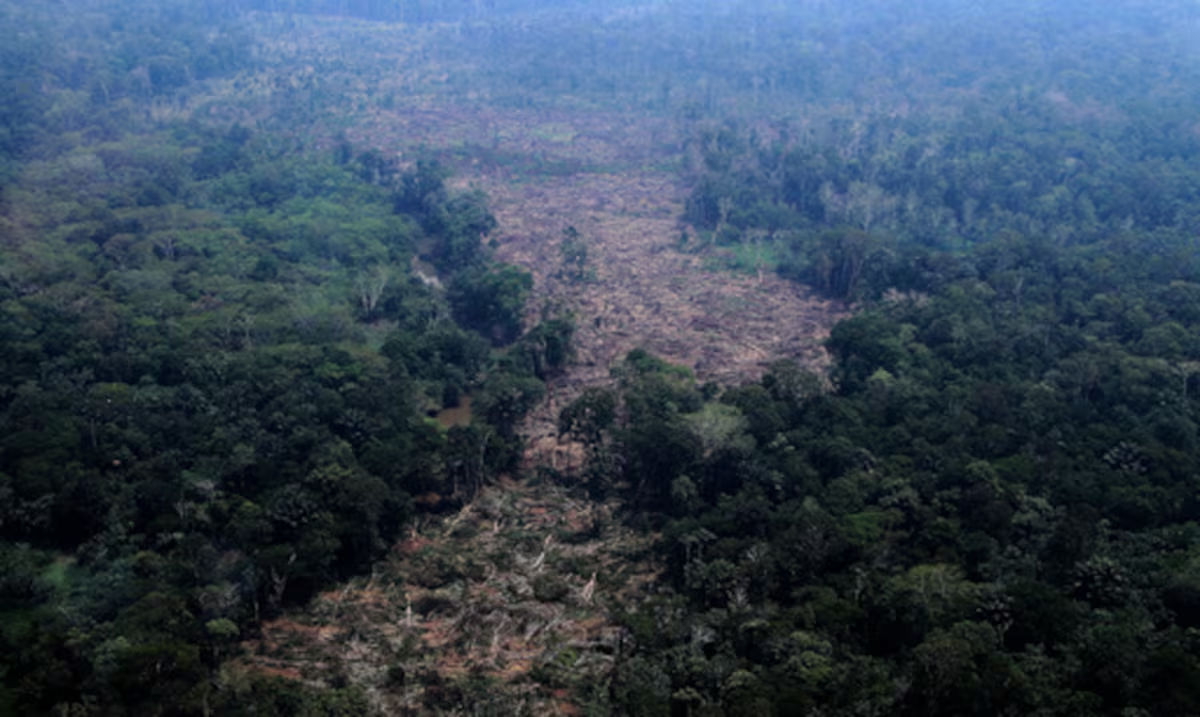
Although the candidates for the presidency of Brazil have not made Amazon policy a central campaign issue, climate scientists and environmentalists say the winner of Sunday’s election could determine whether and when the world’s largest rainforest reaches a “tipping point.”
The key threshold, hotly debated among scientists, could be defined, in simple terms, as the moment at which the dense, humid, moisture-producing forest gives way to a drier ecosystem. This would have irreversible consequences for biodiversity and the climate, since the forest absorbs enormous amounts of carbon dioxide, a greenhouse gas that causes global temperatures to rise. Brazil is home to around 60% of the Amazon, which extends across several countries in South America.
Below, we offer an analysis of the two presidential candidates and how their different visions on the Amazon could coincide at a possible turning point:
Both candidates are expected to take a different approach to Amazon policy
The president Luiz Inácio Lula da Silvaseeking a fourth non-consecutive term, has worked to curb deforestation and finance a sustainable economy through international donations and public and private financing. If he wins, he will be expected to continue these policies.
The senator Flavio Bolsonaroson of the former president Jair Bolsonarohas stated that he does not believe climate change is real, while presenting himself as an environmental defender. It has given few details about its plans for forest protection or its financing. He has advocated for a “modernization” of environmental legislation and for giving landowners in the Amazon greater decision-making power, which environmentalists say would weaken protection measures and allow deforestation to accelerate.
Deforestation skyrocketed during the mandate of Jair Bolsonaro, who governed between 2019 and 2022, by dismantling the agencies in charge of ensuring compliance with the law and making environmental regulations more flexible. For its part, under the current Lula Government, last week the lowest deforestation rate ever recorded in the Amazon was announced.
Tipping Points Could Apply to Many Ecosystems
A tipping point is a critical threshold beyond which a small change can trigger a major transformation in an ecosystem or climate system. Scientists study these risks in regions or systems such as the Amazon, the Antarctic ice caps, and the circulation patterns of the Atlantic Ocean.
In the case of the Amazon, some studies suggest that the loss of more than 20% of the rainforest, coupled with global warming of about 3.6 degrees Fahrenheit since the early 19th century, could lead to widespread changes. About 17% of the Amazon has already been logged and the temperature rise is currently about 2.5°F.
Crossing that threshold could trigger a self-reinforcing cycle in which parts of the rainforest lose their ability to recover from droughts, fires and other disturbances, making way for a drier ecosystem.
“As the climate changes and puts increasing pressure on the Amazon, the forest resists until it can no longer stand and collapses, either piecemeal or all at once, a process that could last decades or centuries once the tipping point is passed,” he said. Bernardo Floresan expert in Earth system resilience and member of the Scientific Panel for the Amazon, an independent scientific initiative dedicated to protecting the basin and guiding sustainable development.
David Lapola, who studies how the Amazon responds to rising carbon dioxide levels, is more cautious. As lead author of a chapter in an upcoming UN climate report dedicated to tipping points, he said models suggest a risk of collapse, but that observations and experiments have not yet shown that losing 20% of the rainforest would trigger it.
“That doesn’t mean we should stop worrying or forget about this problem. We have to investigate it and create a scientific working group to get to the bottom of the matter,” he said.
A 2024 study led by Flores, a resilience expert, and published in Nature, estimated that between 10% and 47% of the Amazon could face multiple threats by 2050, which could convert parts of the rainforest into different ecosystems and exacerbate climate change in the region.
However, Flores noted that we cannot know exactly how close the Amazon is to a tipping point, and that forest degradation could indicate that it is closer than the models suggest. “I think the main sign would be that the Amazon began to dry out a lot and suffer extensive fires.”, he stated.
Forest degradation, caused by forest fires, logging and drought, affects around 40% of the Amazon and has surpassed clear-cutting in recent years.
At the UN climate negotiations in 2023, Brazil presented its “Restoration Arc,” an initiative aimed at reforestation and promoting agroforestry practices to restore 24 million hectares in the southern Brazilian Amazon: 6 million by 2030 and another 18 million by 2050. However, meeting these goals could depend on who Brazilians elect this Sunday.
This story was translated from English to Spanish with an artificial intelligence tool and was reviewed by an editor before publication.