
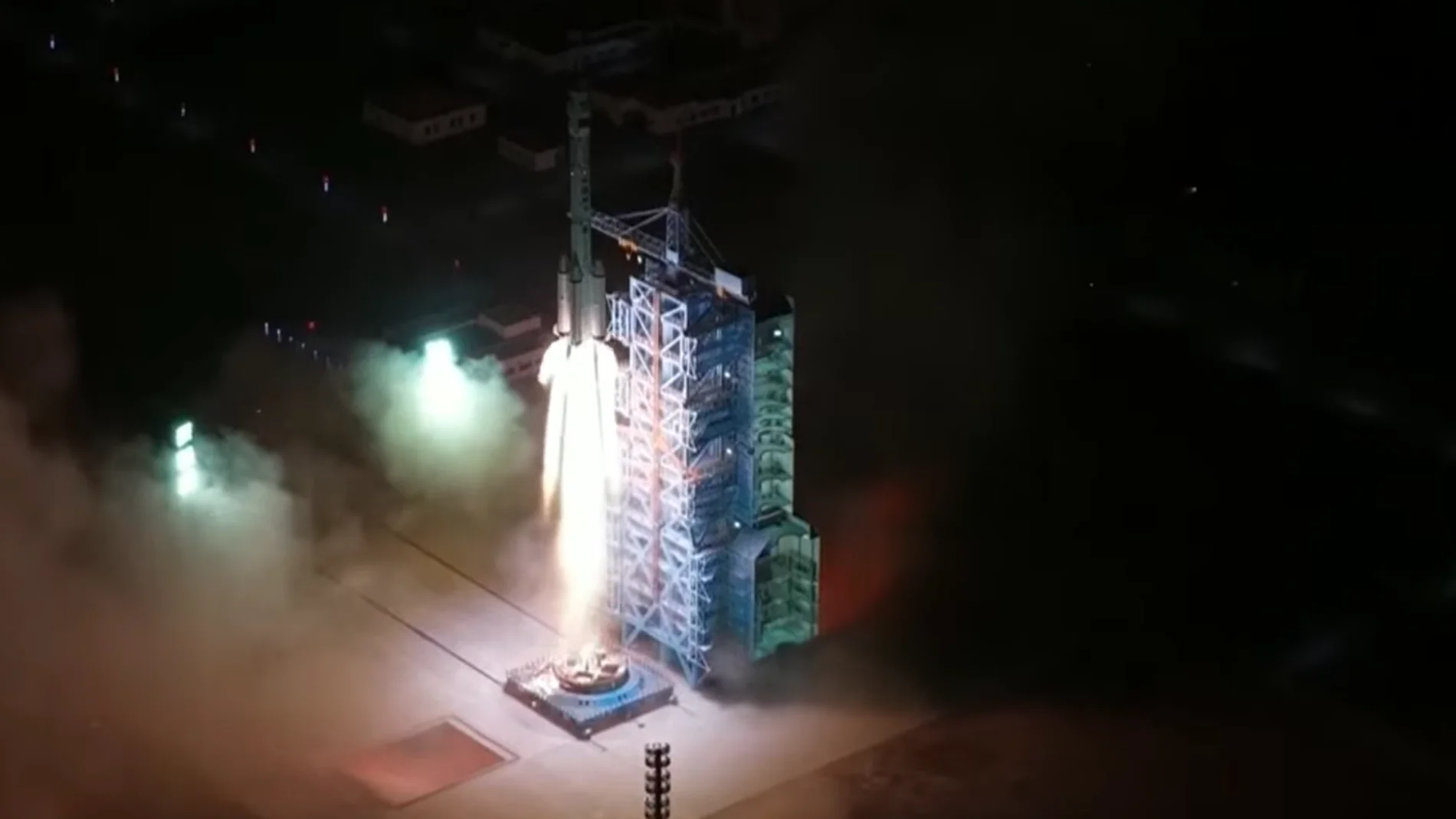
At 5:08 p.m. Spanish peninsular time, a Long March 2F rocket fired its engines in the Gobi Desert and took with it more than just three astronauts. This is the last piece of the China’s most ambitious project in space: the Shenzhou-23 mission.
The launch, which took place from the Jiuquan Center, marks the beginning of a mission that, more than a simple replacement of Shenzhou 21, seeks to consolidate an increasingly tangible idea: space as a permanent laboratory. If everything goes according to plan, the spacecraft will dock in about 6.5 hours to the Tianhe core module of the Tiangong station, where it will begin a carefully choreographed transition with the outgoing crew.
Three profiles are on board that reflect well where the Chinese space program is heading. Commander Zhu Yangzhu repeats experience after his participation in Shenzhou-16, together with him, the pilot Zhang Zhiyuan He faces space for the first time after his career in the Air Force. But it is Li Jiaying who concentrates much of the attention: cargo specialist and first taikonaut originally from Hong Kong, her presence symbolizes the expansion (not only technical, but also political and social) of the Chinese space program.
However, beyond the names, what defines Shenzhou-23 is what will happen in orbit. Over the next few months, Tiangong Station will operate as a laboratory in conditions impossible to reproduce on Earth. Among the more than one hundred planned experiments, some point directly to one of the deepest questions of space exploration: what happens to life when it moves away from its natural environment or at least the one we have studied on Earth. In particular, the study of embryogenesis in microgravity, using zebrafish and mouse embryos and structures derived from stem cells. This experiment will attempt to shed light on whether basic developmental processes can maintain stability away from Earth’s gravity. It is not a minor issue. Thinking about prolonged stays in space (years and even decades) inevitably implies asking whether life can not only survive, but also begin there.
Another key project is added to this line of research: the construction of a “multi-omics atlas” (a map that brings together several “layers” of biological information at the same time) of the human body in space. Thanks to that one of the crew will remain in orbit for approximately a year (the longest stay by China to date)scientists will be able to observe how multiple body systems transform simultaneously, from genetic activity to the immune system. It is, in a way, an attempt to map the limits of the human body outside of Earth.
Although it has not been detailed which member of the crew will take on this extended stay, Typically, this stay would go to someone with previous experience, which would point to Zhu Yangzhu.
In parallel, the mission will also explore more material terrain. New rare earth alloys and high-entropy materials designed to withstand extreme conditions will be studied, and More efficient energy systems will be tested, including batteries that could have future applications both in space and on Earth. Additionally, the crew will conduct spacewalks to install and maintain equipment, including a greenhouse gas monitor that will expand the station’s ability to observe our own planet.
Meanwhile, in the coming hours and days, one of the most delicate moments of the mission will take place: the relay in orbit. The crews of Shenzhou-23 and Shenzhou-21 will coexist for about five dayssharing tasks and transferring responsibilities before the latter’s return to Earth. The station, for its part, will continue to have an additional spacecraft docked as a backup system, a strategy that China has reinforced after recent incidents with space debris.
That detail is not minor. The Shenzhou-23 incorporates improvements in the protection of its windows after a small orbital fragment damaged a previous shipremembering that near-Earth space is an increasingly saturated environment and, therefore, more demanding in terms of security.
If the schedule holds, two of the crew will return in about six months. The third, however, will extend its stay until completing a year in orbit, opening a new stage in the continued human presence at the Tiangong station.. Later in October, the Shenzhou-24 mission will take over, maintaining a pace that begins to seem less exceptional and more structural.
And there, beyond the experiments and prolonged stays, is the importance of this launch that has just occurred. It’s not just about reaching space, but first staying there. And then understand it.