
According to Eurostat data, only 20% of Spanish companies with at least ten employees integrated AI tools into their work processes in 2025. The lack of experienced teams for its technical execution has established itself as the main barrier to its adoption.
This situation worsens when analyzing what happens within the development teams themselves. According to the technology boutique Logixs, Technical teams spend up to 80% of their time on lower value-added tasks such as documentation processes, testing, reviews or coordination, while the market demands a speed of delivery that traditional models cannot sustain. And although AI tools for software development have proliferated in recent years, most are limited to the coding phase, that is, 20% of the real cycle of a project. The remaining 80% continues to be manual, slow and depends on technical profiles that are difficult to hire.
Pioneering platform
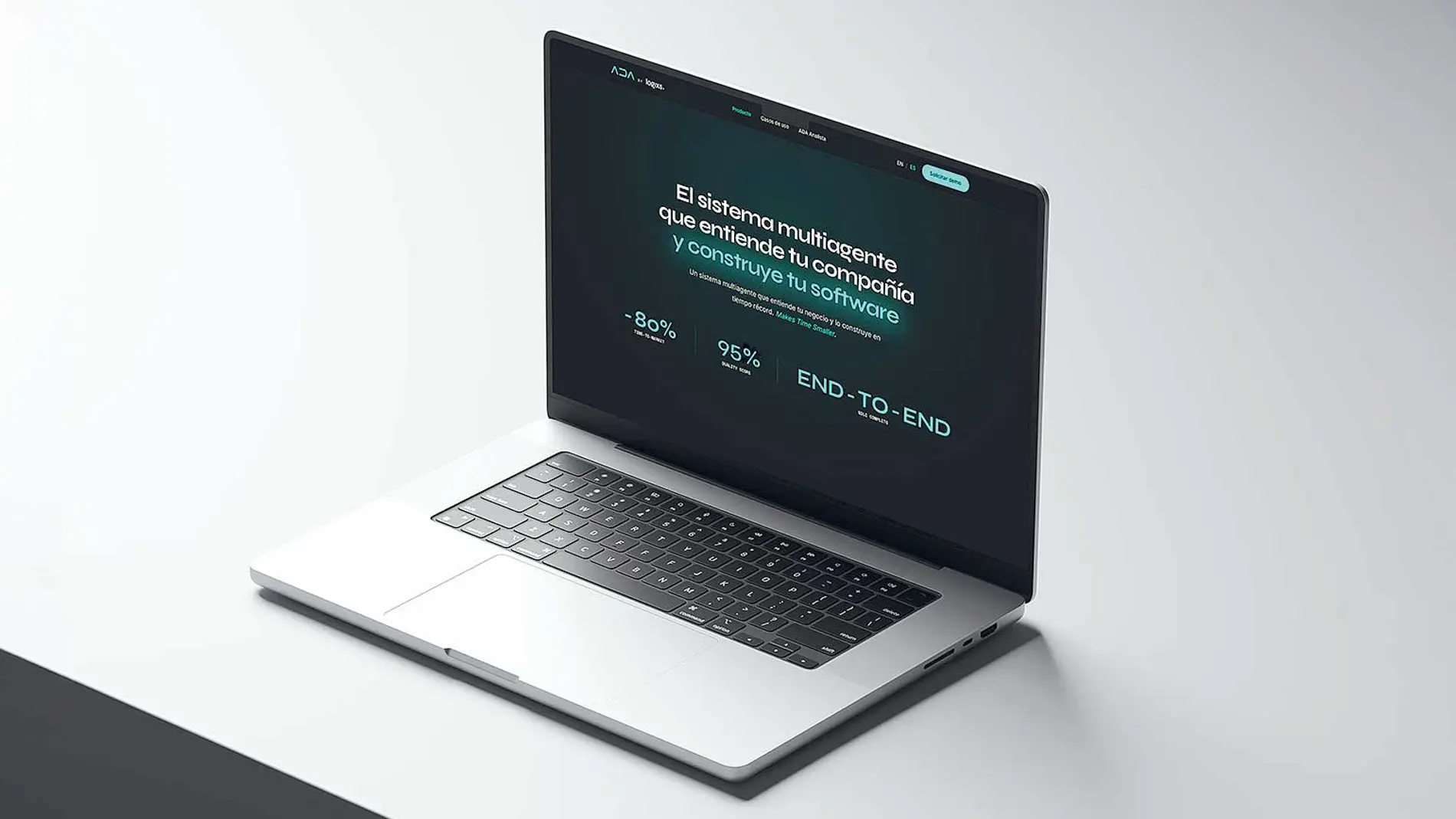
To respond to this problem, Logixs, one of the main technology boutiques of Spanish origin, pioneer in offering generative AI solutions, has launched ADA, the first Spanish agentic platform that covers thecomplete software cycle with artificial intelligence: from understanding the customer’s business to delivering the product. Compared to code co-pilots, who only assist the developer in the coding phase, and individual agents that generate isolated tasks without a project vision, ADA is an autonomous multi-agent system formed by two coordinated teams: on the one hand, it has analyst agents that map the company, its processes and its implicit business rules, and on the other, deploy development agents specialized by domain that work in parallel, communicate with each other and resolve blockages between tasks.
“In the turbulent and accelerated times we live in, in which three months ago almost no one was using Claude or Sora models, tying yourself as a company to a single LLM can be a strategic error that will affect everything in the medium term. Therefore, we created ADA with an agnostic LLM approach, that is, it uses the best models according to the task to be executed, and compares them with each other to be audited and validated,” says Francisco Moreno Balboa, CEO and founder of Logixs.
Reduce cost and time
Designed for reduce cost per task by up to 95% and shorten delivery times by 2-4 weeks, the platform operates both in on-premise and cloud environments under the client’s control, adapting to the requirements of each client, making it the reference option for regulated sectors and enterprise environments where exposing sensitive code to external clouds is not an option. “With ADA, we have managed to drastically reduce times, thanks to agents that work in parallel, validate each delivery automatically and eliminate downtime in coordination, documentation and review, which today takes up a large part of the effort and time of the technical team,” explains Francisco Moreno Balboa.
From the need for a company to the production of software
ADA operates in five sequential phases. First, the platform learns the customer’s business collecting all documentation, emails, recorded meetings and any relevant materials with which to create specialized agents that understand the specific business context, not a generic model. From there, The company explains what it needs, whether by voice, text or through a document, and ADA consults its domain agents, detects ambiguities, requests clarifications and generates structured tickets ready for approval.
With the tasks defined, The specialized agents start their task in parallel. Each one in their area, communicating with each other to resolve the different problems encountered and respecting the rules and code structure of each company. Once the development is completed, one of the most differential elements of ADA comes into play, an automatic validation system that evaluates each delivery with fixed criteria (tests, security, patterns, regulatory compliance…) and domain criteria specific to the client’s business. If the delivery does not reach a minimum score of 90%, the system automatically repeats the process until it passes.
Finally, a independent agent ensures that all agents reach a common conclusion before accepting any result as valid. Only then is the result ready for the final review by the human team, accompanied by all the documentation. In this way, each line of code, each decision and each validation is traced from the original need to its integration into the system, being available for audits and compliance processes.
A European alternative for regulated environments
ADA is designed to respond to the European regulatory framework in which large companies already operate. The AI Act requires traceability, human oversight and document management of AI systems; The GDPR restricts the processing of personal data in infrastructures outside the EU; and sector regulations such as DORA, NIS2 or banking and defense compliance impose strict sovereignty requirements on code and data. “Compared to American platforms that only offer closed cloud models, ADA can be deployed entirely on-premise or in cloud environments under the control of the client, keeping sensitive code within the perimeter of the organization and recording each decision in an end-to-end auditable log,” says the CEO of Logixs.
This technology is designed for the most common scenarios in enterprise environments: from projects created from scratch, to migrations of legacy systems to cloud-native architectures or changes between technologies and frameworks. The platform covers stacks such as Salesforce, Oracle, SAP or SaaS, among others.
About Logixs
Logixs is a leader in customized generative AI solutions, optimizing processes and automating complex tasks to create competitive advantages. With more than 35 projects developed and a team of 70 AI specialists, the company was recently awarded as “Best generative artificial intelligence company” at the IX Technology and Innovation Awards of the newspaper La Razón.
More information:https://www.logixsdigital.com/es