
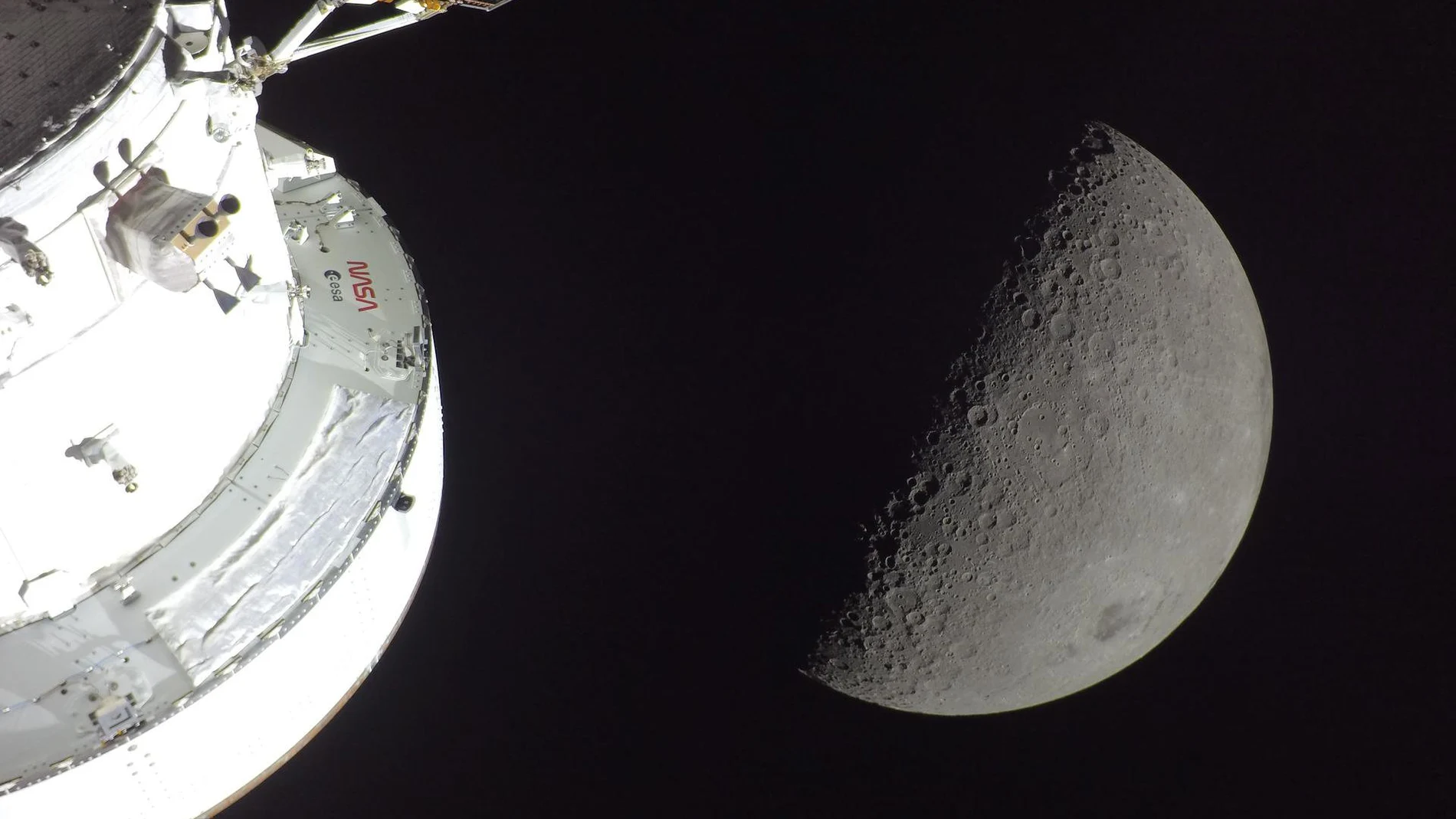
Although the Land and the Moon They are relatively close in astronomical terms, 384,400 kilometers of medium distance, planning a route to the satellite is a complex task that requires a lot of time and effort. The journey, furthermore, is not always the same. On the missions Apollothe direct trip lasted around three days; After the translunar injection, the spacecraft traveled at about 38,900 km/halthough the speed changed during the journey due to the effect of gravity, dropping up to 3,800 km/h. Modern missions like Artemis II have used longer flight profiles, of almost ten days adding round tripto test systems and take advantage of specific trajectories. Researchers are looking for increasingly efficient routes between the Earth and the Moon given that even Marginal improvements in trajectory can reduce fuel consumption and save millions.
An international team of researchers has worked in this sense and claims to have found a method to calculate a more efficient route between Earth and the Moon using advanced computer models.
The method is based on the call ‘theory of functional connections’a mathematical tool that allows you to simplify very complex calculations and explore millions of possible trajectories without having to solve each one from scratch. The researchers used this method to simulate 30 million of different routes to the Moon, and 280,000 simulations They are referenced in their recently published study.
The cheapest route to the Moon that the team found was actually hidden. Spaceships traveling through our solar system only use fuel for a minimal part of the journey, being gravity, which has the enormous advantage of being free, what propels the ship during the rest. Throughout the solar system there are routes determined by gravity, often known as the Interplanetary Transportation Network.
Therefore, finding a cheap route to the Moon has a lot to do with the gravitational attraction of both the Earth and the Moon. In space flights, the term ‘variate’ refers to a natural path that leads to a given orbitlike a spatial “highway.” The researchers discovered that, Instead of using the ‘variate’ branch of the lunar orbit closest to Earth, it is better to enter that ‘variate’ from the opposite side. That is, not do it in the closest ‘lane’, but in the furthest one.
‘Rather than assuming that it is easier to choose the part of the ‘variate’ closest to Earth, we can use systematic analysis with faster methods to try to find non-trivial solutions‘, he states in a statement Vitor Martins de Oliveiraco-author of the study and postdoctoral researcher at the University of São Paulo, in Brazil.
Basically, the team found that the free propulsion provided by gravity is greater when taking the hidden route. This new route described reduces fuel consumption at 58.80 meters per second compared to the cheapest route known so far. Again, even this small efficiency improvement would help reduce the cost of traveling to the Moon.
Another advantage of the route found by the researchers is that it would not cause interruptions in communications with Earth. ‘The mission Artemis IIfor example, lost communication with Earth for a time because it was directly behind the Moon. The orbit that we propose is a solution that maintains uninterrupted communication‘, says Oliveira.
This new route or way of accessing the trajectory may not yet be the most efficient. The researchers point out that their modeling has only taken into account the gravity of the Earth and the Moon. Future research could include variables such as the Sun’s gravity and lead to trajectories that save more fuel.