
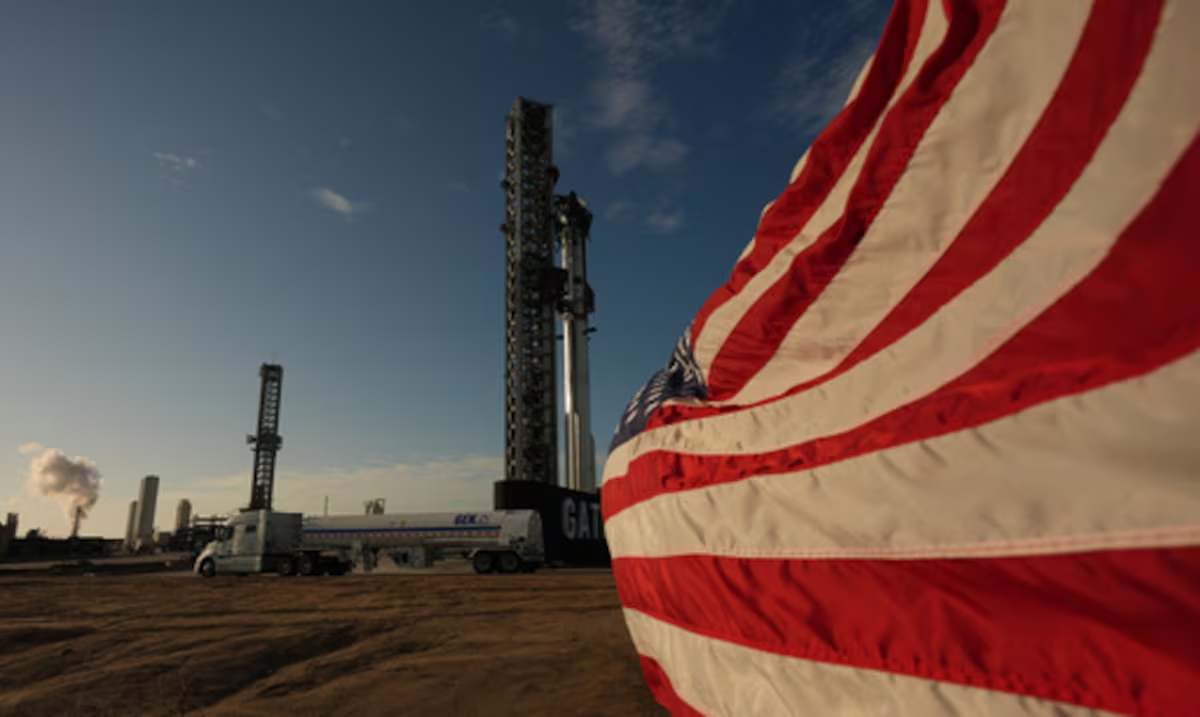
SpaceX carried out on Friday the first test launch of the most recent version of its Starship rocket, a larger and more powerful model with which the POT aims to take astronauts to the moon.
The massive, redesigned rocket made its unveiling two days after SpaceX CEO, Elon Muskannounced that the company will begin trading on the bag. The craft took off from the southern tip of Texas with 20 simulated Starlink satellites on board, which were released midway through the hour-long flight that took the craft to the other side of the world.
Despite having some problems with the engines, the spacecraft reached its final destination in the indian ocean before bursting into flames upon impact. Musk called the day an “epic” launch and landing.
“They scored a goal for humanity,” he told his team in a message on the social network X.
This is the 12th test flight of the rocket with which Musk seeks to one day take people to Mars. But the first step is the Moon and NASA’s Artemis program.
NASA Administrator Jared Isaacman traveled to Texas to witness the launch and said the Starship is now one step closer to the Moon.
The last launch of the previous Starship model was in October. SpaceX’s third-generation rocket – the V3 – lifted off from a brand new launch pad at Starbase, near the Mexican border. Last-minute problems with the platform thwarted Thursday’s launch attempt.
1 / 15 | Meet the crew of NASA’s Artemis II mission. One day (April 1, 2026) before the scheduled launch of the Artemis II mission, the National Aeronautics and Space Administration (NASA) finalized planning for its first manned mission to the Moon since 1972. – EFE Agency
SpaceX had hoped to avoid the problems it suffered on back-to-back launches last year, when mid-flight explosions sent debris across the Atlantic. Previous launches also ended in fire.
This time the fireball went all the way. The spacecraft plummeted upright into the Indian Ocean under apparent absolute control, before flipping over and bursting into flames. None of that was unexpected, the company noted.
Although the takeoff went well, not all engines fired when the booster attempted a controlled return. The ship also had to make do with fewer engines, but maintained its easterly course at about 120 miles altitude. A pair of Starlink’s modified satellites ejected from the Starship offered brief views of the spacecraft in flight, the first time that has happened on one of the company’s test launches.
At 407 feet tall, the latest model towers over previous Starship versions by more than three feet, plus it offers greater engine power.
The renewed thruster incorporates a smaller number of grid fins, although with greater size and resistance to direct its return to Earth. Additionally, it features a larger, firmer fuel transfer line to feed the 33 main engines. This fuel line is the size of the SpaceX Falcon 9 first stage booster. The retro-looking, stainless steel spacecraft also has more of everything – more cameras and greater navigation and computing capabilities – plus docking cones for future rendezvous and lunar missions.
Starship is intended to be completely reusable, with huge mechanical arms on the launch pads to catch the rocket stages when they return. But nothing would be recovered in Friday’s test launch. He Gulf of Mexico marked the end of the journey for the first stage booster, and the Indian Ocean will be the end of the road for the spacecraft and its simulated satellites.
NASA is paying billions of dollars to SpaceX – as well as Blue Originof Jeff Bezos– to provide the lunar landing modules that will be used to carry the program’s astronauts Artemis to the Moon.
The two companies are locked in a fight to be first.
Although Starship has reached the edges of space on several of its launches, Blue Moon has yet to take off, although it is already preparing a prototype for a lunar mission attempt later this year.
NASA conducted a successful lunar flyby in April and the next step would be a docking test in orbit around Earth next year. For that mission – Artemis III – the astronauts will practice docking their Orion capsule with Starship, with Blue Moon, or with both rockets.
A two-astronaut landing – Artemis IV – could take place as early as 2028 with either Starship or Blue Moon, depending on which module is safer and ready first. It will be NASA’s first manned moon landing since Apollo 17 in 1972. This time, the goal is a base located near the south pole of the Moon that will be staffed by astronauts and robots.
SpaceX is now accepting reservations for private flights to the Moon and Mars on Starship.
The world’s first space tourist, Californian businessman Dennis Tito and his wife signed up 3 and a half years ago for a flight around the moon. It is unknown when it would take place.
Another wealthy space tourist – Chinese investor Chun Wang – announced this week that he will fly to Mars on Starship’s first interplanetary mission. Last year, Wang had already chartered a SpaceX polar flight in a Dragon capsule and, together with a crew chosen by him, became the first to orbit above the north and south poles.
Neither the price nor the date of his cruise to Mars was revealed.