
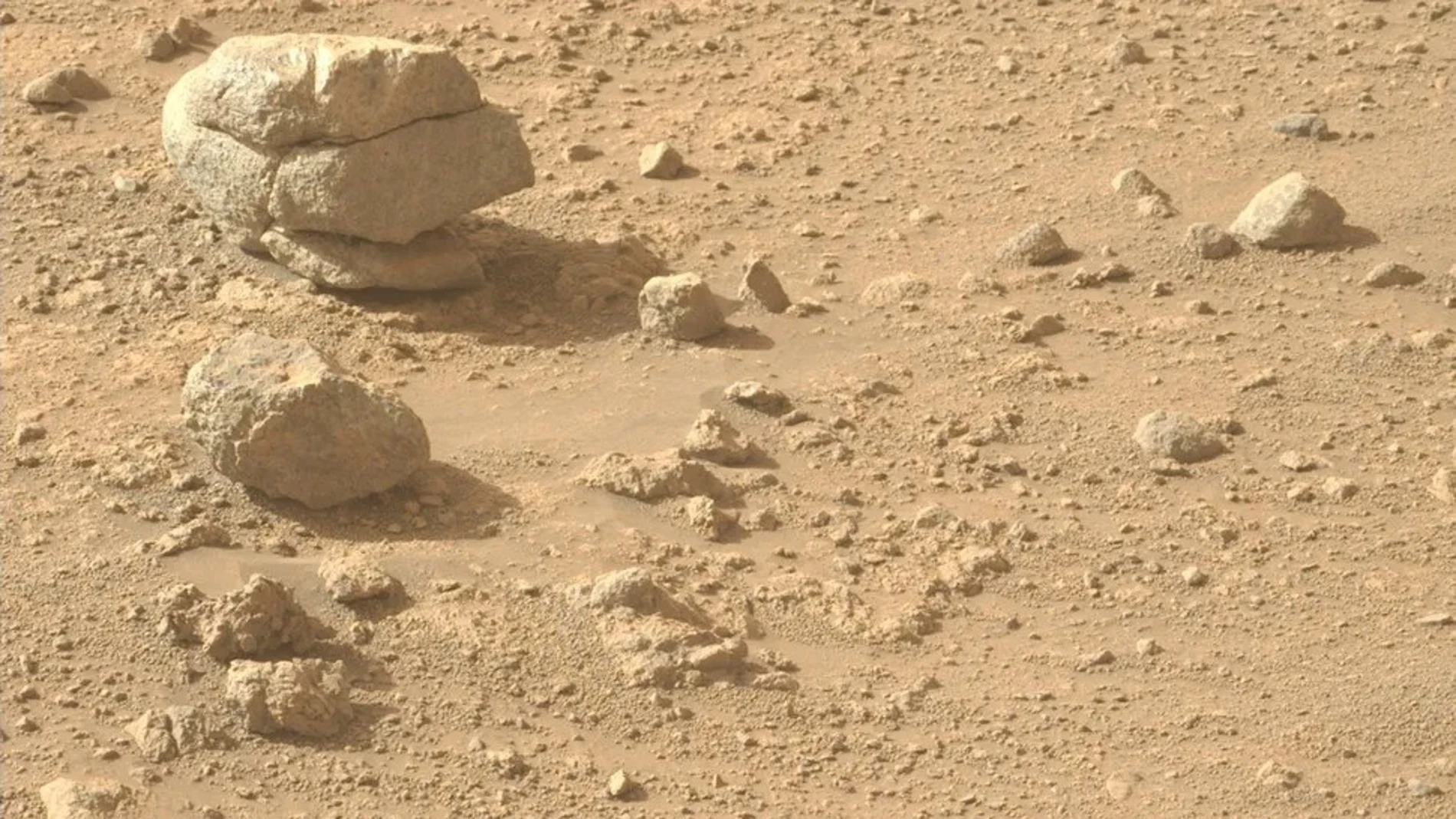
It is not the first time that the POT capture images in Mars that make you scratch your head, even if they have perfectly logical explanations. It has happened again with a photograph taken by the rover Perseverance showing a strange rock formation consisting of three rocks that look neatly stacked on top of each otheras if someone had arranged them like that, in the middle of the dusty and reddish Martian terrain. The image seems almost too organized to be the result of chance, but it is.
The surprising image was taken on May 13, on day 1,859 of Perseverance on the Martian surface. He captured it with Mastcam-Za pair of cameras located at the top of the rover’s mast, looking almost like eyes through which the vehicle sees.
As reported by Space.com, the scientific community believes that what is observed is probably a single rock that was fractured into layers by the action of wind or water. Mars is an arid planet today, but years of NASA research on the ground have brought surprising revelations about its geological activity.
According to observations made by the rover Curiositywhich has been on the red planet since 2012, Wind is the main force that shapes geological processes on Marswearing away rocks over hundreds of millions of years. It has also been pointed out that some areas of Mars had in the past a humid climate, with rain similar to that of a tropical jungle.
During its five years on Mars, Perseverance has photographed several rarities that attracted attention for different reasons. Among them are rocks with ‘leopard spots’whose pattern aroused scientific interest due to its possible chemical or mineral origin; some strange tangled threads on the Martian terrain, but that probably came from the rover itself or its landing system; and some popcorn-like structuresinterpreted as mineral formations created by geological processes. In all cases, what seemed mysterious at first glance ended up having a more earthly explanation, although useful to better understand Mars.
Going back further, we have the famous image taken by the mission viking 1 from NASA in 1976in which a rock formation from the region of Cydonia seemed to have the shape of a human face. That photograph fueled conspiracy theories for years, but later images with much higher resolution showed that it was an eroded rock formation, whose appearance was due to the lighting, shadows and low quality of the original image.
This is one of the most famous examples of visual pareidoliathe phenomenon by which the brain interprets an ambiguous or random shape as something recognizable, usually a face, an animal, a human figure, or a familiar object.