
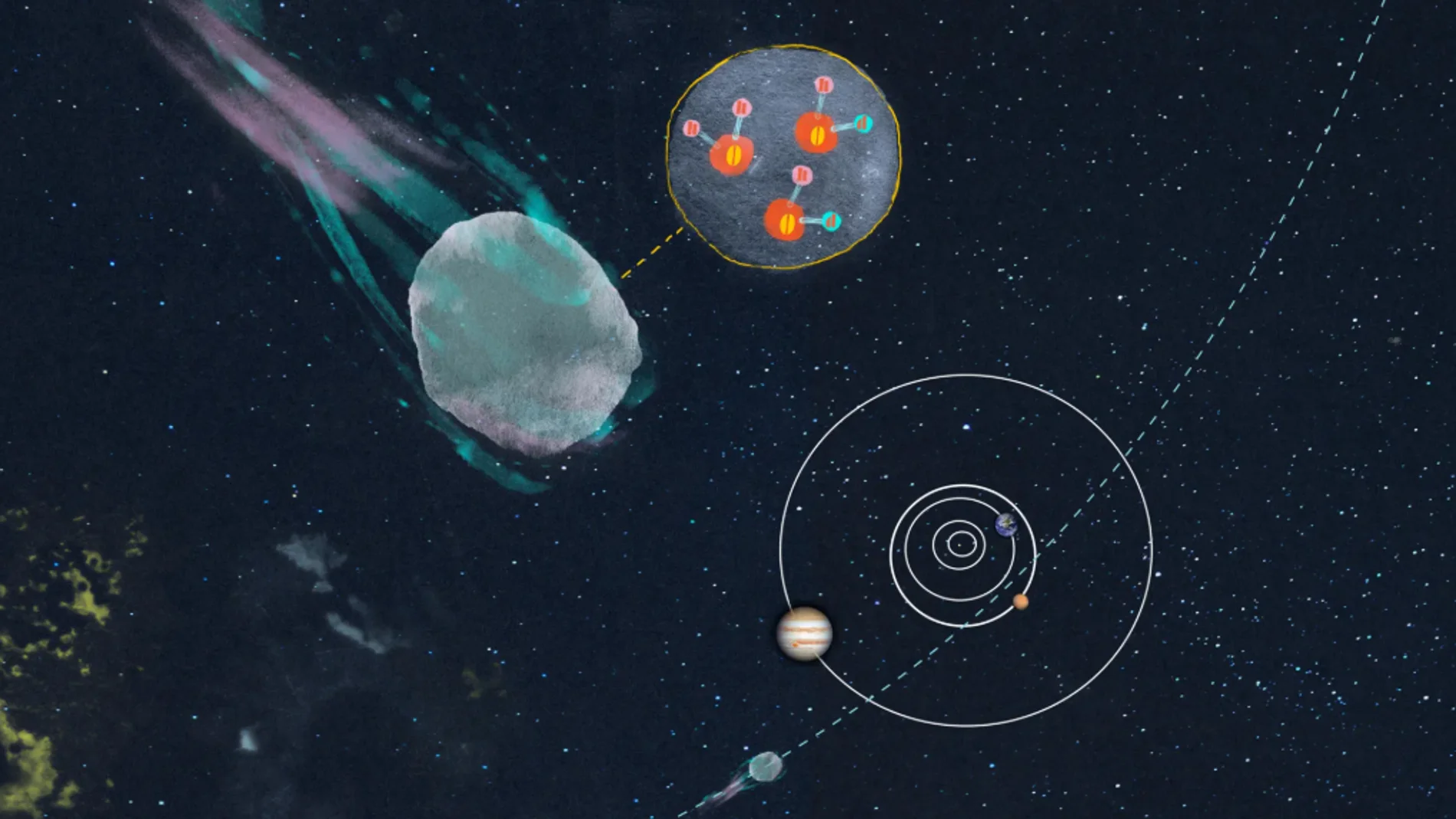
Sometimes the most important discovery is not finding something completely new, but recognizing a different form of what is known. Because Water is everywhere in the solar system: frozen on comets, trapped under the ice of distant moons, or floating as vapor in planetary atmospheres. But the interstellar object 3I/ATLAS has just added a new piece to the puzzle. One that, according to scientists, is unlike anything observed until now.
An international team of astronomers from the University of Michigan has detected in this interstellar visitor a type of water behavior never seen in similar objects. The finding, published in Nature Astronomy, suggests that 3I/ATLAS could have formed in an extremely cold and remote region of another planetary system, preserving chemical and physical properties different from those of known comets in our cosmic environment. Let’s go from the beginning.
3I/ATLAS is not just any comet. Its name already reveals something extraordinary: the “I” means “interstellar.” It is only the third object detected crossing the solar system from outside it, after 1I/Oumuamua and 2I/Borisov. But while those two visitors had alreadyYohave awakened fascinationeithern hundredYofica, this new object seems to hold a surpriseornmtos deep.
The authors of the study, led by Luis E. Salazar Manzano, discovered that the water released by 3I/ATLAS does not behave like that of usual comets. Instead of evaporating relatively uniformly as it approaches the Sun, the object shows much more complex and persistent activity, as if the ice were trapped in internal structures especially primitive or mixed with unknown materials.
In simple terms: water exists, but it seems “enclosed” in a different way. That could indicate that 3I/ATLAS formed under extremely cold conditions, perhaps much further from its parent star than comets in our own solar system. As if it had remained frozen for billions of years in a kind of perfect cosmic freezer before being expelled into interstellar space.
Salazar Manzano’s team believes that this behavior could represent a new physical state of cometary ice: a porous and complex structure capable of retaining volatile compounds for much longer than expected: a chemical capsule intact from the earliest times of another planetary system.
The importance of the discovery goes far beyond a simple comet. Each interstellar object is actually a free sample of another solar system. We don’t need to travel to another star to study it: the galaxy sends us fragments of those worlds. And in this case, the fragment looks especially old.
The analyzes suggest that the object could contain materials practically unchanged since the formation of its original system. That makes 3I/ATLAS a cosmic fossil: a relic that allows us to study how planets, ice and molecules form in regions very different from our own.
Furthermore, water is much more than water in astronomy. Its presence, isotopic composition and behavior help reconstruct the thermal history of an object, its birthplace and even the way planetary systems evolve: analyzing the water of a comet is reading its biography. And this is where the discovery becomes especially suggestive: If the water in 3I/ATLAS is different, perhaps so are the conditions under which worlds are born around other stars.
The analysis using spectroscopic observations identified small variations that did not completely fit with the usual models, which would indicate that there are many more types of ice and configurations of matter in space than we imagined. Chemical forms that can barely survive in our solar system, but could be preserved in much colder regions of the galaxy. Thus, it may be that the most interesting thing about 3I/ATLAS is not only that it comes from another star, but what it brings from it.