
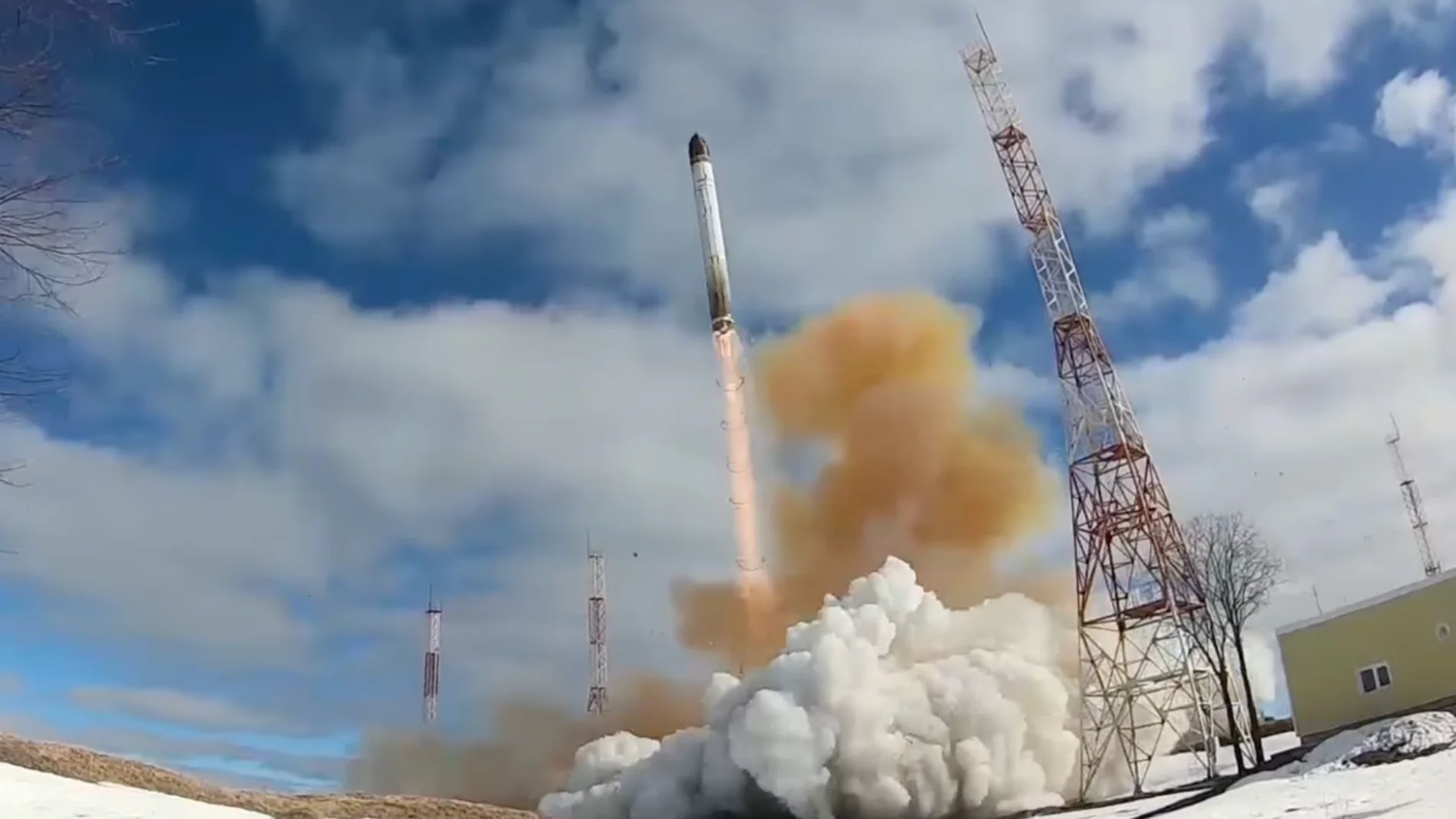
The figures are scary: it measures more than 35 meters, weighs more than 200 tons and can travel practically anywhere on the planet. The RS-28 Sarmat, known in the West as “Satan II”, is not just a missile: it is a piece designed to survive the future.
In the midst of modernizing its nuclear arsenal, Russia has once again focused its attention on one of its most ambitious military projects. This week, Vladimir Putin announced a new test of the RS-28 Sarmat intercontinental missile and assured that it will enter operational service before the end of the year.
Although the official name is Sarmat, the nickname “Satan II” pretty much sums up how he has been presented for years: a weapon designed to penetrate any existing anti-missile shield and keep Russia’s nuclear destruction capacity intact even in an extreme scenario.
To understand why it generates so much attention, you have to start with its size. The Sarmat is a heavy intercontinental ballistic missile, a category that has almost disappeared since the Cold War. It weighs about 208 tons and can carry up to ten tons of nuclear payload.
This allows it to carry multiple independent nuclear warheads (so-called MIRVs) capable of attacking several different targets at the same time. According to different estimates, it could carry between 10 and 16 nuclear warheads. or even Avangard hypersonic vehicles, designed to maneuver at extreme speeds within the atmosphere and make their interception even more difficult.
To give us an idea, while the Hiroshima bomb released energy equivalent to 15,000 tons of TNT, a modern missile like the Sarmat, for example, can carry more than 10 warheads and the combined potential could be equivalent to hundreds of Hiroshimas distributed in different objectives and destined for a different city or infrastructure.
But the true differential element of the Sarmat is not only the power, but the trajectory. Classic ballistic missiles follow relatively predictable routes: they take off, partially leave the atmosphere and re-enter following a calculable curve. The Sarmat, on the other hand, has been designed to use less conventional trajectorieseven suborbital routes capable of approaching their targets from unexpected directions, including the South Pole.
This greatly complicates the work of current defensive systems, which have historically been prepared to intercept threats from the northern hemisphere. Russia also claims that The missile has a range of more than 18,000 kilometers and, in certain suborbital configurations, could even exceed 35,000 kilometers. In practical terms, that means it could reach any point on the planet from Russian territory.
The logic behind Sarmat is not to win a nuclear war, something no country considers really possible, but to guarantee a so-called “second strike capability.” That is to say: ensuring that, even after suffering a massive attack, Russia would still have sufficient capacity to respond. This balance of terror has underpinned much of nuclear geopolitics since the mid-20th century. However, Sarmat also reflects another more recent phenomenon: the return of the technological arms race.
For decades, much of The nuclear treaties between the United States and Russia sought to limit precisely this type of strategic weapons. But many of these agreements have expired or are going through moments of enormous fragility.. The result is a new generation of systems that mix ballistic missiles, hypersonic vehicles, nuclear submarine drones and weapons capable of altering the classic rules of deterrence.
Even so, it is advisable to separate propaganda and reality. Various Western analysts recall that the Sarmat program has suffered delays, failures and problematic tests for years. One of the 2024 tests would have ended with an explosion in the launch silo, and some experts believe Russia may have exaggerated some of its capabilities.
That does not mean that the missile is not real or dangerous, but that, as with many strategic weapons, there is also a psychological and political dimension. The message matters as much as the technology. Because ultimately “Satan II” is not designed to be used. It is designed so that no one dares to provoke the scenario in which it would make sense to use it.