
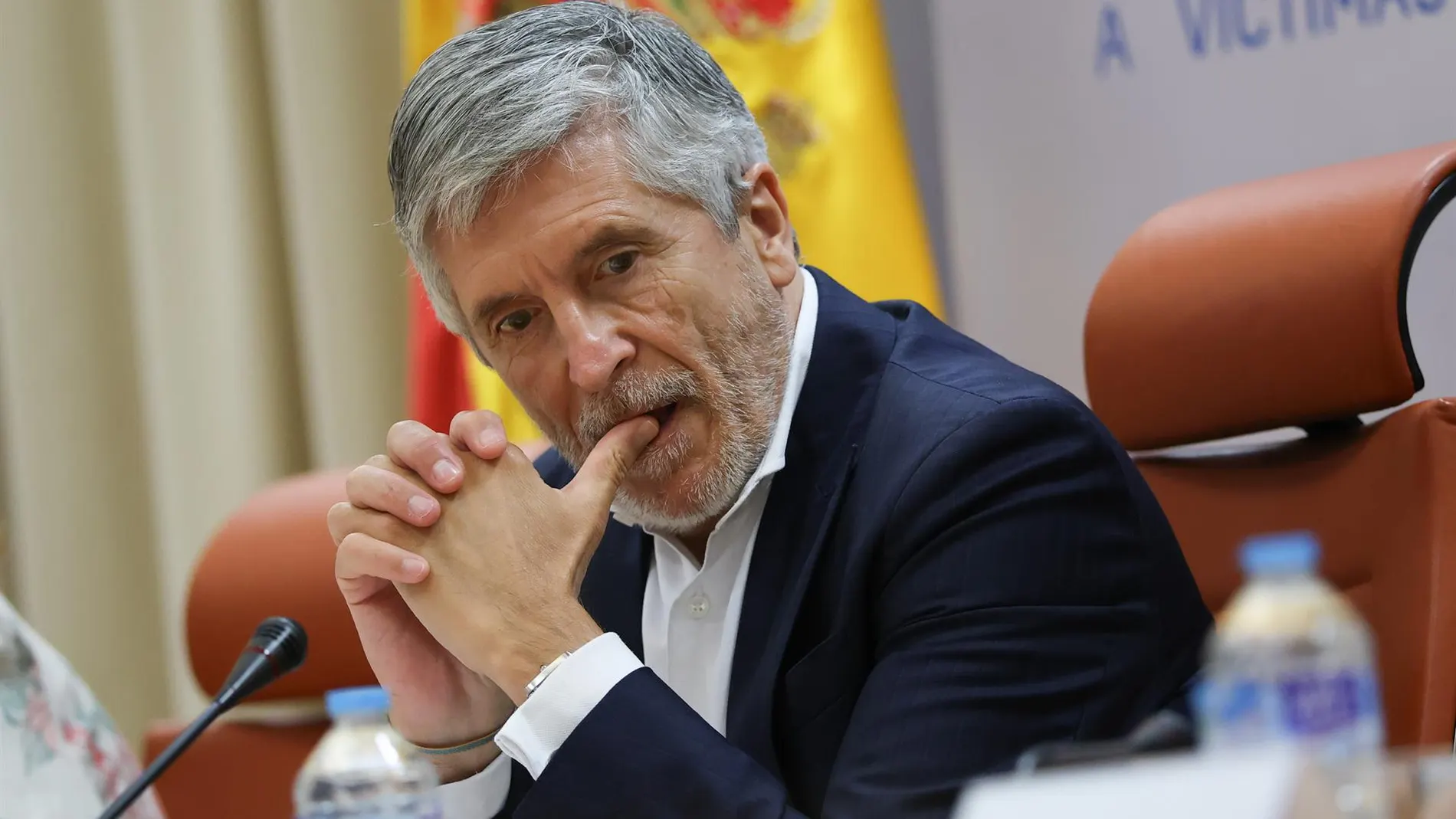
It still resonates in your head, like a thunderous echo… that “rabid” chewed between teeth of the Minister of the Interior, Fernando Grande-Marlaska, silenced by the whistles and cries of indignation of the civil guards and their families in Baeza. Never before has a word done so much damage or meant so much. Because while the agents mourned the death of Germán and Jerónimo, Today’s “rabid” politician was in Tenerife.
And “embarrassing” were also the words of María Jesús Montero, PSOE candidate for the Junta de Andalucía, who had no qualms about calling what was actually a death in an “act of service” a “work accident” and a tragedy. But it must be remembered that many others precede it. At the parliamentary headquarters, MEP Idoia Mendía went so far as to assure that agents “only suffer attacks from time to time”. He said this in Brussels, in the middle of the debate on a directive to declare national police, civil guards, soldiers and prison officers a risky profession. The rest… is history.
The Mossos d’Esquadra are. The Ertzaintza is also one. And the Foral Police of Navarra and the local police officers… but the Government has a particular obsession with the State Security Forces and Bodies whom boycott whenever he can. This has been done in the Congress of Deputies where day in and day out, the Executive, and therefore, the PSOE, have blocked the bill that would allow early retirement for national police and civil guards, as well as their recognition as a risky profession.
The last time, just yesterday, five days after Germán and Jerónimo lost their lives while they were chasing some drug traffickers. The Congress Boardwith the approval of the socialist Francina Armengol, approved the 71st extension of the deadline to register amendments to a rule that the Senate approved in 2024 and that would allow civil guards to be recognized as a risky profession.
Marlaska’s tricks
And such is his determination to close doors to agents that Grande-Marlaska himself came up with a report in which he concluded that the “risk profession does not exist.” The head of the Interior went so far as to state that “from a legal point this concept does not exist” and lied when stating that “dangerousness is already considered in other concepts such as productivity.” Needless to say, the agents have already denounced that their payrolls do not include any remuneration for this concept. And meanwhile, studies on the dangerousness of their profession are delayed.
In that report that the Government itself sent to the Senate in November 2024, it was concluded that “the concept of risk profession does not exist as such neither in the regulation of the Social Security regime nor in the Passive Classes regime. It has its origin in Royal Legislative Decree 8/2015, of October 30, which approves the consolidated text of the General Law of Social Security, which provides for the possibility of lower the minimum retirement age by royal decree and through reducing coefficients for those groups or professional activities whose work is of an exceptionally harmful, toxic, dangerous or unhealthy nature and show high rates of morbidity or mortality”.
However, in that report they forget to mention that belonging to a risky profession directly affects retirement. In what sense? The professionals grouped in the so-called risk professions have the option of requesting early retirement receiving 100% of the benefit. And who decides which professions are risky? The Ministry of Labor, which is in charge of preparing this list of which the railway workers, artists, miners, flight crewbullfighting professionals, firefighters, as well as members of the regional and local police forces. However, although the Mossos and Ertzainas are on the list, the agents of the National Police and the Civil Guard are not. Neither prison officials nor the military appear.