
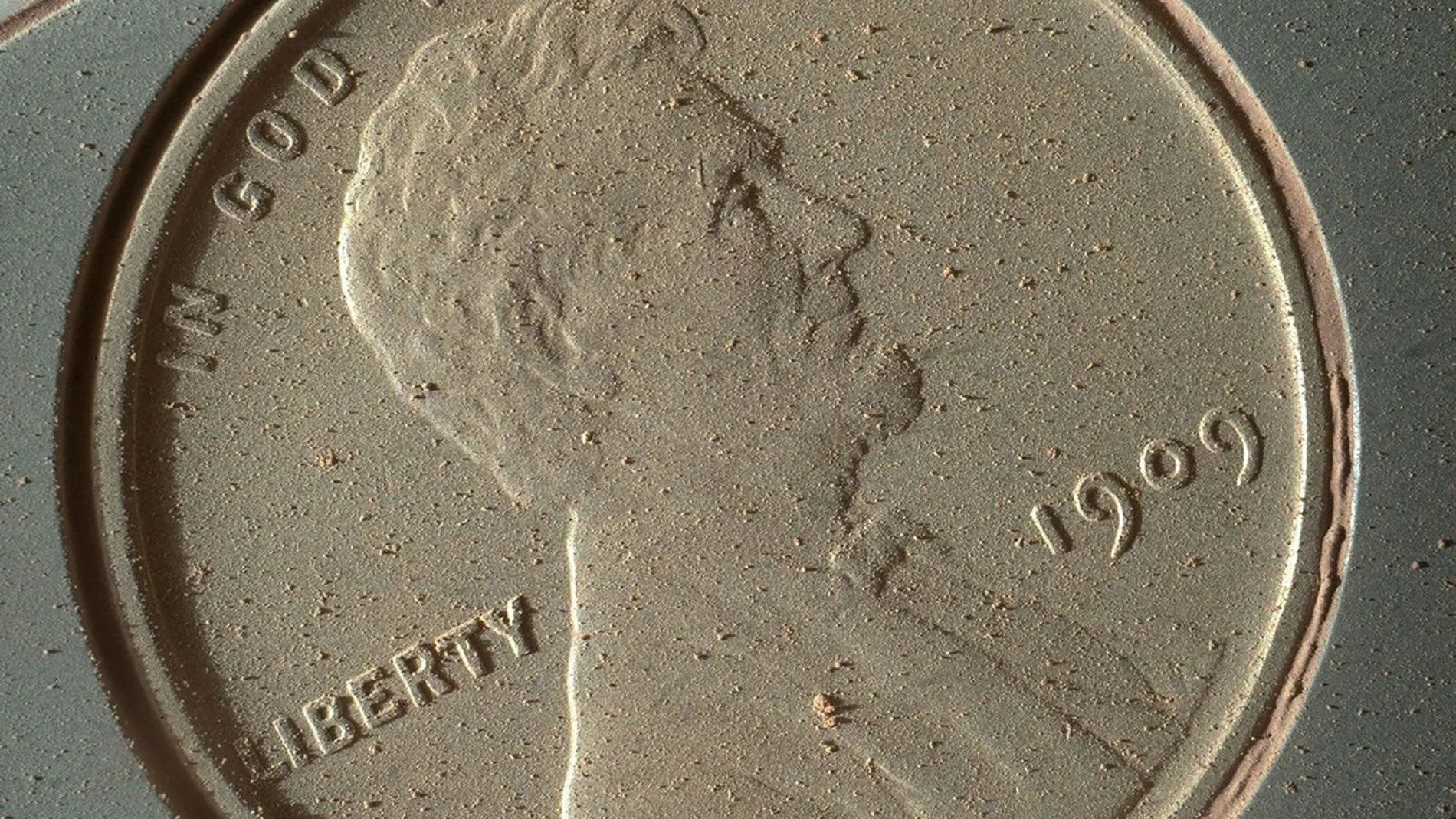
In Anglo-Saxon culture, there is the idea that finding a penny can bring good luck. It’s what they call ‘lucky penny’, ‘lucky penny’ or ‘lucky penny’. One of these is what someone could find on Mars if they were to set foot on its surface and get close to the rover. Curiosity of the POTbut it’s not there to give anyone luck.
This lucky coin is the one that can be seen in the image that heads the article, taken by Curiosity on October 2, 2013, during sol 411 of the mission, that is, Martian day number 411. The 14 months that the mission had already been on Mars at that time allowed there was already reddish dust accumulated on the coin.
The coin, minted more than 100 years ago and now millions of kilometers from Earth, is a 1909 Lincoln penny. This penny does not refer to the English pennybut it is the common way to call a penny in the United States.
This penny, called ‘lucky penny’ by NASA itselffulfills an important function that is serve as a scale. In photographs, it can sometimes be difficult to tell how big or small something is if there is no object of known size, such as a penny, in the image to serve as a reference.
‘When a geologist takes photographs of the rock outcrops she is studying, she wants there to be an object of known scale in the images,’ he said. Ken Edgettprincipal investigator of MAHLIin a 2018 statement in which NASA referred to the coin as a ‘lucky penny on Mars’.
‘If it’s the entire face of a cliff, you’ll ask one person to appear in the shot. If it’s a view from about a meter away, maybe use a geological hammer. If it’s a close-up, like the ones MAHLI can take, you can take something small out of your pocket. like a penny‘, he added.
MAHLI is one of Curiosity’s instruments. The acronyms correspond to Mars Hand Lens Imagerwhich could be translated as ‘Martian hand-held magnifying glass imager’. It is about A close-up camera installed on the end of the Curiosity rover’s robotic arm. It is used to photograph rocks, soil, dust and other Martian materials in great detail, similar to how a geologist would use a hand-held magnifying glass in the field.
The coin is not next to the camera lens, but fixed on a rear-mounted calibration plateon the shoulder of the robotic arm. When engineers want to check that MAHLI is focusing correctly and measuring sizes correctly, the arm moves so that the camera points at that plate and photographs the coin. The diameter of the penny, 19mmallows you to check the scale in the image. It also serves as a simple visual reference to evaluate sharpness and dust buildup on the instrument.