
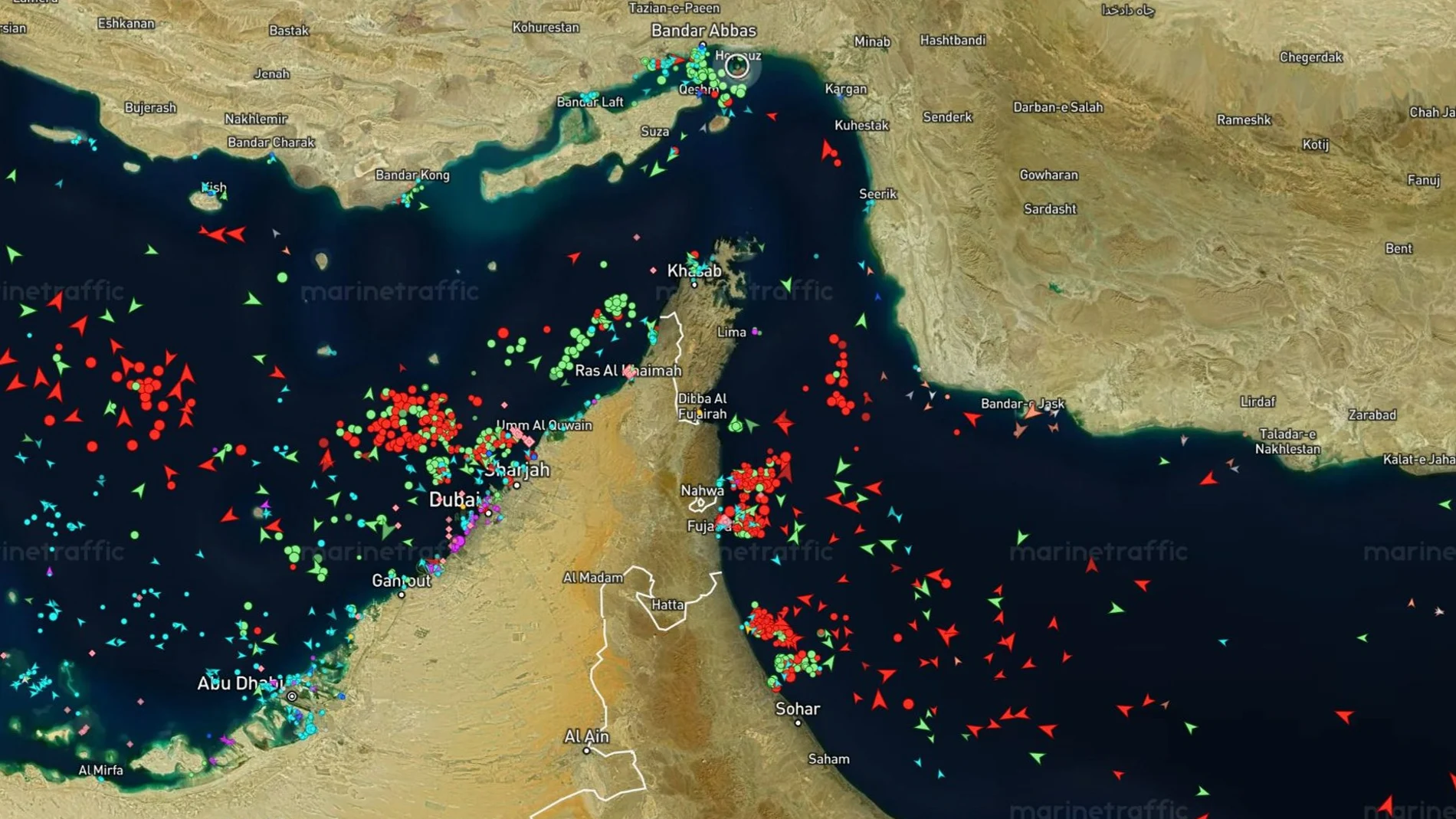
The tension in the Strait of Hormuz is forcing companies and governments to seek urgent solutions. This strategic step, key for the transport of energy and goods between Asia and Europe, has become a critical point due to the conflict between Iran and the United States.
The consequences include less maritime traffic, tripped insurance and increasing pressure on international logistics chains.
The Strait of Hormuz, an increasingly expensive bottleneck
For years, passage through the strait has been practically mandatory to connect the Persian Gulf with Europe. Now, the situation has changed. Insecurity in the area has significantly reduced ship transit, while war risk premiums have gone from residual levels to multiplied several times.
This increase in costs is having a domino effect. Many companies have begun to rethink their usual routes, and some have even opted for more expensive solutions, such as air transportto guarantee urgent deliveries. The result is a more stressed and less efficient logistics system.
What is the Ro-Ro route and how does it work?
In this scenario the call arises via Ro-Ro (Roll-on/Roll-off), a model that combines maritime and land transport to avoid passage through the strait.
The operation is simple: trucks loaded with goods go directly onto specialized vessels, They cross the Mediterranean and continue their journey by road to their destination. In this case, the route connects the Egyptian port of Damietta with that of Trieste, in Italy.
From there, The goods continue by land to the Red Sea, where they resume maritime transport to countries such as the United Arab Emirates, Oman or Qatar.
This system not only reduces exposure to conflict zones, it also shortens delivery times on certain routes and provides greater predictability to operations.
Egypt positions itself as a new logistics hub
The commitment to this alternative has strong political support. Egyptian Prime Minister Mostafa Madbouly has defended the corridor as part of a national strategy to turn the country into a logistics hub between Europe, Africa and the Middle East.
Since its launch at the end of 2024, the route has been gaining weight. At the moment, It has an approximate capacity of 420 trucks per week and is beginning to consolidate itself as a viable optionespecially for time-sensitive goods.
The move comes at a delicate time for Egypt, which has seen revenue from the Suez Canal decline due to reduced global shipping traffic. The Ro-Ro route appears like this an opportunity to regain prominence in international trade.
Is it the definitive solution?
Although the Ro-Ro corridor is gaining ground, it is not the only alternative in play. Other countries are exploring options such as oil pipelines or new sea routes to avoid the Strait of Hormuz. The problem is that many of these solutions have limitations such as lower capacity, higher costs or similar risks.
In this context, The Ro-Ro route stands out for its flexibility and speed of implementation, although it is still far from completely replacing traditional routes.
What does seem clear is that the map of global trade is changing. And in that new scenario, Egypt tries to turn a crisis into a strategic opportunity which could redefine its role in international transportation in the long term.