
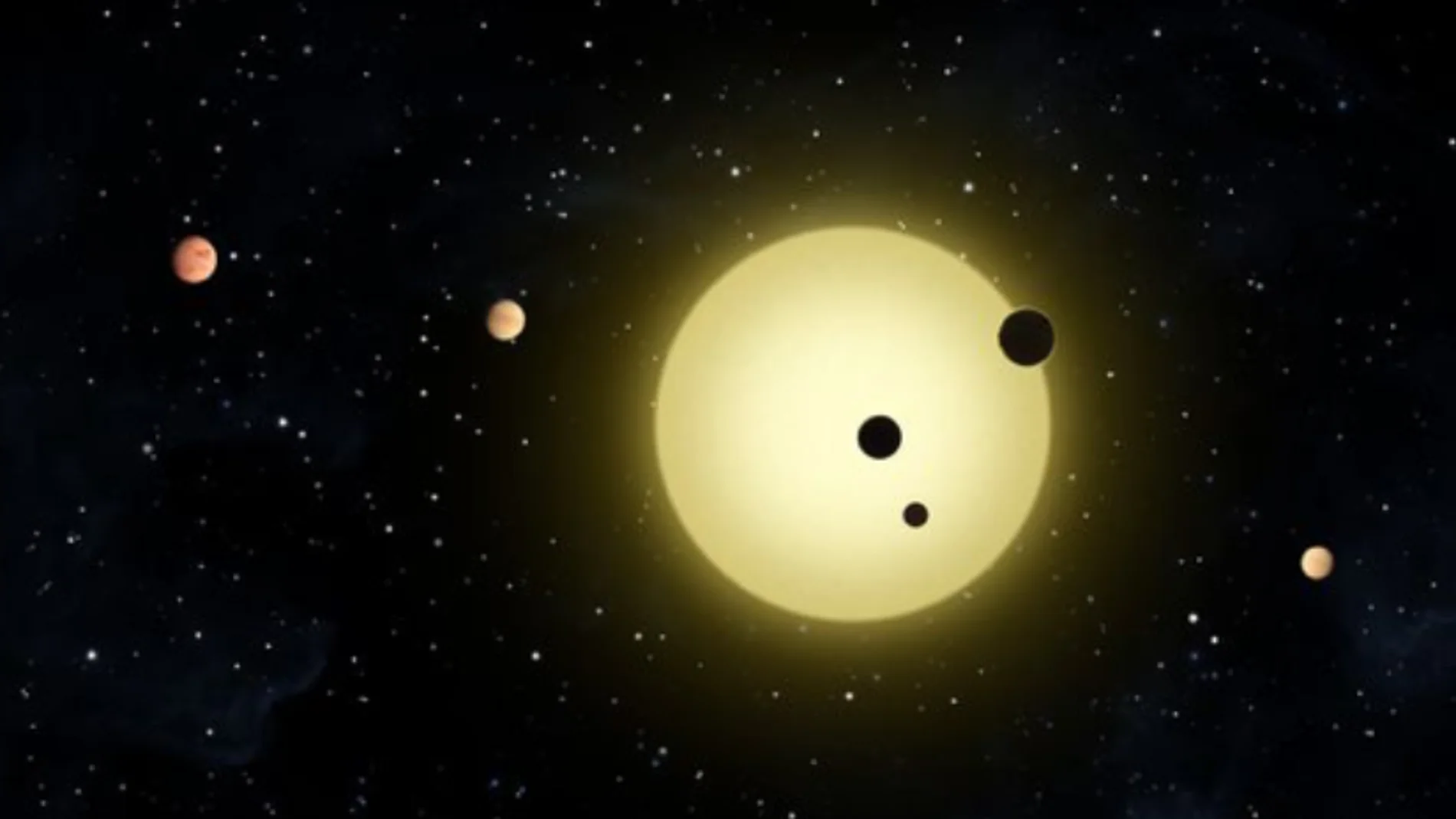
At first glance, the idea seems like a provocation: to say that The Earth does not revolve around the Sun almost sounds like a denial of centuries of astronomyto go back to the times of the Galileo trials or even further back, and confront Ptolemy. But what is at stake here is not a radical correction, but a much finer nuance.
To understand it you have to introduce a less intuitive concept than the orbit: the barycenter. Instead of imagining a planet orbiting a fixed star, physics describes a system in which both bodies rotate around a common point, determined by their masses.
In the case of the Earth and the Sun, that point is so close to the center of the Sun that, in practice, we still say that the Earth orbits around it. It’s not wrong: it’s a useful simplification. But it’s not the whole story.
The difference becomes evident when a more massive actor appears on the scene: Jupiter. With a mass more than twice that of all other planets Together and 318 times that of the Earth, Jupiter exerts enough gravitational influence to move the barycenter of the solar system away from the Sun itself. At those times, not even the Sun is exactly “in the center” of the system.
NASA explains it quite clearly: All bodies in a system orbit around that shared center of mass, not around a fixed object. This seemingly technical nuance changes the way we understand the balance of the solar system. There is no absolute and immobile center, but rather a dynamic point that moves depending on the relative positions of the planets. The solar system, seen in this way, is not a rigid structure, but a network of constantly adjusting influences.
It also helps understand why orbits are never perfectly stable in the long term. Small gravitational disturbances (especially those from giants like Jupiter) introduce variations which, accumulated over millions of years, can alter trajectories, tilt orbits or even expel smaller bodies from the system.
In everyday terms, nothing changes: the Earth continues to describe its annual trajectory, the seasons continue to mark the passage of time and the Sun continues to dominate the sky. But on a physical level, the image is more subtle. We do not orbit a fixed point, but rather participate in a balance in motion.
It is one of those corrections that do not dismantle what we knew, but they do refine it. And in that small conceptual shift (from the immobile center to the shared center) there is a key to detecting exoplanets. These types of objects are very difficult to observe directly. They are hidden by the intense brightness of the stars they orbit. Detecting the wobble of a star (that instability mentioned above) is one way to find out if there are planets orbiting it. By studying barycenters, astronomers have detected many planets around other stars.