
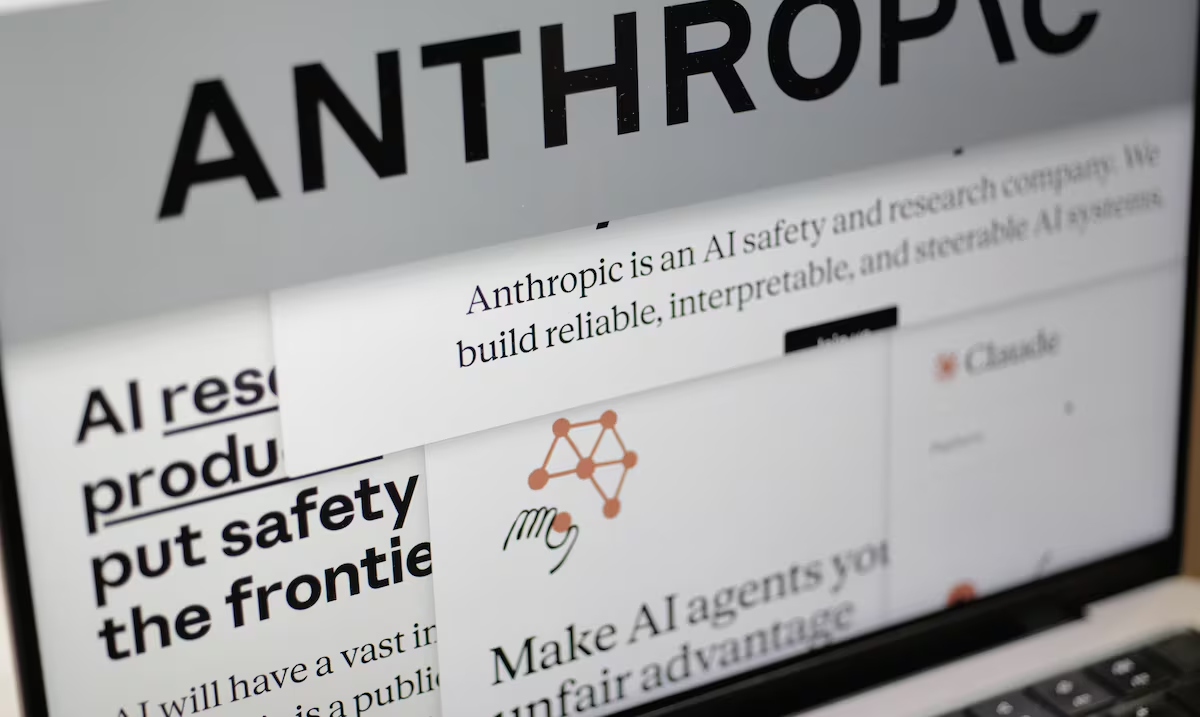
As concerns grow about the artificial intelligence (AI) and their rapid integration into society, tech companies are increasingly turning to religious leaders for guidance on how to shape technology, a surprising turnaround from the entrenched skepticism of Silicon Valley towards organized religion.
Leaders of various religious groups met last week with representatives of companies such as Anthropic and OpenAI at the inaugural “Fe-AI Pact” roundtable in New York to discuss how best to incorporate morality and ethics into this rapidly developing technology. The event was organized by the Geneva-based Interfaith Alliance for Safer Communities, which seeks to address issues such as extremism, radicalization and human trafficking. The roundtable is expected to be the first of several to be held around the world, including in Beijing, Nairobi and Abu Dhabi.
Technology executives must recognize their power – and responsibility – to make the right decisions, said Baroness Joanna Shields, a key partner in the initiative. She worked as a technology executive, with stints at Google and Facebook, before turning to British politics.
“Regulations can’t keep up with this,” he said. “This dialogue, this direct connection is so important because the people who build this understand the power and the capabilities of what they build, and most of them want to do it well.”
The goal of this initiative, according to Shields, is to eventually arrive at a “set of standards or principles” informed by different groups and faiths, from Christians to Sikhs to Buddhists, that companies will respect.
1 / 22 | These are the 10 high-paying jobs that would not be replaced with AI. The newspaper El Diario reported a list of well-paid jobs with lower risk of automation, since they require human interaction, adaptation to changing situations and manual work in real environments. – Pablo Martínez Rodríguez
Challenges ahead
Various religious groups were present at the meeting, including representatives from the Hindu Temple Society of North America, the Baha’i International Community, The Sikh Coalition, the Greek Orthodox Archdiocese of America, and the Church of Jesus Christ of Latter-day Saints, widely known as the Mormon church.
Before these companies began the approach, some traditions had issued their own ethical guidance on the use of AI. The Church of Jesus Christ of Latter-day Saints has given a nuanced endorsement of the technology in its manual. “AI cannot replace the gift of divine inspiration nor the individual work necessary to receive it. However, AI can be a useful tool to improve learning and teaching,” the text reads.
The Southern Baptist Convention, the largest Protestant denomination in the United States, passed a resolution in 2023: “We must proactively engage and shape these emerging technologies rather than simply responding to the challenges of AI and other emerging technologies after they have already affected our churches and communities.”.
One challenge in creating a list of common principles is that global religions, despite commonalities, differ in their values and needs. “Faith communities see priorities differently,” said Rabbi Diana Gerson, a roundtable participant and associate executive vice president of the New York Board of Rabbis.
The alliance highlights a growing coalition between faith and technology, born of the effort to create moral AI, a controversial concept that raises questions about whether that is possible and what it means.
“We want Claude to do what a deeply and skillfully ethical person in Claude’s position would do,” Anthropic maintains in “Claude’s Constitution,” a public document drafted for its chatbot. That constitution was crafted with the help of numerous religious and ethical leaders.
In this growing alliance, Anthropic has been the most determined, at least publicly, in its efforts to court religious leaders. The move comes after a public dispute earlier this year with the Pentagon on the military use of artificial intelligence, after Anthropic said it would restrict the use of its technology to develop autonomous weapons or for mass surveillance of Americans.
“There’s a public relations component to this. The slogan was ‘Move fast and break things’. And they broke too many things and too many people,” said Brian Boyd, U.S. faith liaison for the nonprofit Future of Life Institute. “There is a moral obligation on the part of the companies, which are belatedly recognizing it, and also, I believe, a sincere questioning on the part of some members of the companies.”
Some skepticism arises
But other advocates of AI regulation and safety aren’t so sure these efforts are genuine.
“At best it’s a distraction. At worst it’s diverting attention from things that really matter,” said Rumman Chowdhury, executive director of the nonprofit Humane Intelligence and the U.S. scientific envoy for AI under the Biden administration.
Chowdhury says he’s not inclined to believe religion is the best place to help answer questions around AI and ethics, but he thinks he understands why companies are increasingly turning to it.
“I think a very naive view that Silicon Valley has had for a couple of years regarding generative AI was that we could come up with some kind of universal principles of ethics,” he explained. “They’ve realized very quickly that that’s just not true. It’s not real. So now they look to maybe religion as a way to deal with the ambiguity of ethically gray situations.”
It’s unclear to what extent these notoriously opaque companies translate what they hear from religious leaders into action, or what those actions might look like. But some critics fear that the conversation about creating ethical versions of the technology will distract from broader conversations about AI and its role in society.
“Under the guise of, ‘We’re going to build all these things. That’s already decided. And when we build these things in these ways, how do we make sure that the end result is maybe good?'” asked Dylan Baker, principal research engineer at the Distributed AI Research Institute. “It’s like, ‘Wait, wait, wait. We have to question whether we really want to build these things.'”