
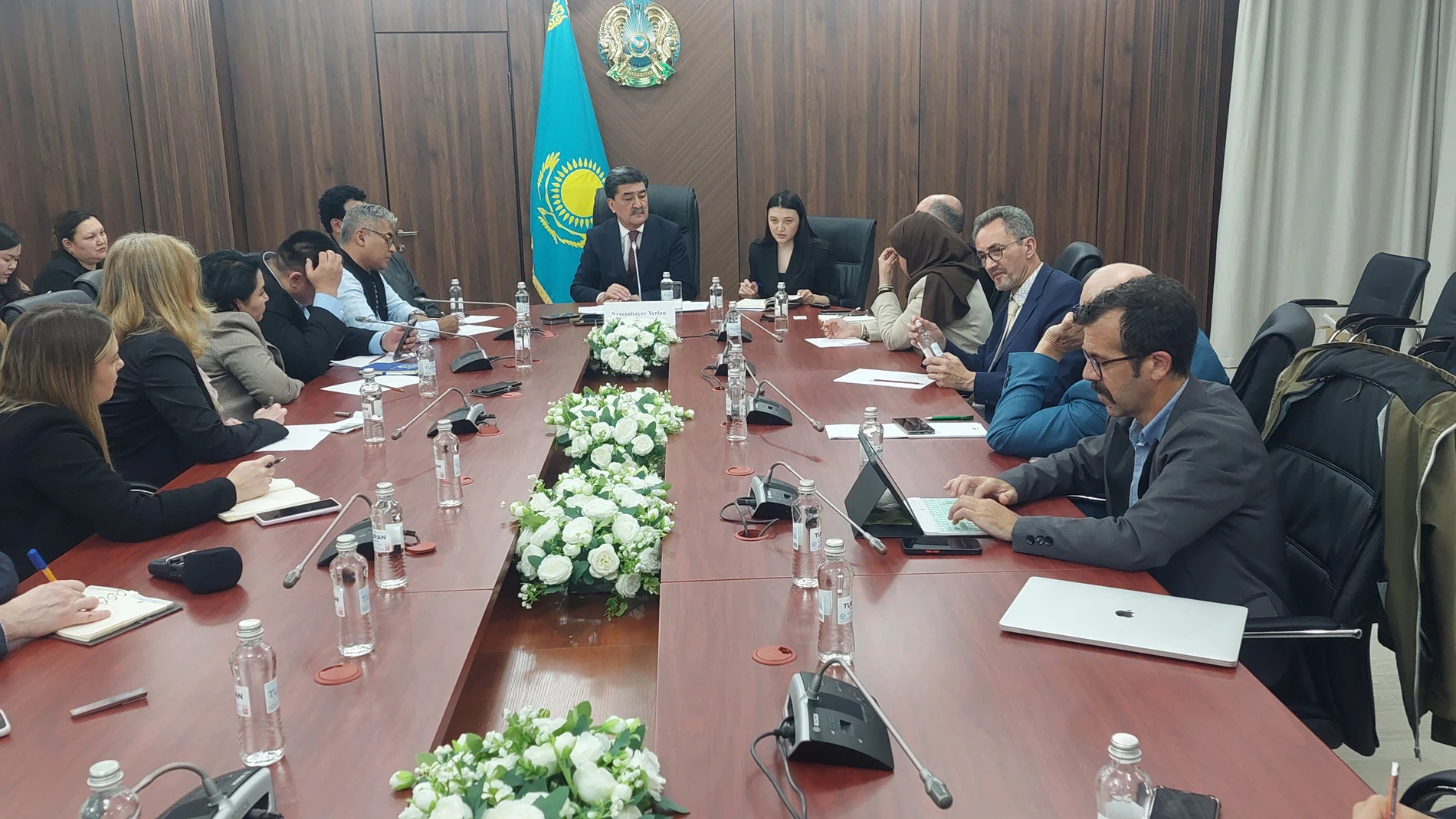
The Kazakh capital will be, from April 22 to 24, the epicenter of the environmental debate in Central Asia. The celebration of the Regional Ecological Summit 2026 (RES 2026) is a high-level event convened by the Government of Kazakhstan in collaboration with the United Nations. The meeting was born with a clearly executive vocation: to translate the environmental challenges shared in concrete policies, strategic investments and cross-border projects that promote the sustainable development of the region.
Multilateral cooperation
The summit brings together heads of state, multilateral leaders, scientific experts and representatives of the international financial sector, at a critical time for Central Asia. The region faces increasing pressure on its natural resources: water scarcity, accelerated glacier retreat, desertification and extreme climate events. that threaten both economic stability and food security. In this context, regional cooperation ceases to be an option and becomes a structural necessity.
Among the participants are political figures such as Kassym-Jomart Tokayev, host president of the meeting, along with his counterparts Shavkat Mirziyoyev (Uzbekistan), Emomali Rahmon (Tajikistan), Vahagn Khachaturyan (Armenia) and Ukhnaagiin Khürelsükh (Mongolia). Their presence underlines the strategic nature of the summit, in which political decisions will be key to moving towards coordinated management of shared resources.
The international component is reinforced with the participation of senior officials from multilateral organizations, such as Li Junhua (Deputy Secretary General for Economic and Social Affairs of the United Nations), Feridun H. Sinirlioğlu (Secretary General of the Organization for Security and Cooperation in Europe -OSCE-), Tedros Adhanom Ghebreyesus (Director General of the World Health Organization -WHO-), Celeste Saulo (Secretary General of the World Meteorological Organization) and Doreen Bogdan-Martin (General Secretary of the International Telecommunication Union).
This institutional range reflects the transversal nature of the challenges addressed, which connect public health, climate, technology and economic development.
One of the distinctive elements of the RES 2026 is its integrated approach. Far from treating the environment as an isolated area, the summit articulates the water, energy, food and territorial systems as an interdependent whole. Water management, for example, not only affects agriculture, but also energy production and social stability. In a region where rivers cross borders and ecosystems are shared, any effective solution must necessarily be coordinated.
In the energy field, the summit acquires special relevance. Central Asia has enormous potential for the development of renewable energy, especially solar and wind, but also faces the challenge of guaranteeing energy security in economies still dependent on fossil resources. The transition to low-carbon models is not only a global climate requirement, but a strategic opportunity to modernize infrastructure, attract investment and diversify economies.
Regional leadership
Kazakhstan, as the host country, arrives at this event with significant credentials. Its commitment to the green economy, the commitment to carbon neutrality by 2060 and the development of Sustainable financial instruments—such as green bonds—position it as a key actor in regional transformation. Furthermore, initiatives such as the restoration of the North Aral Sea or the recovery of emblematic species reflect practical experience that serves as a model.
Another of the central objectives will be to mobilize financing. The ecological transition requires massive and sustained investments, and the summit seeks precisely to align governments, development banks and private investors around a common agenda. Identifying scalable projects and channeling resources towards them will be decisive to prevent commitments from remaining on paper.
The RES 2026 also aims to strengthen the data exchange, technological innovation and early warning systems, essential tools to anticipate risks and improve regional resilience. In a global context where the impacts of climate change are increasingly visible, Central Asia is presented as a laboratory of challenges, but also of solutions.
According to the organizers, the success of the summit will be measured by its ability to generate tangible results. At stake is not only the environmental balance of the region, but also its economic stability, its energy security and its role as a strategic bridge between Europe and Asia.
The creation of permanent cooperation mechanisms, the promotion of technical dialogue platforms and the periodic evaluation of progress will be key so that RES 2026 is not an isolated event, but rather the starting point of a regional agenda.