
Mónica García has the private management of public health between her eyebrows. What’s more, the Government, promoted by the Minister of Health, approved a draft bill in February 2026 to limit this public-private collaboration in the health system. This normseeks to repeal law 15/1997 that allowed private management of public centers. A management that García called “parasitic”, a statement now flatly denied by an international report.
In the midst of the commemorations of the 40th anniversary of the General Health Law (today President Pedro Sánchez participates in the closing events at the Ministry of Health), the research published in “NEJM Catalyst Innovations in Care Delivery”, a scientific journal from the prestigious group The New England Journal of Medicine, concludes that When outsourcing is based on the principles of so-called value-based medicine, not only does it not deteriorate the system, but it can improve its clinical results, improve the patient experience and reduce the cost to the taxpayer.
The analysis focuses on the health system of the Community of Madrid, which serves around 7 million inhabitants (approximately 14% of the Spanish population) under a model of free universal coverage. freedom of hospital choice and a policy of transparency in results that allows centers to be compared. This environment is especially relevant because it combines hospitals under direct public management with others whose management has been outsourced to private operators, which offers a unique comparative framework in Europe.
Value-based medicine
In this context, the study presents a clear hypothesis: outsourcing to providers who apply value-based medicine can improve clinical outcomes, efficiency and patient satisfaction without increasing public spending. To verify this, the researchers analyzed data from 25 public hospitals between 2014 and 2023. Four of them were outsourced to the Quirónsalud network, which operates under principles of value-based medicine, while the other 21 remained under direct public management. The robustness of the analysis rests on the diversity and quality of the sources used.: official reports from the Madrid health system, standardized clinical databases, satisfaction surveys, infection surveillance systems and public audits. In addition, the study evaluates multiple key dimensions: quality of care (measured by hospital mortality and complications), efficiency (length of stays and readmissions), patient experience and public spending per inhabitant.
The patients
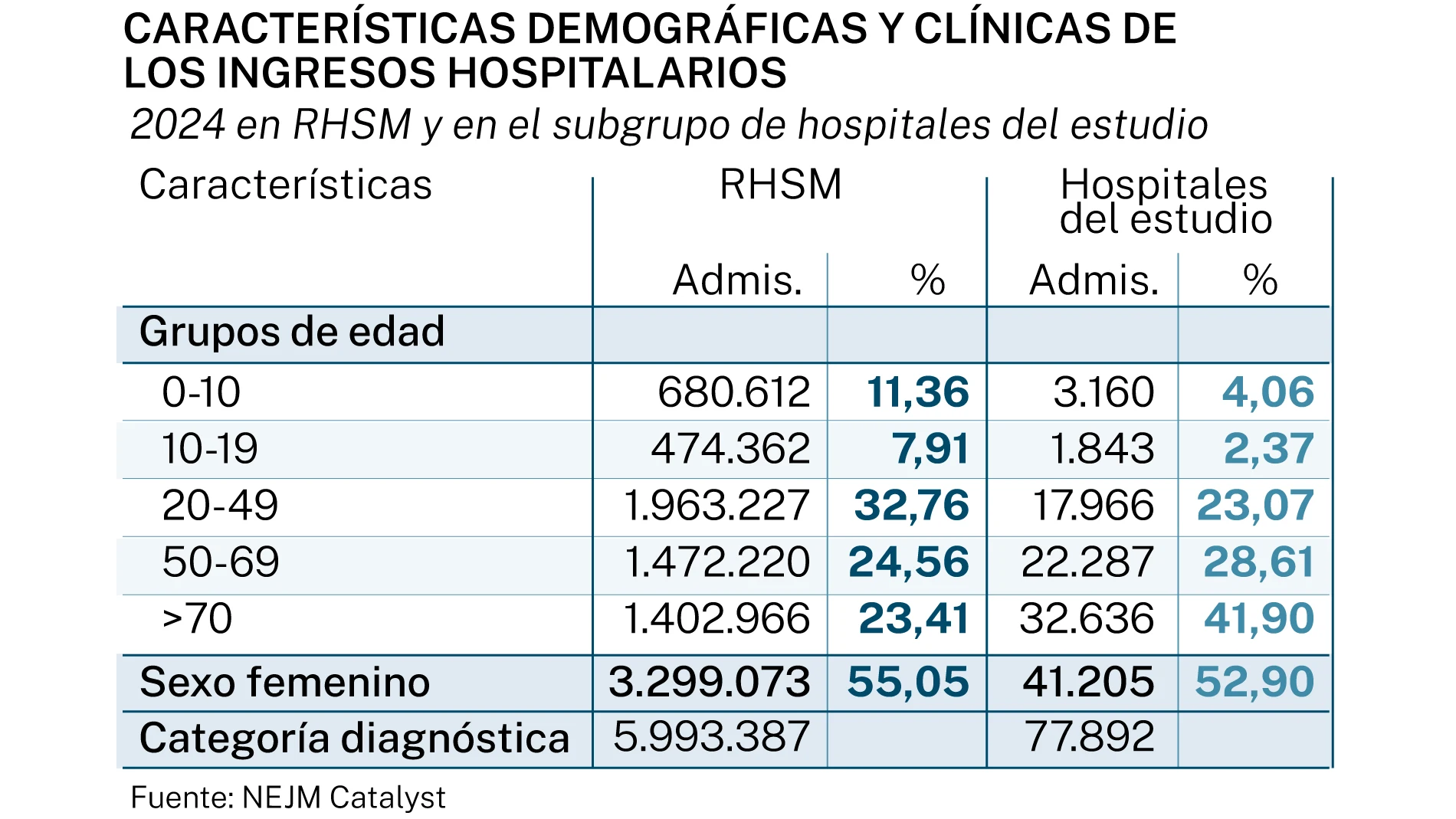
One of the most relevant elements is that the observed differences cannot be attributed to simpler patient selection. More than 40% of the patients treated in outsourced hospitals are over 70 years old, which indicates an aging population with high clinical complexity.. In fact, the case complexity index is practically identical in both groups (around 1.09).
In terms of in-hospital mortality, outsourced centers presented consistently lower adjusted rates over the ten years of the study, frequently falling below expected values. This data points directly to better clinical quality.
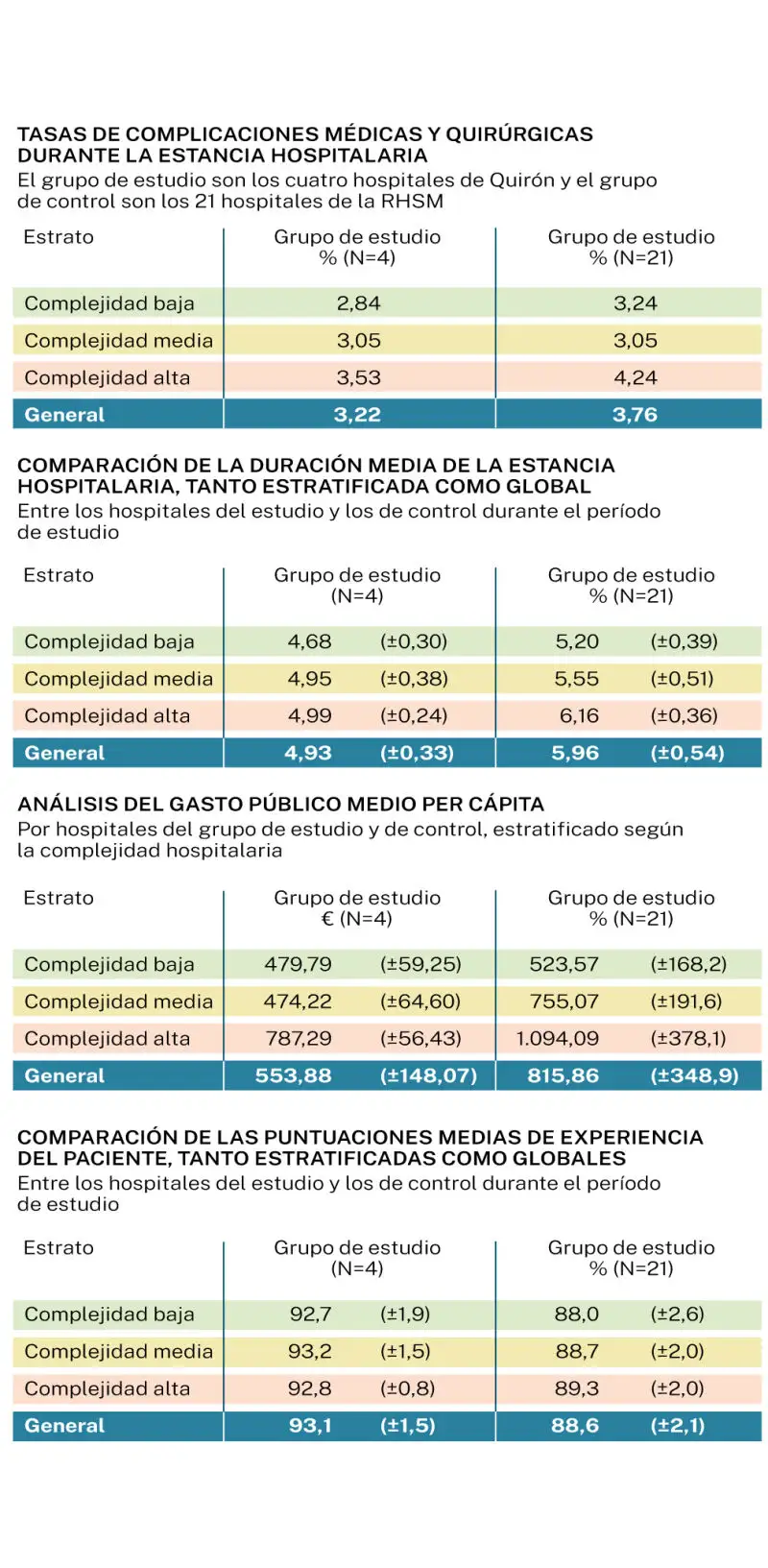
As to medical and surgical complicationsthe difference is also clear: 3.22% in outsourced hospitals compared to 3.76% in publicly managed hospitals, a significant reduction that implies fewer adverse events and greater safety for patients. Efficiency, measured through the average length of hospital stay, also shows a relevant advantage: 4.93 days versus 5.96 days. That is, almost one day less per patient, which represents a considerable saving of resources without translating into worse clinical results.
In fact, one of the common fears in healthcare management is that reducing hospital stays could increase readmissions. However, the study does not find evidence of this negative effect. The overall average readmission rate is 8.63%, with 4.12% of readmissions related to the initial processand although there is a certain proportional relationship between stay and readmissions, this does not compromise the quality of care.
The experience
Patient experience is another indicator where the differences are especially notable. Outsourced hospitals achieve a customer satisfaction rate 93.1%, compared to 88.6% of directly managed public hospitals. This statistically significant gap reflects a better perception of the care received, an increasingly relevant factor in the evaluation of health systems.
But perhaps the most striking data from the study is related to cost. Outsourced hospitals record an average public expenditure of 553.88 euros per patient, approximately 262 euros less than directly managed hospitals. That is, the system achieves better clinical results and greater satisfaction at a lower cost to the public coffers, a finding that challenges some of the traditional assumptions of the debate.
Among the signatories of the study is Jeffrey Braithwaite, one of the most influential international researchers in the development of value-based healthcare at a global level, and his participation highlights the international interest of this analysis, which transcends the Madrid case and provides relevant evidence for other healthcare systems. “The synergy between free choice and transparency constitutes the basis of a governance model that strengthens accountability and encourages continuous improvement,” point out the authors, who also point out that “While some studies have found that privatization may be related to increased patient satisfaction, public opinion on outsourcing fluctuates and may be influenced by political and economic factors”.
The analysis also reveals a significant phenomenon in terms of equity. Outsourced hospitals attract a greater volume of patients who exercise their right to free choice, especially in highly complex centers, where numbers of more than 56,000 patients are reached annually. Besides, More than 62.9% of these patients come from areas with lower income, with an average income of 21,866 euros, lower than the regional average. This data suggests that the model not only does not generate inequalities, but can contribute to reducing them.
Likewise, factors that explain this better performance are identified. One of the most important is the financing model. Outsourcers operate under capitation systems, in which they receive a fixed amount per patient. This model encourages efficiency, since an increase in activity does not necessarily imply more income, which forces resources and processes to be optimized. In contrast, Public hospitals operate with more rigid budgets, based on historical expenses.
“The results suggest that outsourcing to value-based healthcare providers is a successful strategy to improve healthcare management and reduce costs, while focusing on high-quality healthcare, by placing respect for patient values and achieving patient outcomes as the primary goal of healthcare delivery,” the authors conclude.
Meanwhile, García continues with his particular political crusade, despite the fact that the data points in the opposite direction.