
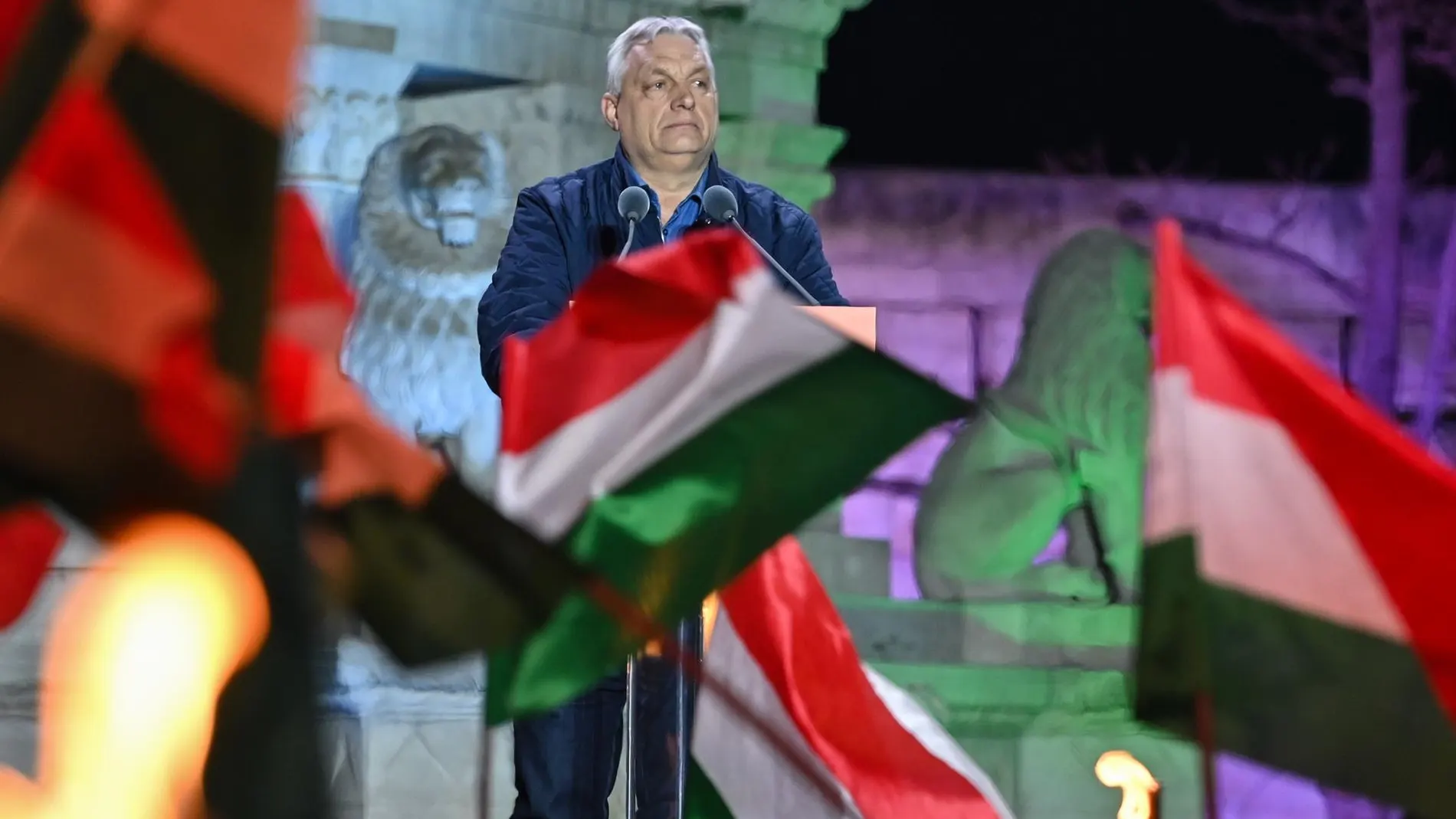
The electoral defeat of Viktor Orban marks more than just a change of Government in Hungary. It represents, above all, the closing of a political stage that for more than a decade turned the country into the main laboratory of the European extreme right within the European Union.
Since his return to power in 2010Orban transformed Hungary into a model of “illiberal democracy” that inspired a generation of leaders and parties across the continent. Its defeat, in that sense, leaves orphaned a political space that saw Budapest not only as an ally, but as a practical example of how to erode the rule of law from within European institutions.
For years, the Fidesz leader built a political system based on the concentration of power, control of the media and a nationalist narrative that combined sovereignty, rejection of immigration and constant confrontation with Brussels. This model not only resisted internal and external pressures, but also managed to consolidate itself as a viable alternative within the Union.
Hungary became a case study. This was not a frontal break with the European system, but a more subtle strategy: remaining in the EU while its fundamental principles were questioned. That ambiguity allowed Orban to benefit from European funds while openly challenging community values.
His influence transcended Hungarian borders. Leaders like Giorgia Meloni in Italy or parties such as National Rally in France closely observed the Hungarian model. Orban showed that it was possible to govern for years with a national-populist agenda without becoming completely isolated in Europe.
But that balance, always precarious, has ended up breaking. The electoral defeat comes in a context of accumulated wear and tear: economic tensions, growing political isolation and evident fatigue in a part of the electorate after more than a decade of almost uninterrupted power.
The economy has been one of the key factors. Hungary has suffered in recent years from high inflation and structural difficulties that have eroded support for the Government. Added to this is the impact of the conflicts with Brussels, which have blocked part of the European funds destined for the country, directly affecting its room for maneuver. In parallel, the opposition has achieved something that for years seemed impossible: articulating an alternative capable of competing electorally with the Fidesz political apparatus. The fragmentation that had weakened the opposition parties in previous events has given way to greater coordination.
Orban’s fall also has a European dimension. For years, Hungary has acted as a disruptive actor within the EU, blocking key decisions, especially in foreign policy, and straining consensus mechanisms. His departure from power could open the door to greater cohesion in the European bloc.
However, the most significant impact occurs in the ideological field. With Orban, the European extreme right loses its main reference point for a consolidated government within the Union. Unlike other leaders, his project was not limited to the opposition or specific coalitions: it was a model of power sustained over time.
That does not mean that the political space it represents disappears. On the contrary, the extreme right continues to be a relevant force in many European countries. But the loss of Hungary as a practical example weakens its ability to project a coherent alternative government.
In Italy, Meloni has opted for a more pragmatic strategy, moderating his speech in the exercise of power. In France, the party of Marine Le Pen The Government still has not been reached. And in other countries, related formations continue to face structural limits to consolidate power. In that context, Orban was an exception. His Hungary represented proof that an illiberal project could not only come to power, but also remain there for years. Without this precedent, the narrative of the European extreme right loses one of its most solid pillars.
The question now is what will come next. The new Hungarian Government will have to manage a complex situation, both internally and in its relationship with Brussels. Institutional reconstruction, if it occurs, will not be immediate, and Orban’s legacy will continue to be present in many State structures.
For the EU, the fall of the Hungarian leader can be interpreted as an opportunity. For years, Brussels has dealt with the tensions generated by its illiberal drift without finding fully effective mechanisms to correct it. The political change in Budapest could facilitate a normalization of relations.
But it also poses a challenge: to demonstrate that the European model is capable of offering answers to the problems that fueled Orban’s rise. Because its success was not only the result of its political strategy, but also of the weaknesses of the European system itself.
Orban’s defeat closes a cycle. But it does not resolve the tensions that made it possible. In an increasingly fragmented Europe, the battle for the continent’s political model remains open.