
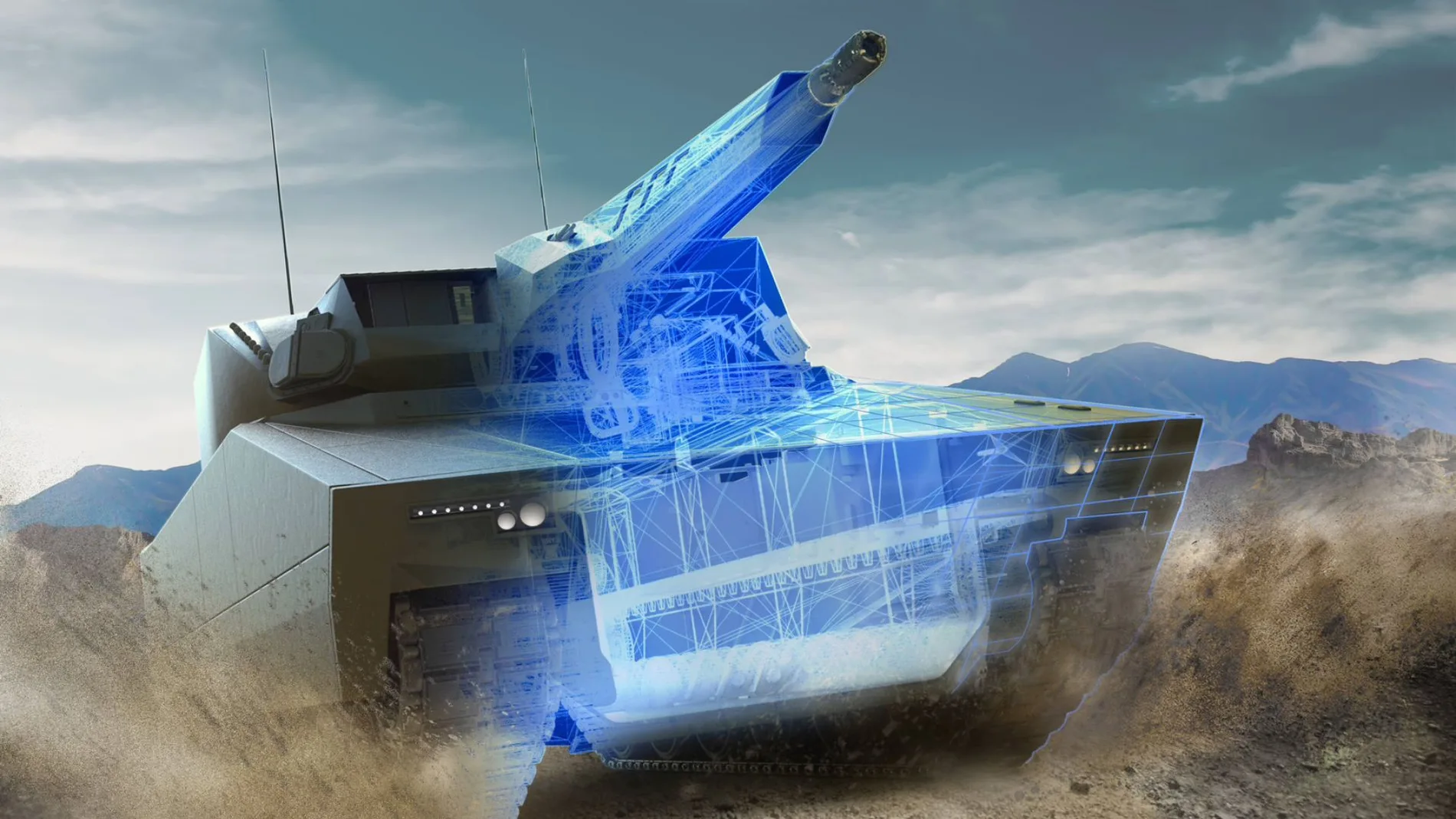
In military modernization programs, there are vehicles that not only replace previous ones, but also change the relationships between powers. That seems to be the goal of the Lynx XM30, the candidate to become the new infantry fighting vehicle of the United States Armydesigned to operate in an environment where warfare is increasingly digital, distributed and automated.
The XM30 (provisional name within the Optionally Manned Combat Vehicle program) is not simply an evolution of the classic M2 Bradley. It is, rather, a paradigm shift. While the Bradley was conceived in the middle of the Cold War for conventional confrontations, The Lynx XM30 is designed for a battlefield saturated with sensors, drones and emerging threats.
Originally, the Lynx is a German armored fighting vehicle developed by Rheinmetall that was presented at the Eurosatory defense fair in 2016. In the first versions it included a Lance turret (KF31) with a 30 mm Rheinmetall MK30-2/ABM or 35 mm Wotan 35 autocannon.
One of its most notable features is its open and modular architecture. This means that Its electronic systems, sensors and weapons can be updated relatively easily, without the need to redesign the vehicle from scratch.. In a context in which military technology evolves at great speed, this flexibility is not a luxury, but a necessity. It allows, for example, to integrate new active protection systems, improve sensors or incorporate electronic warfare capabilities as they appear.
In terms of protection, the Lynx XM30 goes for a multi-layer approach. It combines physical armor with active systems capable of detecting and neutralizing threats before they impact, such as anti-tank missiles or armed drones. This type of active defense has become a priority in recent conflicts, where guided weapons have proven effective against traditional armored vehicles.
Weapons, for their part, also reflect this adaptation to new threats. In addition to the automatic main cannon, the vehicle can integrate missiles and anti-drone defense systems, which expands its role beyond direct combat against other vehicles. In a sense, it stops being just an armored transport with offensive capabilities and becomes a multi-function combat node.
Another key element is its integration into information networks. The XM30 is conceived as part of a larger system in which vehicles, drones, satellites and troops share data in real time. This allows you to improve situational awareness and make faster and more accurate decisions, an increasingly determining factor on the modern battlefield. And now it will receive a renewal.
This latest update coincides with the Pentagon’s plans to acquire 19 vehicles by 2027. According to its manufacturer, the changes will include the crew compartment of 6.43 cubic meters offers space for 3 crew members and 8 soldiers, even with an unmanned turret.
The core of the XM30’s capabilities is this turret equipped with a 50mm Bushmaster XM913 autocannon. This weapon offers greater range and firepower than the Bradley’s 25mm cannon, improving its effectiveness against modern armored threats.
The unmanned turret allows the vehicle to operate with a crew of two. Both crew members remain inside the hull, improving protection by eliminating the need for a traditional manned turret position. The platform also features a highly mobile chassis and integrated protection systems.
One of the distinctive features of the XM30 is its optional manned operation capability. The vehicle can transport soldiers into combat and provide firepower during combined arms operations. At the same time, it can operate without a crew on board when necessary. This flexibility extends to its ability to control robotic and semi-autonomous systems that operate alongside it, acting as a central node in coordinated operations.The combination of increased firepower, reduced crew exposure and autonomous capability positions the XM30 as a key component of the Army’s future combat strategy.