
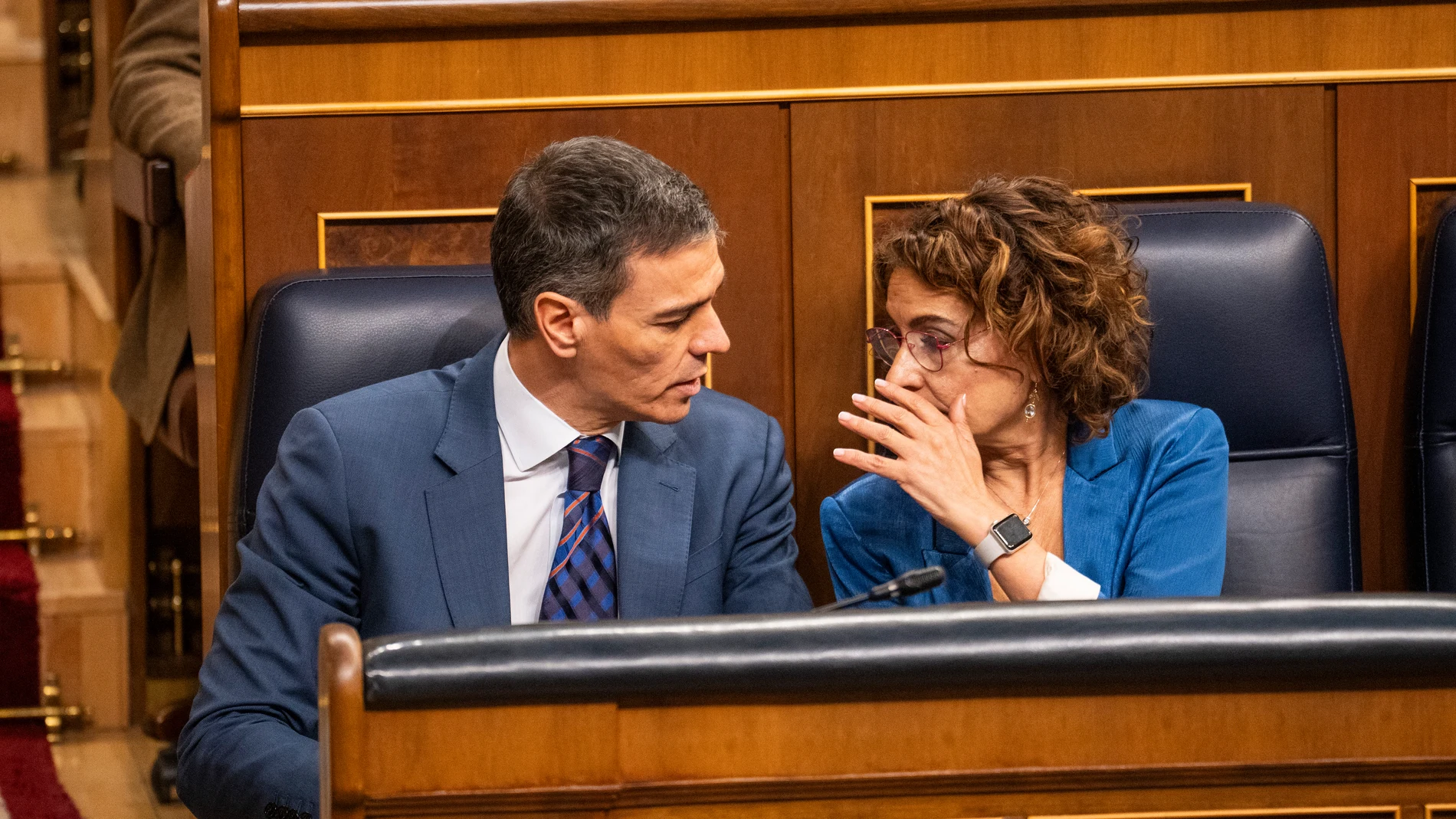
The Government is trying to outline at forced marches the expected and demanded anti-crisis plan for the war in Iran, amid reproaches and criticism for its delay, when other countries in the European Union already implemented theirs last week. The Executive hides behind the fact that “it has to adapt to the impact that we are observing at this moment”, but the opposition claims that “we are already late.”
The Government is torn between satisfying its usual government partners or achieving the greatest possible consensus. While Sumar, Podemos, Bildu or ERC demand that the extension of rental contracts and the prohibition of evictions of vulnerable people be included in the decree law that the Council of Ministers will approve tomorrow, PP, Vox, Junts and the PNV have already warned that if these measures are included they will vote against. The position of both blocks has forced the Minister of Finance, María Jesús Montero, to affirm yesterday that the decree will only include “measures that have consensus”, which leaves out the initiatives rejected by the opposition. «We are not going to have a decree law for other groups to reject. We will try to ensure that there is no issue that is a problem, an obstacle so that any of those who usually do not support the Government’s measures can support it.”
Government sources consulted by LA RAZÓN have confirmed that the Government has ruled out “at this time” including measures on housing and will focus the aid package on tax reductions in the transport, tertiary (agriculture, livestock and fishing) sectors and electro-intensive industries, ruling out any “generalization of direct aid”, in addition to the fact that the measures will focus almost entirely on professionals, so households could only benefit from cuts in the electricity bill. Specifically, the tax reduction would focus on the suspension of the Tax on the Value of Electrical Energy Production (Ivpee), the reduction in the Special Tax on Electricity (II EE) and a minimum reduction in VAT on the final invoice.
The same sources assure that the “package will be broad” and will be intended “both to protect families and companies in the short term.” However, in the case of households, the Minister of Economy himself, Carlos Body, has already ruled out the bonus on fuel prices, as was done during the war in Ukraine, of 20 cents per liter, or the reduction in VAT on food. “Right now it is not considered a priority, but there is still time to reconsider it.”
In addition to these temporary measures, this anti-crisis plan will present others of a structural nature. This second block would be focused on a transformation of the energy system that allows greater resilience to external shocks, “which have nothing to do with the functioning of the Spanish economy”, as is the case of the “energy crisis derived from the war in Iran”, said the President of the Government, Pedro Sánchez, yesterday in the Congress of Deputies.
Therefore, the Executive is betting on surgical measures that will hardly alleviate the pockets of households, except for the reduction of taxes on electricity, and will avoid adopting universal measures as it did during the energy crisis derived from the invasion in Ukraine “because right now there is not the same degree of disruption as then,” explain ministerial sources, who emphasize that “all those that are going to be taken will be proportional to the impact to protect companies and homes.”