
The most important tourism fair has reopened its doors and Fitur 2026 once again incorporates FiturNext, the fair’s initiative to promote good social and environmental practices in the tourism sector. In this edition, with the focus on water and the challenges for water sustainability posed by tourism.
Aqualia, an ally of the FiturNext Observatory, has held a series of meetings with institutional and technical representatives to analyze the challenges posed by the comprehensive management of the water cycle in tourist destinations. Thus, dialogues have been developed on how the municipality of Torrox (Málaga) faces (successfully) the drought or the impact of technology on the citizen, as well as the singularities that water management poses in World Heritage cities, such as Mérida.
Santander, 10 years of experiences
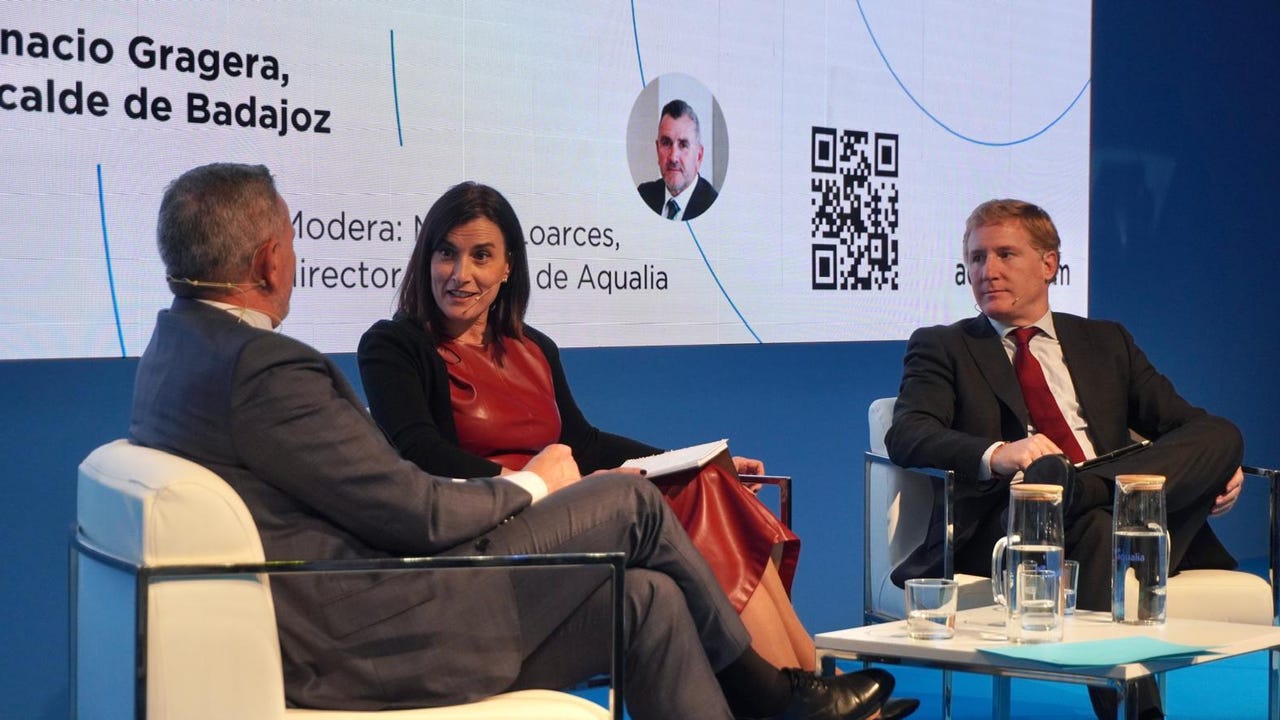
In the session “The digitalization of water at the service of citizens”, they shared experiences the mayor of Santander, Gema Igual, and the mayor of Badajoz, Ignacio Grajera.
In the case of Santander, its path in the digitalization of water management began “more than 10 years ago, its mayor recalled, when we began to develop Smart Cities projects, specifically in Smart Water”, and continues today “always with the premise of guaranteeing a safe and quality water supply.”
The digitalization of water management in the Cantabrian capital has led, according to its mayor, “to a radical change: We have remote control, sectorization, mathematical modeling of networks, etc. These tools allow, for example, to view the entire network from an office and know exactly where a breakdown occurs and act precisely. “This speeds up work, reduces inconvenience and avoids unnecessary cuts.”
For Gema Igual, “digitalization has also changed the way the city works: we have gone from lifting entire streets to look for breakdowns to acting at the exact point where the breakage is, there are fewer incidents and the entire city is under pressure.” Collectively, digitalization has allowed, among other things «a saving of 24% in water needs and reducing the energy consumption of the water supply and sanitation operation by 29%, which reduces the energy footprint as a society»
Likewise, Igual has highlighted how in a tourist city “like Santander, water is not only an essential service, it is also a factor of competitiveness and reputation for the city. 20 years ago, in the summers and with the multiplied population, there were frequent water cuts, there was insufficient pressure in the high areas of the city, etc. The obsolete infrastructures we had did not allow us to ensure the level of quality of service that the city needed, which generated inconvenience, inequalities and economic impacts on the tourism sector.
Badajoz, reduction of leaks
For his part, the mayor of Badajoz highlighted how «Thanks to digitalization, leaks have been reduced by 35%; In fact, we have managed to reduce them to a historical minimum thanks to control and sectorization and we have performance ratios of around 80%.». Grajera also explained that «We are in the process of generating clean energy in water infrastructures» and advanced the «upcoming inauguration of the Deep Purple project to purify water without requiring any tools other than the bacteria themselves».