
Particle accelerators have become one of the most important scientific structures in history. In pure science, they help us understand the basic components of the universe by colliding particles to study the results, recreate the conditions of the early universe, and explore the structure of matter. In practical applications, they are crucial for medicine (such as cancer therapy and sterilization of medical equipment), industry (such as food irradiation and materials science), and technology (such as security scanners and space electronics).
The problem? Accelerators are usually huge and very expensive. Let us think, for example, of CERN’s Large Hadron Collider (LHC), with its 27 kilometers of magnetic tunnels. What would happen if we managed to reduce the size (physical and expensive) of the accelerators thousands or millions of times?
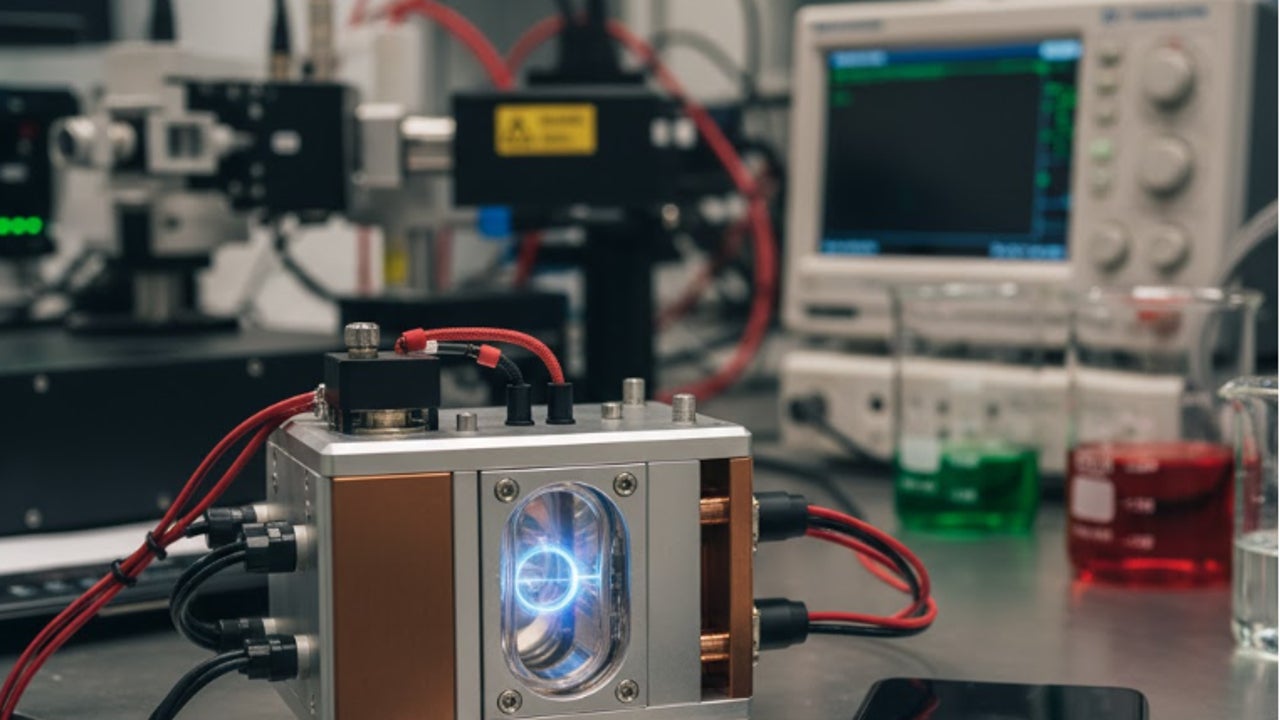
A recent study proposes a revolutionary design: a particle accelerator so compact it could fit on a table, capable of generating very intense X-rays with a totally different architecture than traditional accelerators. This idea, still in the simulation phase, has been published in Physical Review Letters.
Conventional particle accelerators are usually huge. But the new concept uses tiny structures, carbon nanotubes, combined with a polarized laser to create very powerful electric fields and accelerate electrons within them. The key lies in surface plasmonic waves: the laser “spins” inside the nanotube and forces the electrons to spiral, producing coherent X-ray radiation with a very high intensity, up to one hundred times more than conventional accelerators of similar size.
This “pocket” device could transform fields such as medicine, materials science and biology. Currently, intense X-rays are only obtained in giant laboratories (syncrotrons or free electron lasers), which many researchers do not have easy access to.
With a compact accelerator, hospitals or universities could have their own source of powerful x-rayswhich would allow more precise medical images to be obtained without the need for contrast agents, to study proteins and drugs directly in research laboratories, accelerating the development of new treatments and to analyze delicate materials and semiconductor components without damaging them, or even to do non-destructive testing in situ.
For now, the design has been demonstrated only in computer simulations, based on real structures of nanotubes and lasers that already exist in the laboratory. The authors of the study, including Javier Resta-López, from the University of Valencia, have shown that fields of several teravolts per meter can be generated, which is much more powerful than many current accelerators can support. The next step will be to validate this concept experimentally, building real prototypes and demonstrating that it works outside of the simulated environment.
Unlike traditional compact accelerators, this new concept is not intended to compete with giants such as the Large Hadron Collider (LHC), whose 27 kilometers in circumference place it in another league. His cThe logical comparison is in modern synchrotrons, the machines that today generate the electron beams used in physics, chemistry, medicine and materials science.. And those synchrotrons are enormous: the French ESRF measures 844 meters in perimeter, the British Diamond Light Source 561 meters, the American APS exceeds 1,100 meters and the Japanese SPring-8 colossus reaches 1,436 meters. They are facilities the size of two, three or even four full football fields. Faced with this deployment, an accelerator capable of offering comparable performance on a “desktop” scale would represent a true scientific and technological revolution.
If this accelerator manages to materialize, it could democratize access to sophisticated X-ray sources, until now restricted to large centers. This would not only accelerate scientific research, but could bring cutting-edge technologies closer to smaller laboratories, hospitals and universities. The big dream: bringing frontier physics tools to many more people.
In short, this “desktop accelerator” represents a bold and transformative idea: The same physics that powers giant colliders could, in the future, fit on a chip.