
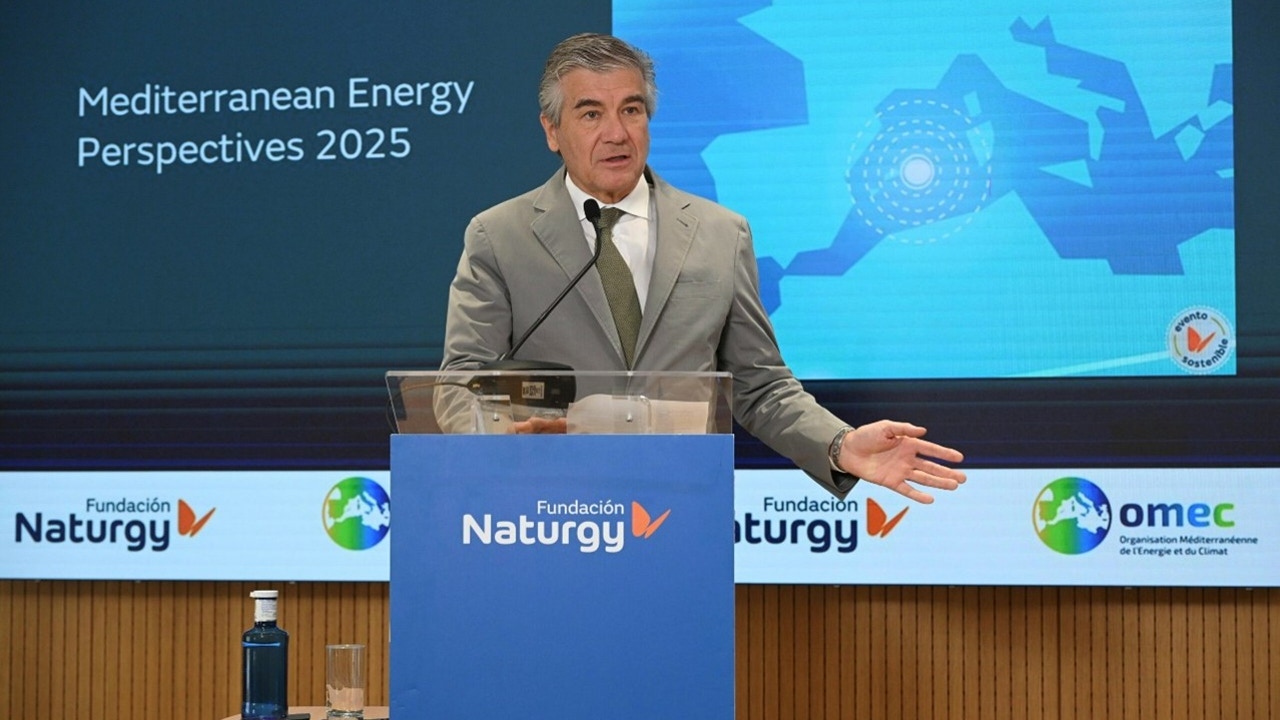
The report ‘Mediterranean Energy Perspectives 2025’ – elaborated by the Organization Méditerranéenne de l’Enorie et du Climat (OMEC) and presented by the Naturgy Foundation – concludes that the Mediterranean is facing an energy and climate challenge marked by a strong dependence on fossil fuels, the high geopolitical vulnerability and the growing climatic risks.
Faced with this situation, the document raises two possible alternatives to achieve climate neutrality in 2050. The first option, raises an extension of current trends with a reduction of relative emissions and a persistent dependence on fossil fuels; and, the second, achieve climate neutrality thanks to the impulse of energy efficiency, electrification and massive deployment of renewables.
According to this report, in order to carry out the transition to a neutral mediterranean energy system in carbon, investment levels that should reach 6.8 billion euros until 2050 will be required. In spite of the high investment figures, Omec experts consider that the cost of inaction could be much higher.
In addition, the report includes that electricity would cover 59 % of the final energy consumption, compared to current 22 %, and renewables would reach 79 % of the electricity generation, thereby reducing emissions by 90 % compared to those of 1990.
The document also values the role of gas in this transition, since renewable gases and hydrogen would be viable options to reduce net fuel fuel imports by 40 % by 2030 and would turn the region into a net exporter for the 2040s.
The presentation of the report had with the participation of Naturgy’s executive president, Francisco Reynés, who after highlighting the growing role that the energy in social and economic development occupies, stressed that the conclusions of the study come to remind us that “the energy opportunity offered by the Mediterranean goes through cooperation, first so that it does not become a bottleneck and second neck, so that the different industries can access the resources they need”.
In addition, Reynés put the focus on investment, highlighting the key role that the European Union has as guarantor of a framework that allows energy companies to move forward. He also pointed out “the urgency of investing in transport, transmission, distribution and raw materials to have a diversified energy mix and meet the marked objectives.” “We must have hope, but, above all, determination to realize the decarbonization with affordable prices,” concluded the executive president of the Energy.
Strategic compass
On the part of the OMEC, its general director, Houda Ben Jannet, referred to the integral vision that this organization has of the energy panorama in the Mediterranean region. “This report is not only a perspective, but a strategic compass to help the region realign their priorities and act with determination. The Mediterranean has the resources and experience necessary to build a safer, competitive and sustainable energy system.”
“The transition will be complex and demanding, but the address is clear, so this report is a call to increase ambition, deepen cooperation and accelerate investment throughout the region,” said the general director.
For his part, the vice president of the Strategy, Governance and Cooperation Committee of the OMEC, Marco Piredda, pointed out that the new edition of the ‘Mediterranean Energy Perspectives 2025’ report is presented “at a crucial situation for the Mediterranean, which experiences deep changes in energy, connectivity and political and environmental pressures in constant evolution”.
For Piedda, “this situation requires acting without delay, the transformative progress depends on the adoption of practical solutions and the achievement of a real balance. Guaranteeing energy security, together with the construction of solid social and economic bases, it should be the engine of the transition that is coming,” he concluded.
The role of Europe in the Mediterranean
The acting general director for the Middle East, North Africa and the Gulf of the European Commission, Stefano Sannino, valued “the vast renewable potential of the Mediterranean to become a pillar of the shared green transition”. And he gave as an example, the trans-mediterranean initiative Energy and Clean Tech Cooperation (T-MED), which comes to demonstrate that the European Union is making decisions in this direction, “linking investment, reforms and industrial cooperation to build a resilient and fair Mediterranean Energy Energy space.”
For his part, Paula Ceballos, representative of the European Commission in Spain, highlighted the role played by certain raw materials in the production of clean energy, “in the south of the European Union we have sun and wind, but we do not have all the necessary elements to produce clean energy, which makes us dependent on other countries.” The shortage of these raw materials such as lithium, cobalt, copper, among many others and the forecast of their high demand, will be a problem if measures are not taken. Therefore, in his opinion, it is important that, on the one hand, “the European Union has approved legislation to process these materials in Europe” and, on the other, that there is “international collaboration to diversify the supply chain and implement strategic projects between the two shores of the Mediterranean.”
Finally, for the president of Fundación Naturgy, Rafael Villaseca, this report “offers an integral vision of the energy scene until 2050, drawing an ambitious roadmap that drives innovation and the use of our common resources” and values the importance “in a context of great complexity and growing challenges”, to offer the energy sector data, reports and analysis that serve as a basis for decision making. ”