
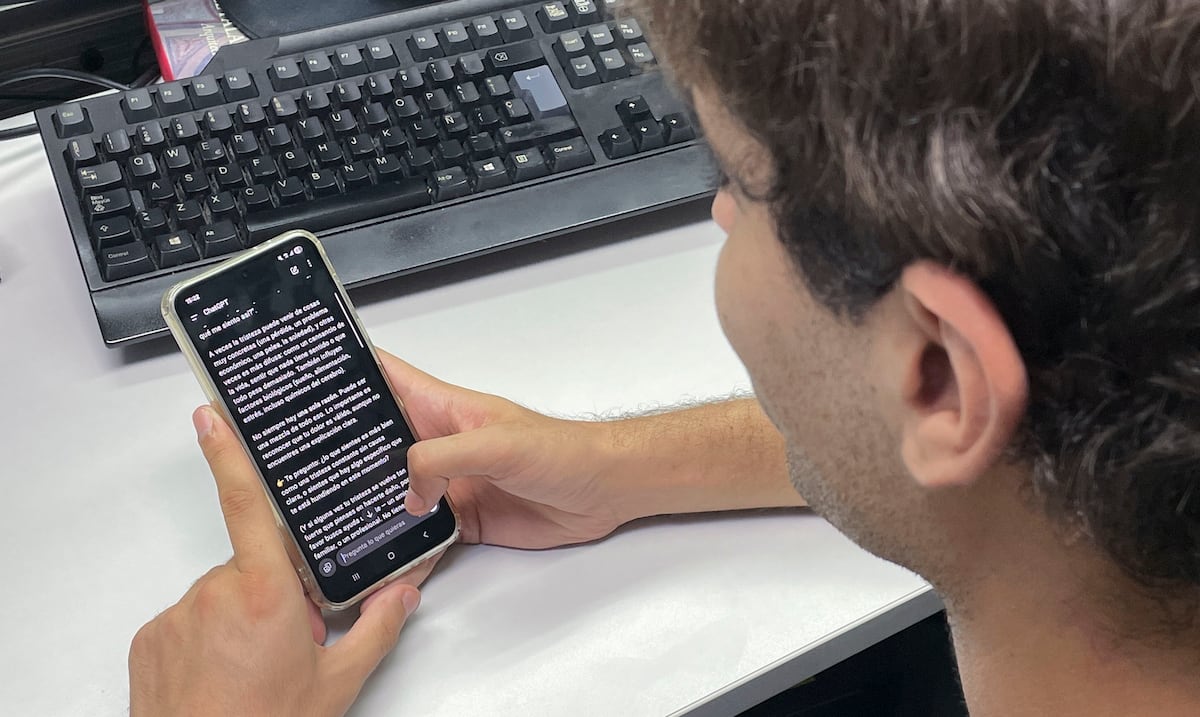
Taipéi – Pei-Chen (fictional name) is unable to relate to anyone. Immersed in a depression, her partner has just left her, her family lives in another city and her work does not provide enough income. Blocked and lost, begins to share your day to day with Chatgpt and there you find the comfort that I needed so much.
“I have created a character and I have trained it to make it an emotional support, using a lot of psychological techniques: behavior therapy, cognitive-behavioral therapy, brief therapy focused on solutions … It has offered me a lot of help, it is really amazing,” he says.
Pei-Chen is among young people, both from Taiwan and other Asian countries, which resort to artificial intelligence (AI) tools to address their mental health problems, taking advantage of the latest technological advances to deal with their daily suffering.
These new applications are especially helpful in cultures such as the Taiwanese, where the population is usually more evasive when sharing their emotions with strangers, says Yi-Fang Chiu, president of the Taiwanese association of multicultural accompaniment (TMCA).
“Western therapy often emphasizes verbal catharsis, emotional expressiveness or individual agency, but these concepts are very foreign for some Taiwanese. Taiwanese are more emotionally, indirect, are more reluctant to talk about their needs or their true feelings, ”he explains.
A support available 24 hours
Although there are still no official data on how many young people resort to AI to manage their psychological discomfort, some international analysis, such as a recent study published by Harvard Business Review, suggest that mental health is among the main motivations to use “chatbots” today.
Chiu subscribes this thesis by verifying that more and more people use chatgpt or other language models “to regulate their emotions”, a trend that, he says, will only accentuate in the coming years.
“Why are there more and more customers using this? Because it is efficient, is 24 hours a day, seven days a week; it gives immediate answers, sometimes in just one or two seconds, and in therapy you have to program an appointment, wait until that appointment and then you have 50 or 60 minutes to process everything,” he says.
For Jen-Ho Chang, of the Institute of Ethnology of the Synica Academy of Taiwan, the “unlimited” memory, personalization and accessibility make artificial intelligence software an interesting counterpoint to humans, and even more so on a “digital island” like Taiwan, “familiar” with AI devices.
This technological development contrasts with an alarming social landscape: The proportion of deaths from suicide between people from 12 to 17 years in Taiwan has gone from 12.5 to 18.4 % in the last five yearsbecoming the second cause of death in adolescents, according to the Alliance for Taiwan’s Infant Welfare.
Will IA replace psychologists?
The AI may seem smarter, will be available all the time and will do everything that is ordered; However, there is something that has not yet been able to replicate: the warmth of human interaction, the immediate relief of seeing us sustained by another person, of knowing that we are not alone, that there is someone who listens to us.
“The ‘heart’ of therapy is basically healing and connecting, and in some cultures being accompanied is already something transformative in itself,” says Chiu, who warns of the risks inherent to seek help only in the “chatbots”, a “safe listener” that sometimes “simplifies things excessively.”
“Users dependent or AI addicts can delay the work of relational depth, when, in some cases, that is what they really need (…). AI can offer rapid cognitive solutions, but without true integration,” he says.
While many people openly express their emotions, AI can also sometimes become a double -edged sword: much of the therapeutic process implies not only venting, but also questioning and transforming the perceptions of reality, an exercise that the ‘chatbots’ still cannot do.
In fact, Jen-Ho Chang believes that for “really serious” problems, such as schizophrenia, AI “will not detect illusion or deception, and human is required for diagnosis.”
“AI can attend in some therapeutic processes, although not replace the entire therapeutic process,” emphasizes the researcher, who bets instead of “combining” traditional artificial intelligence therapy to achieve more comprehensive results.
Meanwhile, for people like Pei-Chen, Chatgpt has already become a silent and faithful confidant; An algorithm without body, emotions or its own critical thinking, but whose company is enough to soften, at least in part, the edges of pain.