

In December 2024, after a week of negotiations, the representatives of the 177 countries that met in Busan (South Korea), were leaving home without having closed a binding agreement – first – to end plastic pollution in 2040. Before leaving the meeting and with a very open text they set a new appointment for this year. The Intergovernmental Negotiation Committee, INC-5.2, will meet again next August for the second part of its fifth session trusting that this time the agreement will be possible (perhaps for this reason, the UN has decided to dedicate the World Environment Day of this year to plastic).
The starting point is not easy. Plastic pollution is one of the great environmental problems, and health, of the 21st century. If we continue on the current path, the world can reach generate up to 2050 a mountain of 3.5 km high garbage capable of burying the island of Manhattanaccording to the World Economic Forum in a very visual way. The key issue is: what to do to end the problem? The answer divides countries into two: those who want and ask to limit plastic production and those who want to bet only to improve residue management. Carmen Morales, professor at the Marine Research Institute at the University of Cádiz was there and is part of a group of scientists who ask that a top to be put to production. «There are two poles. The most ambitious countries, among which are Spain, the EU, Canada or Mexico, seek to take into account the complete life cycle of the material, since the raw material begins to produce until it becomes residue. What we believe is that we have to look for measures for the principle of the chain, which implies reducing production. And despite all prohibitions of single -use products, for example, manufacturing continues to grow. The current waste management levels do not reach the same ratios, so we believe that the improvements in this management are important, but they are only a piece of the entire chain. It is important to reduce production and, for this, it would also be interesting to apply the principle of essentiality. That is, to see what plastics we can do without and which we really need because they provide key solutions, as in medicine. But for some uses there is a plastic overproduction, ”details the researcher at the University of Cádiz. That same group asks «that the chemicals associated with plastics are limited. We know that there are 16,000 chemical substances within the plastic material and that many of them can be harmful. In some cases, we do not even know if they are, and in a majority of cases we do not know what the materials include transparent listings. For all this, the precautionary principle should be applied, ”he says.
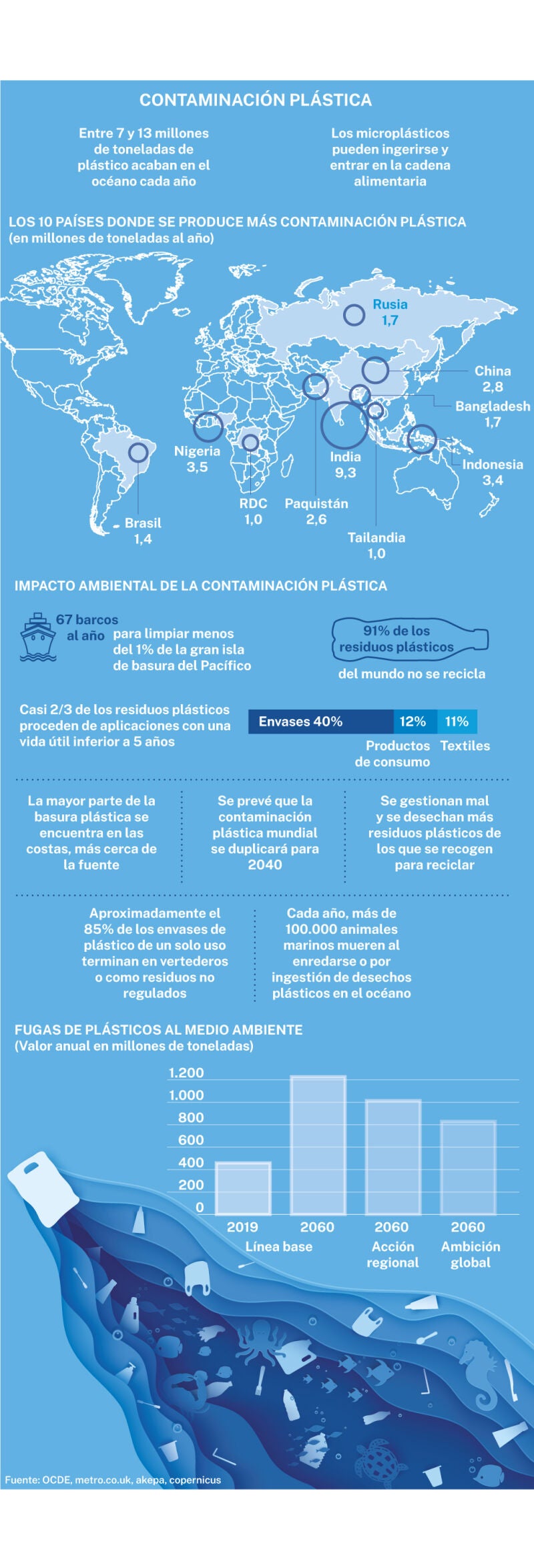
According to data from the Organization for Cooperation and Economic Development, it points out, Between 2000 and 2019, the world production of plastics doubled until reaching 460 million tons per year and the University of Berkeley states that only limiting the production of non -essential plastics would descend 26% plastic pollution. Should we make a list of what is expendable and not? For Luis Cediel, general director of the Spanish Association of Plastics Industries (Anaip), sometimes «when we talk about plastic we forget what this material contributes. Thanks to him, the weight of airplanes and cars has been reduced and with it, his need for fuel and emissions has descended … even renewable energies depend on this material. The plastic looks as negative, when the problem it has appears, basically, when it becomes an abandoned waste, ”he says.
Recycling
The other large group of treaty countries bet on improving the management of plastic waste. And is that Recycling rates remain very low worldwide, less than 10%. Of all the plastics that end in the trash, 34% end up incinerated (the incineration percentage is increased, according to a recent study published in Communications Earth and Environment) and 40% on average ends up in landfill or directly in the natural environment, exposed to fragmentation and turned into soil, rivers and ocean pollutants. «A couple of years ago we published a job in which the most common plastic waste was detailed in the ocean and it was seen that they are plastic containers, food containers, bottles … Only they represent almost 50% of all the garbage we find in aquatic ecosystems. If the management really went to those objects, we could greatly reduce what appears in our environment. It is interesting to see what are the most prevalent objects as waste and study if they have alternatives that can replace them. But they have to be sustainable alternatives so that another problem is generated. There are times that biodegradable solutions are presented or that are sold as ecological that are not so. Plastic recycling is only a partial and limited solution. First because the mixtures of existing polymers in many products make them difficult to manage. The collection of waste has to be very selective and, yet, we are not prepared in any country for a similar collection. Remember that there are studies and modeling to see what would be achieved by reducing production and improving waste management, because let’s not forget that we continue with very low recycling rates, below 10%. What we believe is that we have to limit production and see what we do with what is used and the millions of tons of waste that we generate. And this also implies that we cannot continue making consumption as until now. For example, clothing is not something that people associate with plastic and yet 70% of current tissues are made of polymers, ”says Ethel Eljarrat, director of the Institute of Environmental Diagnosis and Water Studies (Idaea-CSIC).
Use recycled material
The OECD points to the development of recycled plastic markets as another option to reduce the problem and says: “Although the world production of secondary plastics from recycling has more than quadruplicate in the last two decades, they continue to represent only 6% of the total raw material with which it is manufactured.”
In Europe the rate is a little above, but only slightly. In 2023, 7.1 million tons of recycled plastic were consumed in the old continent, which represents 14% of the total. The European Commission has set goals to increase this figure, which implies, for example, that in 2025 10 million tons of recycled plastics are consumed, but, Luis Cediel alerts, you have to be careful with the normative excess. «Especially for producers or small companies, which still call us with doubts, after years of new regulations. There are also resolutions that have been taken against the European recycling sector. This is the case of the tax that taxes the use of non -reusable plastic that only third -party imports is increased (since it appeared in 2022 they have grown by more than one billion). If local producers have to pay for the virgin raw material (0.45 euros per kilo) and it turns out that the sale price of our products is between 1.5 and 2 euros kilo, it is easy for 0.45 to seem a barbarity. In addition, the incentive to use recycled material is causing that between product with 80-90 and up to 100% recycling, but we know that it is technically impossible. Many products cannot be manufactured with recycled rates. Border fraud is increased, ”he says.
Microplastics
The OECD says that 12% of what ends up contaminating the natural environment are microplastics. They have been found in seawater, in the placenta of pregnant women, in Everest and in many organisms of the trophic chain. They come from the abrasion of the tires, the wear of the brakes or the textile washing or the pellets that are transported. «People do not have too internalized that we have plastic pollution everywhere. There are studies that say that the waste that may be in the terrestrial ecosystem are of the order of 5 times higher than those in a marine environment. Now in the office I am breathing microplastics. Also about these plastics will be discussed and, above all, we want to emphasize the transport of the virgin raw material to avoid the thousands of pellet losses that occurs every year, as we saw with the touched ship on the Portuguese and Galician coasts, ”concludes Eljarrat.
Additives present in food
A recent study of Idaea CSIC has discovered the presence of plastic -related additives in more than 85% of basic food products of the Mediterranean diet (from fish and meats to oils or children’s foods). The study has revealed that eight out of ten foods have at least one plasticizer (Of about 20 totals, the most frequent phthalates being.
The daily average intake is 288 nanograms per kg of body weight in adults and 1155 nanograms per kilo in children from 1 to 3 years and, although the average intake values are lower than the recommendations, “it must be taken into account that the feed is only one of the exposure roads to these toxic.”