
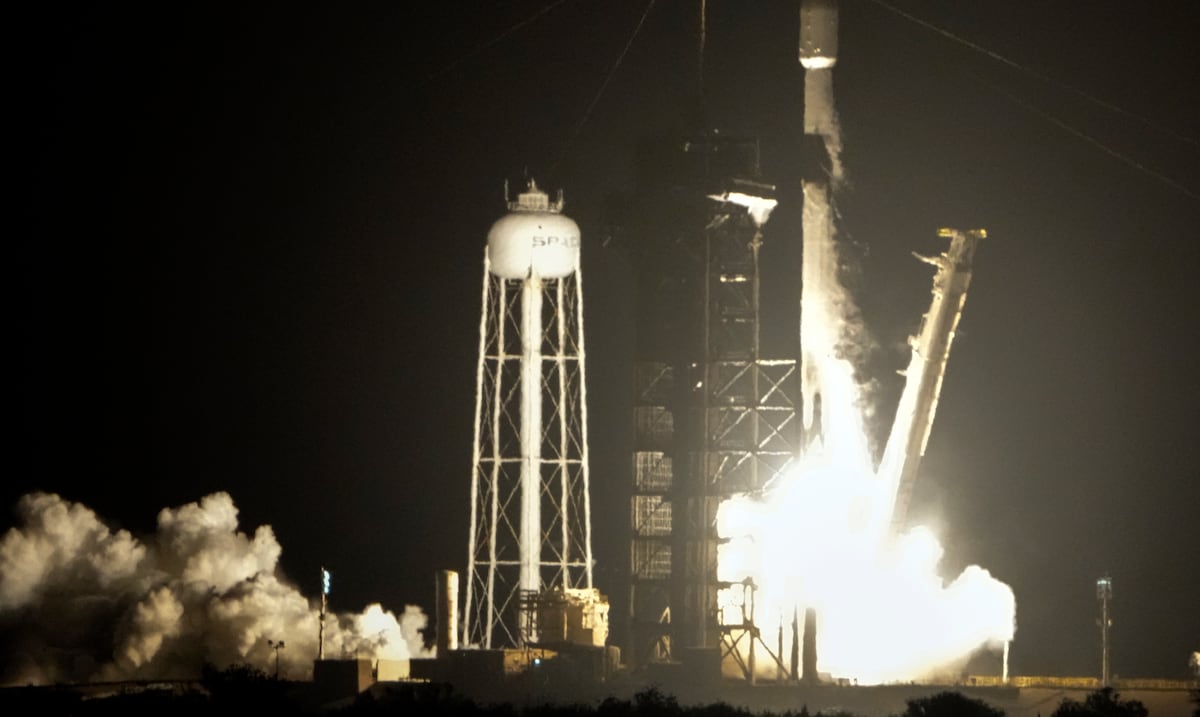
Cape Canaveral, Florida – In a double shipment, SpaceX on Wednesday launched two lunar landers for companies in the United States and Japan seeking to boost business on Earth’s dusty moon.
The two modules took off in the middle of the night from NASA’s Kennedy Space Center, joining other private spacecraft bound for the Moon. They carpooled to save money, although they split up an hour into the flight exactly as planned and took separate indirect routes for the months-long trip.
It is the second attempt for Tokyo-based company ispace, whose first module crashed on the Moon two years ago. This time, it is carrying a vehicle with a shovel to collect lunar soil for study and plans to test possible sources of food and water for future explorers.
Texas-based lunar rookie Firefly Aerospace leads 10 experiments for NASAincluding a vacuum cleaner to collect dirt, a drill to measure subsurface temperature, and a device that could be used by future moonwalkers to keep sharp, abrasive particles out of their spacesuits and equipment.
Firefly’s Blue Ghost—named for a species of fireflies in the southeastern United States—should reach the Moon first. The lunar landing module, which measures 2 meters high, will attempt descent in early March on Mare Crisium, a volcanic plain in northern latitudes.
The ispace module, called Resilience and slightly larger, will take four to five months to arrive, aiming for a late May or early June landing at Mare Frigoris, even further north on the near side of the Moon.
“We don’t think this is a race. “Some people say ‘race to the moon,’ but it’s not about speed,” ispace CEO and founder Takeshi Hakamada said this week from Cape Canaveral.
Both Hakamada and Firefly CEO Jason Kim acknowledge the challenges that still lie ahead, given the debris littering the lunar landscape. Only five countries have managed to place spacecraft on the Moon since the 1960s: the former Soviet Union, the United States, China, India and Japan.
“We’ve done everything we can in the design and engineering,” Kim said. Still, he pinned an Irish shamrock to the lapel of his jacket Tuesday night for good luck.
The United States remains the only one to have taken astronauts to the satellite. NASA’s Artemis program, a successor to Apollo, aims to return astronauts to the Moon by the end of this decade.
Before that can happen, “we’re sending a lot of science and a lot of technology ahead of time to prepare for that,” NASA science mission chief Nicky Fox said on the eve of the launch.
If they make their respective landings, both spacecraft will operate for two weeks in constant daylight, shutting down once darkness arrives.
Once lowered to the lunar surface, ispace’s 5-kilogram rover will remain close to the module, moving in circles of up to hundreds of meters at a speed of less than a centimeter per second. The rover has its own special delivery to leave in the lunar dust: a toy-sized red house designed by a Swedish artist.
NASA pays $101 million to Firefly for the mission and another $44 million for the experiments. Hakamada declined to reveal the cost of the restarted ispace mission with six experiments, saying it is less than the first mission, which exceeded $100 million.
NASA’s second lunar launch by Houston-based Intuitive Machines is scheduled for late February. Last year, the company achieved the first American lunar landing in more than half a century, which landed on its side near the South Pole but still managed to operate.