

The arms race between Soviet Union and USA During the almost half century that lasted Cold war It gave rise to numerous advances in military technology, but not all with the same fortune. Among the latter, the history of the K-278 Komsomoletsa name that could be translated as ‘Young Communist’a supersubmarine prototype developed by the Soviet Union in the 1980s that broke the depth record, passed all its tests and sank with nuclear weapons on board on her first operational mission in 1989two years before the end of the Soviet Union, causing the death of 42 of the 69 crew members.
During the Cold War, Soviet submarines They were faster than their American counterpartsthey could resist more damage thanks to their double-structured hulls and submerge at greater depthreaching 500 meters in some cases. They also had disadvantages, such as a higher accident rate due to poor radiation protection and a very weak safety culture, and being much louder. This gave American submarines a significant advantage by being able to routinely detect and track them without being discovered.
The K-278, classified by NATO as a class submarine Mikerepresented a significant advance in underwater warfare technology when it was introduced in the mid-1980s. It was a prototype to test future capabilities of Soviet submarines, designed to operate at unprecedented depths —set the record for the deepest dive for a military submarine in 1984, descending to more than 1,000 meters— and was built with double hull; the interior with alloy 48T titaniuman extremely expensive metal that is as strong as steel but considerably lighter.
The 685 Project
Its story begins in 1966when a team in the Rubin Design Officeunder the direction of NA Klimov and the main designer YN Kormilitsinreceives the order to start the Project 685a submarine capable of diving to great depths. The development lasted for 8 years, in part due to the difficulties in working the metal capable of withstanding the pressure given to the immersion that was sought to be achieved. In 1974 the double hull design was completed and 48T titanium alloy was chosen for the inner hull.
The shipyard Sevmash Construction began on April 22, 1978 and the ship was officially completed on May 30, 1983. The difficulty of manufacturing titanium contributed to the unusually long construction period. The process of welding the large sheets of this alloy for the inner hull was also very expensivesince it had to be done in facilities with an oxygen-free atmosphere, flooded with argon gas, while the workers wore suits similar to those of an astronaut to be able to breathe.
This was the invulnerable Soviet supersubmarine K-278
The K-278 had 110 meters long and 12 meters widewith the inner hull of approximately 7.3 meters wide. Its displacement, submerged, was 6,500 tons and, thanks to the use of titanium instead of steel, it could be considered, relatively speaking, lightweight. The double hull gave it its ability to reach great depths. The titanium inner hull was divided into 7 compartments, 2 of which were reinforced to create a safe area for the crew, and An escape capsule was incorporated to allow the crew to exit with the submerged submarine.
The submarine was powered by a 190 megawatt OK-650B-3 pressurized water nuclear reactorwhich powered two steam turbines 45,000 horsepower each one, which allowed it to reach a speed of 30 knots (55.56 km/h) submerged and 14 knots (25.93 km/h) on surface.
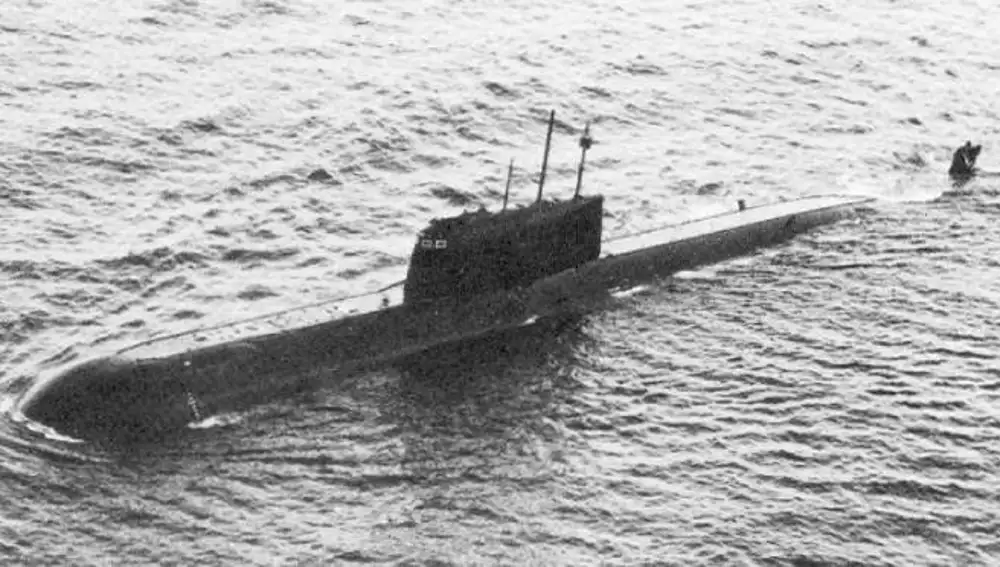
As for sonar systems, it had the MGK-500 ‘Skat’ (Shark Gill, according to NATO nomenclature), a low-frequency active/passive system that is the same one currently used on class submarines Yasen. This system was integrated into the combat information control system Bus-685. The armament consisted of 6 torpedo tubes of 533 millimeterswith capacity for 22 Type 53 torpedoes and Shkval anti-submarine torpedoespowered by rockets, which reached 200 knots (370.4 km/h), as well as missiles RPK-2 Vyuga designed to deploy anti-submarine nuclear depth charges.
The Komsomolets was thrown out in June 1983 and spent the next five years conducting tests. In 1984under the command of Captain Yuri Zelenskiyreached a depth of 1,020 meters in the Norwegian Sea, the deepest dive ever made by an armed military submarine; only a few scientific research submarines have descended lower.
In comparison, class submarines Los Angeles and Virginiacurrently in service with the US Navy, reach a depth of 240 meterswhile its 3 class submarines seawolf They reach 600 m.
The Soviet Navy considered that The K-278 was invulnerable at depths greater than 1,000 meterssince it was difficult to detect at that level of immersion and enemy torpedoes could not reach it. Although originally intended to serve only as a test ship, it was eventually became a fully operational combat submarine in 1988. Was sent to its first operational mission in April 1989under the command of Captain Evgeny Vanin.
The K-278 accident
He April 7, 1989while sailing at a depth of 386 meters In the Norwegian Sea, K-278 began to have problems. On board was the second crew of the submarine, newly trained to handle it and, due to its original status as a prototype for testing, lacking specialized damage control equipment.

It occurred a fire in the seventh aft chamber and the flames burned an air supply valve, allowing pressurized air to stoke the fire. Attempts to put out the fire failed, the reactor was stopped and the ballast tanks were emptied so the submarine could surface. Once afloat, the fire continued to spread and the crew fought the blaze for six hours before the order was given to abandon ship.. The fire was so intense that crew members on deck saw the anechoic rubber coating tiles on the outer hull peel off due to the heat.
The rescue capsule that killed its crew
Captain Vanin, along with four other crew members, He re-entered the submarine to look for companions who had not heard the evacuation order.. But they could not advance too much due to the inclination of 80 degrees from the bow down, so that They entered the rescue capsule of K-278. After several attempts, the capsule was freed from the submarine, but once on the surface The sudden change in pressure caused the upper hatch to be ejected and two crew members died.. The capsule, with the captain and another member of the rescue team unconscious, sank beneath the waves. Only one crew member managed to swim and survive.
Until then, only four men had died in the incident, but after the sinking of the submarine many more succumbed to hypothermia caused by the frigid water temperature of around 2°C. An hour later the fishing boats arrived Alexi Khlobystov and Omawho rescued the survivors, some of whom later died from their injuries. Of the 69 crew members aboard the submarine when the disaster occurred, 42 died.
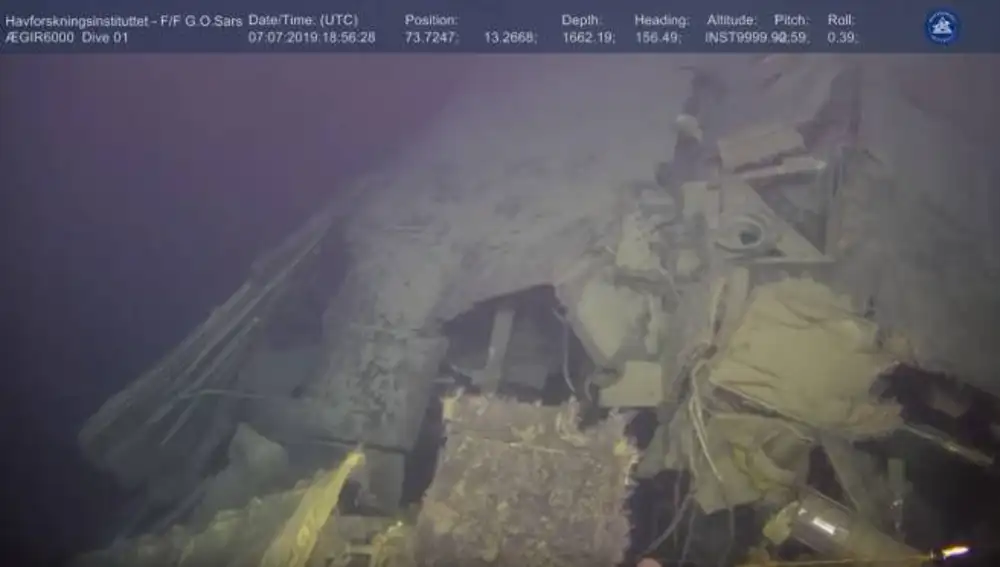
The K-278 has since lain at the bottom of the Norwegian Sea, with 2 nuclear missiles on board, 1,680 meters from the surface. For years, successive Scandinavian governments periodically inspected the cracked hull for contamination. In 1994, signs of plutonium leaks were found. Cracks and leaks were sealed and only minimal additional contamination has been detected in subsequent inspections..