
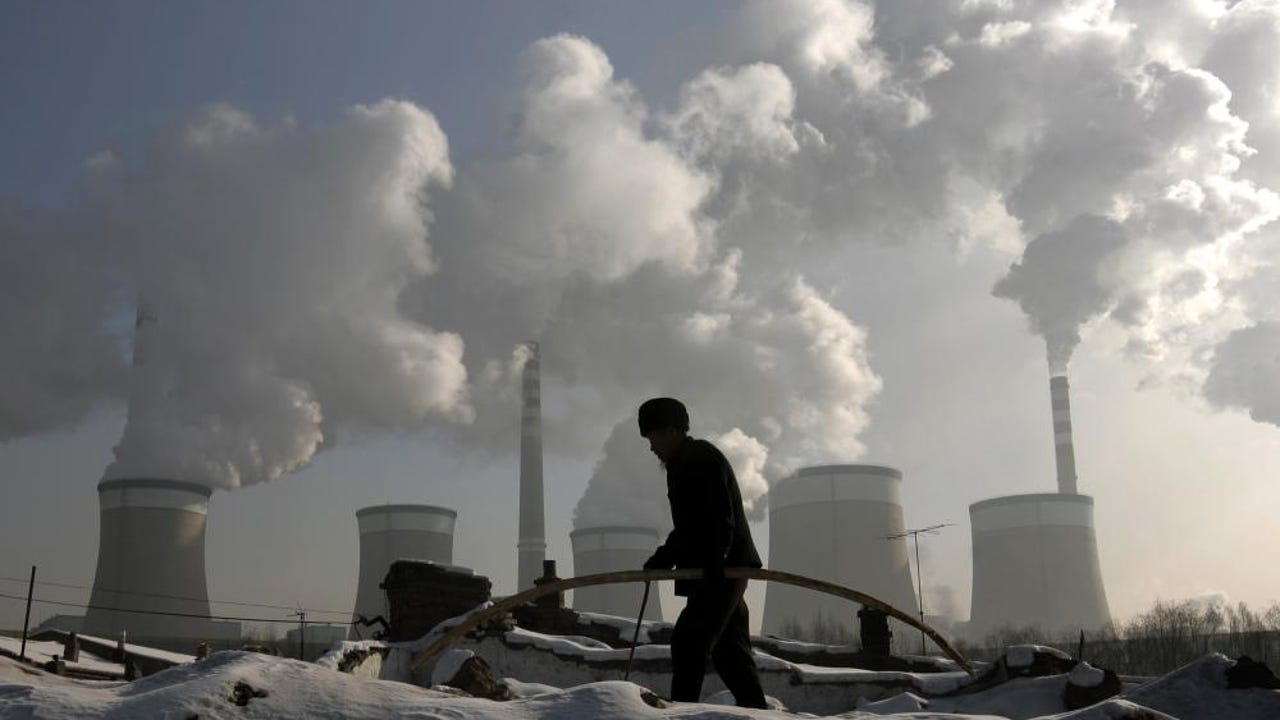
The world burns more coal than ever and not to heat itself, but to charge the batteries of cell phones and tablets, to power global data centers, the supercomputers that control social networks and, of course, so that electric cars “refuel”. In supposedly increasingly “green” economies, in which paper is not spent and everything is apparently innocuous and without smoke in sight, the horizon turns into an immense black cloud, with soot covering everything, behind the scenes.
However, the record of coal demand is not global, it is concentrated in Asia and not in all of it: China is responsible, followed at a long distance by India. Because coal consumption is not only declining in Europe and the United States, but also in Japan, South Korea and Australia.
The big numbers don’t lie: the planet devoured 8.70 billion tons of coal in 2023, 2.6% more than the previous year. 80% of consumption came from Asia.
China, the largest producer, importer and consumer of coal, increased its demand for black mineral for electrical generation by 8% and non-electrical generation by 2.5%. The coal boom coincides with a 7% rise in electricity demand and the expansion of Chinese plug-in cars across Europe. Beijing has launched with unusual vigor into developing these vehicles with the help of the regime, something that has generated bitter tariff disputes with Brussels, while it reloaded them by burning more and more coal.
Thus, global decarbonization falls on the extreme that, curiously, drives the electric car the most. The International Energy Agency admits in its latest report on the coal sector that, despite the development of wind and solar in China, a good part of the growth in energy demand in China is covered by coal generation “due to the low availability of hydroelectric plants.
What does China do if demand rises and its renewables don’t work? Burn coal in abundance, 276 million more tons, until reaching the record of 4,883 million tons in 2023, more than half of the entire world.
Third reserves in the world
And China is gobbling up more and more mineral because it draws more and more voraciously on its own reserves, one of the largest in the world, every day. And the quality of Chinese coal is lower and it generates less energy, which makes a greater volume consumed necessary.
To get an idea of the situation, just look at India, the second “culprit” that the world is very far from achieving that desired decarbonization.
There, the demand for coal to generate electricity has grown by 10% in a year and renewable backup is very far from being able to cover the electricity demand. As a consequence, coal consumption – also supported by the growth in demand for cement and steel – has grown by 9% to 1,252 million tons annually. Still, it is a quarter of what China consumes.
While, Coal use in Europe plummeted by 23% and 17% in the United Statesand the decline is expected to continue. The IEA believes that China and India will continue to increase global consumption by at least 1% above the 2023 record during the first part of 2024, up to 4,308 million tons, especially due to the increase in electricity generation, which will grow by 1.4%. For 2024 as a whole, the IEA report expects an increase of 0.4%, to 8,737 million tons.
And the demand for coal to generate electricity will grow in China by 0.9% in 2024 despite photovoltaic development and greater hydraulic availability. This is the lowest growth since 2015, but it continues to advance and could do even more due to the greater demand for iron and steel.
India will continue with double-digit increases in electric coal consumption (10%) and general demand for the year will grow by 6% to 1,330 million tons, although Vietnam will take the cake, which will burn 12% more.
The arrival of donald trump The White House expects a rebound in coal consumption in the United States or, at least, a less pronounced fall. By contrast, demand in the EU is expected to plunge another 19%, to 287 million tonnes, the first time on record that Europe burns less than 300 million tonnes of coal annually.
The largest producer
The fervor with which China has approached electrification has a lot to do with coal. The Asian giant has the third largest reserves in the world, with 14%, tied with Australia and only surpassed by the United States (22%, the majority in Montana and Illinois) and Russia (15%). In fact, China is the world’s largest producer.
Together with India and Indonesia, they hold 72% of the global market, but it is Beijing that controls it. Because between imports and growing own production – especially in the Shanxi region, where 1.3 billion tons come from – China hoarded more than 5 billion tons for the 1,000 million produced by India or the 775 million tons of Indonesia. Although China’s own coal production is expected to fall by some 38 million tons, to 4,572 million, imports from the rest of Asia will meet the scarce needs for foreign coal.
With this data, it is clear that China has a lot of its own coal to burn and, as it electrifies its economy, the mineral becomes more relevant as a backup fuel.
Meanwhile, China manages disengage from its acute dependence on oilof which it is the largest global importer as it barely has reserves. It produces just over 4 million barrels of crude oil each day for the 15.3 million barrels per day processed, according to JPMorgan data, which even suggests that China would be accumulating oil, since it imports more than it processes, well a cooling of its production or the need to hoard due to Trump’s return.
Tesla and Volkswagen against Chinese brands
The proof that China is interested in electrification is that its electric vehicle brands dominate sales and that of the around 50 million electric vehicles circulating in the world around 60% of registrations they come from there.
Although Tesla – with a gigafactory in Shanghai that has just surpassed 3 million cars produced – has the best-selling models, the Chinese BYD has more registrations and together with Geely, GAC and SGMW, the Chinese brands take over half of the global sales of electric vehicles.
A growing phenomenon, because in the gigantic Chinese market there are already 150 electric models competing, 97 of them 100% local.