
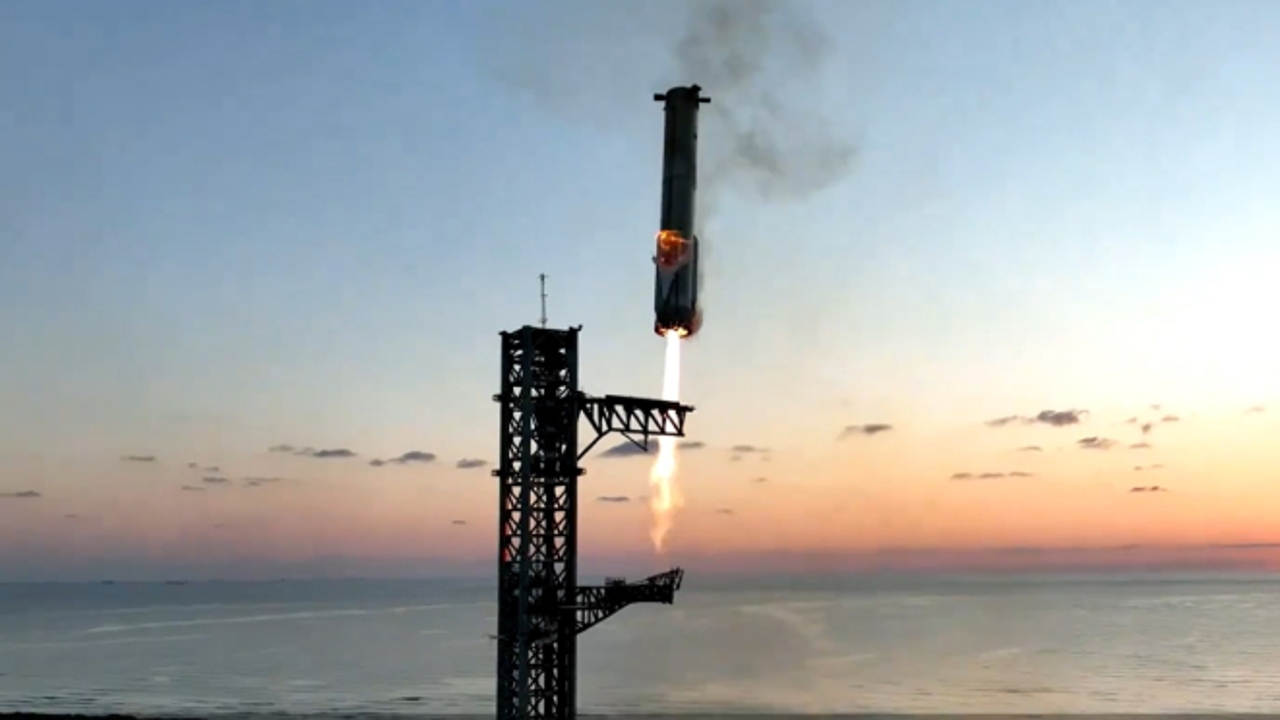
SpaceX yesterday managed to make an engineering prodigy a reality and marked a new milestone in the space race. On its fifth test flight, the gigantic rocket 121 meters high Starship managed to meet its objectives. The second stage, Starshipagain made a controlled landing in the Indian Ocean. The first stage, the propellant Super Heavy 71 meters, for the first time landed at the launch site and was caught in the air by the tower’s mechanical arms from the launch pad, a mechanism known as Mechazilla.
The company of Elon Musk He did not have it all with him and, in fact, he had been very cautious about the possibility of carrying out, on this test flight, the maneuver of landing the Super Heavy at Starbase, in the south of Texas. He said he would only try it if everything worked correctly during the flight and the risks were reduced. Finally, 7 minutes after takeoff, Super Heavy landed successfully.
Thousands of distinct vehicle and pad criteria had to be met prior to catching the Super Heavy booster. Thanks to the tireless work of SpaceX engineers, we succeeded with catch on our first attempt. pic.twitter.com/6wa5v6xHI0
— SpaceX (@SpaceX) October 13, 2024
The flight started at 14:25peninsular time. Super Heavy fired its 33 Raptor engines, generating 7,650 tons of thrust and consuming 20 tons of methane and liquid oxygen propellants per second when taking flight. This is twice the power of the rocket Saturn V from NASA, used to send astronauts to the Moon more than 50 years ago.
Following the vertical climb, Starship headed east, flying over the Gulf of Mexico. The 33 Raptors remained on for 2 and a half minutes, accelerating the rocket up to 5,300 km/h. So, Starship split from Super Heavy and ignited its 6 Raptor engines to continue its flight into space.
Although Starship completed its flight without incident, something it had already achieved on the fourth test flight in June, all attention was on Super Heavy. After the separation maneuver, Super Heavy turned on its engines again to reverse its course and return to Starbase. from a height of 96 kilometers. In the last phase of the supersonic descent, the thruster It used 13 of its engines for braking, which it later reduced to 3 to position itself in hover. on the launch pad, at which point Mechazilla caught him about 60 meters above the ground.
‘This is the first capture of a propellant, an important step on the path to rapid reusability,’ he said. Dan HuotSpaceX communications manager, during the test flight broadcast. The first time SpaceX managed to land a reusable booster was with the Falcon 9 in December 2015. But the Falcon 9’s two stages do not exceed the height of Starship’s booster. The Falcon 9 lands on a sea platform or a land landing zone separate from the launch pad, but this has been the first time a system like Mechazilla has been used and with the largest rocket ever built. And it was achieved on the first try. SpaceX has landed Falcon 9 boosters more than 350 timesbut the Super Heavy is 50% taller than the Falcon 9 first stage and almost two and a half times its diameter. It is larger than the fuselage of a Jumbo 747.
Just inspected the Starship booster, which the arms have now placed back in its launch mount. Looks great!
A few outer engine nozzles are warped from heating & some other minor issues, but these are easily addressed.
Starship is designed to achieve reflight of its rocket… pic.twitter.com/oWZoOOfHmk
— Elon Musk (@elonmusk) October 14, 2024
Was everything perfect? No, but it was close. In the final moments of landing it was possible to see flames coming out of one of the sides of the propellerbut that did not prevent the maneuver from being carried out successfully.
Starship, for its part, made a flight of 40 minutes before landing. After slowing to below the speed of sound, the craft transitioned from a horizontal to a vertical orientation and engaged its Raptor engines for the final braking maneuver. The ship made a soft landing and sank into the sea in view of a camera on a nearby buoy. This confirmed that Starship landed exactly where it was supposed to..
For this flight, SpaceX installed Improved heat protection tiles and added a layer of secondary heat shield below them. During the previous test flight in June, the very high temperatures of reentry caused Starship to parts of the heat shield would be lost and the ship’s flaps would be damaged.. This Sunday, it was seen through the ship’s cameras, whose signal was retransmitted through Starlink, minor damage to the flaps, much less significant than on the fourth test flight.
Splashdown confirmed! Congratulations to the entire SpaceX team on an exciting fifth flight test of Starship! pic.twitter.com/FhCGznq9RO
— SpaceX (@SpaceX) October 13, 2024
The buoy video also showed Starship disintegrating seconds after landing, already under water, in a ball of fire. ‘That was incredible,’ said Kate Tice, a SpaceX engineer who hosted the live broadcast of the test flight. ‘We had no intention of recovering any of the ship’s hardware, so that was the best ending we could have hoped for.’
The success of Starship’s fifth test flight has also been met with relief in the POTwhich you hope to use a modified version of the Starship capsule for Artemis III astronauts to land on the Moon. And it brings Elon Musk’s goal of reaching Mars in a few years using reusable rockets.