
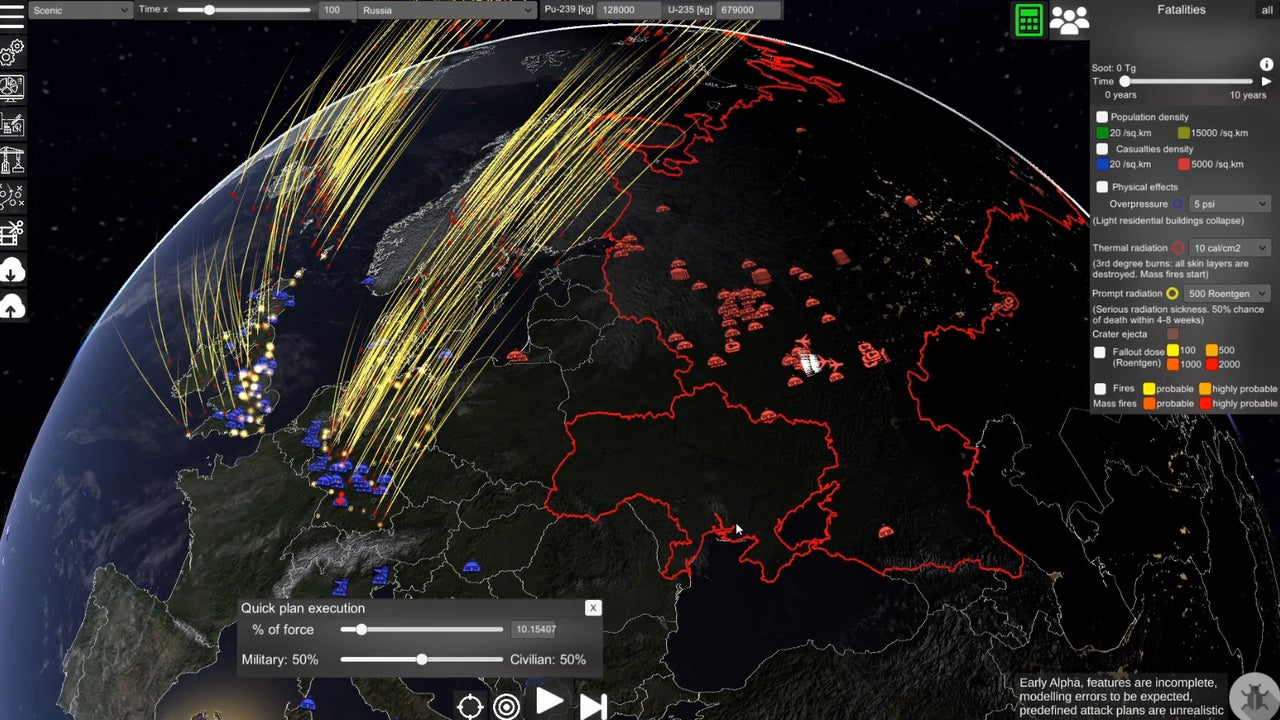
Between November and December 2023, a team of scientists from the Non-Proliferation Policy Education Center decided to conduct a simulation due to the escalation of conflicts in Gaza. The question was simple: what would happen if a nuclear escalation occurred? and the answer was a simulation, known as War Gamesjust like in the famous 1984 movie.
For decades, most security analysts assumed that Israel’s undeclared nuclear weapons were only deployed to deter attacks and that Iran would not dare attack Israel directly. The simulation carried out by the experts discards these assumptions and suggests that military attacks between Israel and Iran, including nuclear ones, are possible.
In total, the simulation included 35 participants including Republican and Democratic congressional staff; US Executive Branch officials and analysts; outstanding academics; experts from national security and Middle East think tanks; and US military personnel.
The game consisted of three moves. After receiving a war briefing and instructions from the Israeli prime minister, teams representing the Israeli Ministry of Defense, the Ministry of Foreign Affairs, and the intelligence community formulated their preferred options for launching nuclear strikes against Iran. The prime minister selected one. The second movement begins after the Israeli army carries out this attack.
In the second move, the teams were reconstituted to represent Israel, friendly Arab nations and the United States and its European allies. Control played with Iran, Russia and China. Each team responded diplomatically and militarily to Israel’s initial nuclear attack on Iran. The third and final move of the game was a “hot wash” in which the participants discussed their ideas.
The game began in 2027 with Israeli intelligence reports indicating that Iran is attaching nuclear warheads to its long-range missiles. This leads Israel to ask Washington to collaborate on a conventional military strike against key Iranian nuclear facilities and missile bases. Not wanting to be drawn into a major war with Iran, the United States is reluctant and instead offers Israel long-range American hypersonic missiles.
Israel uses them to attack Iran’s key nuclear and missile facilities. Almost immediately, Tehran’s proxies (Hezbollah and the Houthi rebels) respond with devastating conventional missile attacks against Israel. These attacks kill at least as many Israelis as during the Hamas raid of October 7, 2023. In response, Israel attempts to prevent further military attacks by launching airstrikes against military strongholds. These attacks kill more than 2,000 people.
Iran responds directly and takes advantage of the fact that Israeli missile defenses are now degraded to attack key Israeli Defense Ministry buildings in Tel Aviv, killing more Israeli civilians. At the same time, Iran announces that it has withdrawn from the Nuclear Non-Proliferation Treaty (NPT), signaling its willingness to use nuclear weapons.
Israeli intelligence then learns that Israel’s previous conventional attacks on Iranian nuclear and missile facilities failed to delay the integration of nuclear warheads into Iran’s missiles. When Israel shares this information with US officials and again asks them to approve a new joint US-Israeli raid, Washington only offers “ongoing assistance” and tells Israel that it must stop attacking Iran so that the fight does not escalate to a nuclear exchange.
Israel feels that it is now isolated and that further Israeli conventional attacks are unlikely to thwart an Iranian nuclear attack, Israel’s prime minister decides that Attacking Iran with nuclear weapons is Israel’s only option. After consulting his war cabinet, he approves a non-lethal demonstration nuclear detonation in a remote location in Iran combined with conventional strikes against major Iranian nuclear facilities and military sites. Israel also launches cyberattacks against Iran’s military communications networks and uses its secret channels to make a private diplomatic appeal to Tehran to desist from further offensive actions against Israel.
However, Israel’s actions fail to break Iran’s will to continue fighting the war. Worse, the United States is now urging Israel to withdraw. Isolated and desperate, Israel concludes it has no choice: launches follow-up “precision” nuclear strike with 50 weapons against 25 targets Iranian military (including Russian manned air defense sites). The goal is to paralyze Iranian offensive forces and perhaps induce enough chaos to cause the collapse of the Iranian revolutionary regime. However, almost immediately after the Israeli attack, Iran launches a nuclear attack of its own against an Israeli air base containing US military personnel.
With this play, The game ends leaving more questions than answers. “Would Israel or Iran launch more nuclear attacks? – the authors question – Would Israel attack Tehran with nuclear weapons? And vice versa, would Iran attack Tel Aviv with nuclear weapons? Would Russia or the United States be drawn into the war?”