
Donald Trump wants to change a word that has been defining one of the greatest technological revolutions in history for seven decades. He no longer wants the US Government to talk about Artificial Intelligence (AI), but rather about Super Intelligence (SI). “When you say artificial intelligence, it is artificial – the president explained in the executive order -. This is extreme intelligence. It is superior intelligence.” And then he added a phrase that allows us to better understand what is behind baptism: “Whoever wins superintelligence, wins.”
It is not just an occurrence uttered in front of the cameras. Trump signed Executive Order 14434, in which he orders federal departments and agencies to use Super Intelligence and the acronym SI instead of AI in their official communications, websites, reports and non-legislative documents. The order, however, contains a small paradox. For now, superintelligence legally means exactly the same as artificial intelligence. The text refers to the definition of AI that already exists in US legislation and establishes that this will be the definition of IS until it is replaced. At the same time, it instructs the presidential advisor for Science and Technology to present a new federal definition of “Super Intelligence” within 60 days.
That is, Trump has changed the name first and wants to change the concept later. His public argument is that the term artificial intelligence has become too small. According to the White House, current systems are no longer limited to imitating or automating certain human capabilities, but rather amplify creativity and allow tasks that previously seemed impossible to be carried out. For this reason, he maintains, the SI better describes the new technological frontier.
But here an important question arises. In scientific and technological parlance, superintelligence does not simply mean better AI. The term is usually reserved for a hypothetical artificial intelligence that greatly exceeds human capabilities in practically all cognitive areas.. A model that writes texts, generates images or analyzes large amounts of data can be extraordinarily capable without being superintelligence. Trump is, therefore, doing more than just updating the vocabulary. It is broadening the meaning of a much more powerful word. And China is at the center of that operation and there is the less public part of Trump’s order.
The president himself made it clear in his statements. “There is no one in third place – he stated when talking about the technological race -. Everything is between us and China.” He also rejected the idea of jointly developing this technology with Beijing. because, as he explained, the United States would end up sharing knowledge that it considers strategic.
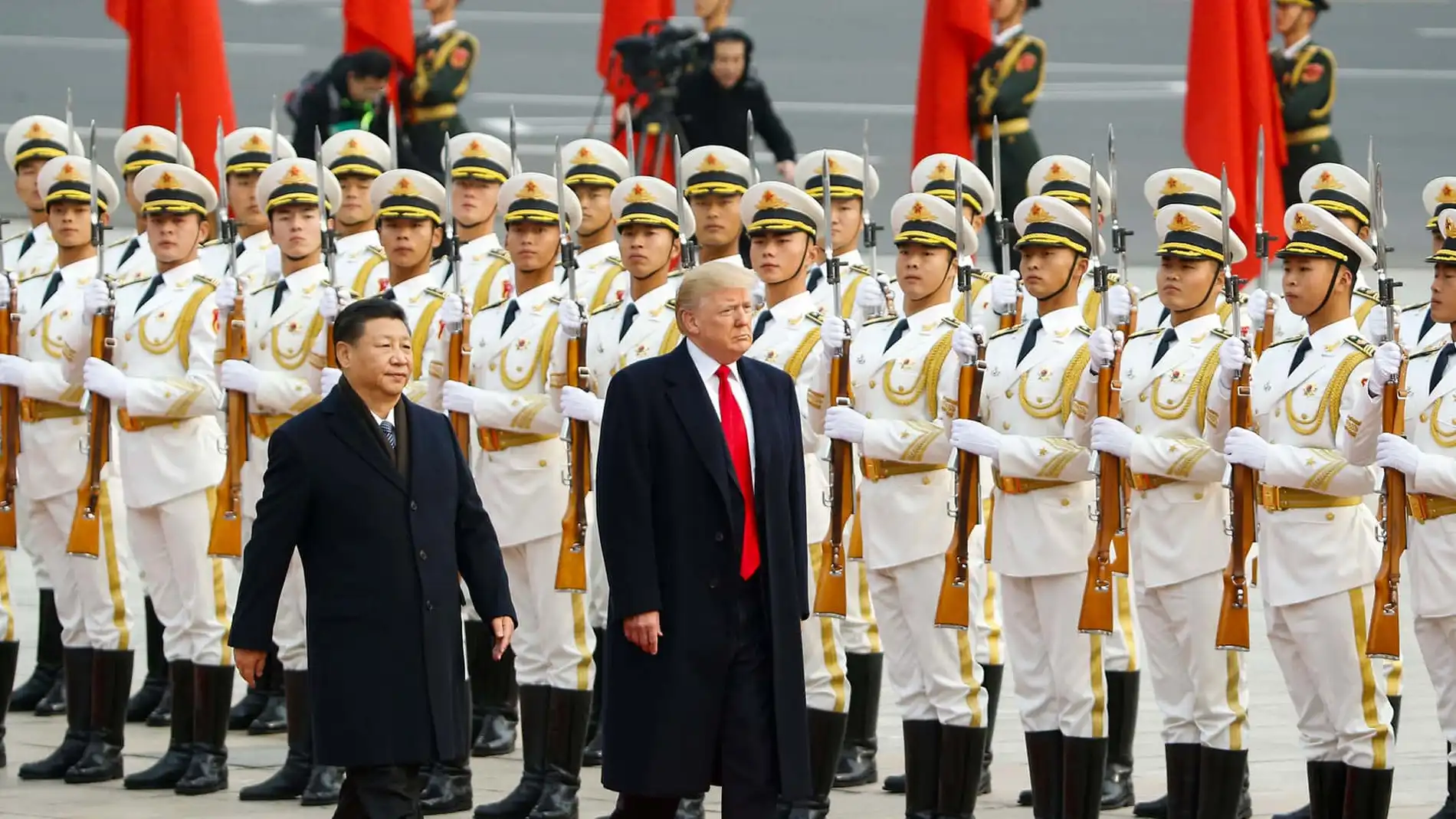
The choice of the term does not come in a vacuum either. During Xi Jinping’s visit to Washington, Trump had already announced that Super Intelligence would be one of the big topics of conversation. Days later, the United States and China agreed to establish a bilateral dialogue on the risks and benefits of this technology and a communication channel for incidents related to it. Trump posted on his social media that “Like almost everyone, (Xi) seemed to prefer to call the (misnamed) Artificial Intelligence by a much more precise and important name: SUPERINTELLIGENCE”.
But the reality is very different… China does not agree with the name change: “On the issue of wording on artificial intelligence and super intelligence, the Chinese side attaches importance to the position of the American side and respects the formulation used by the latter,” the Chinese ministry declared in a statement. In a nutshell: China has said, in millennial language, “I respect it, but I don’t share it.”
And Trump assures that this is a race that is already underway and that “we are leading China by a long shot.” But it’s not true. According to the Stanford University AI Index (American university), In AI models, the United States leads by 2.7%, but China “leads in volume of publications, citations, patent production and installations of industrial robots”.
And that is probably the real reason for the change: Trump wants to control the narrative at a time when China is closing the gap. The word artificial can suggest imitation, substitution or even something false. Super Intelligence, on the other hand, conveys superiority, power and future. The idea is to control the limits of the “old AI” and give carte blanche or a blind eye to those who want to go further… and thus win the race. That is why the gesture has something of the Trump who renamed the Gulf of Mexico as the “Gulf of America”: there is an evident desire to impose his own language and prevent the United States from coming second.