
Humanity has transformed near space into a satellite highway. From the first scientific missions to telecommunications constellations of thousands of devices, artificial objects in orbit fulfill functions as diverse as connecting phones, guiding airplanes, monitoring the weather or mapping forests. Currently, according to NASA, there are about 15,000 active satellites around our planet, but by 2030 the number will increase more than exponentially: The European Space Agency speaks of 100,000 satellites. Thus, as low orbit (LEO) fills, the eyes of engineers and scientists turn to wider spaces, including the region between the Earth and the Moon known as cislunar space.
That region, which spans up to hundreds of thousands of kilometers beyond Earth’s orbit, has been considered the next logical step in extending satellite infrastructure: from communications between Earth and future lunar bases to observation stations or space data centers that serve human missions. However, a study published in Research Notes of the AASshows that it is not easy to maintain stable satellites in that area.
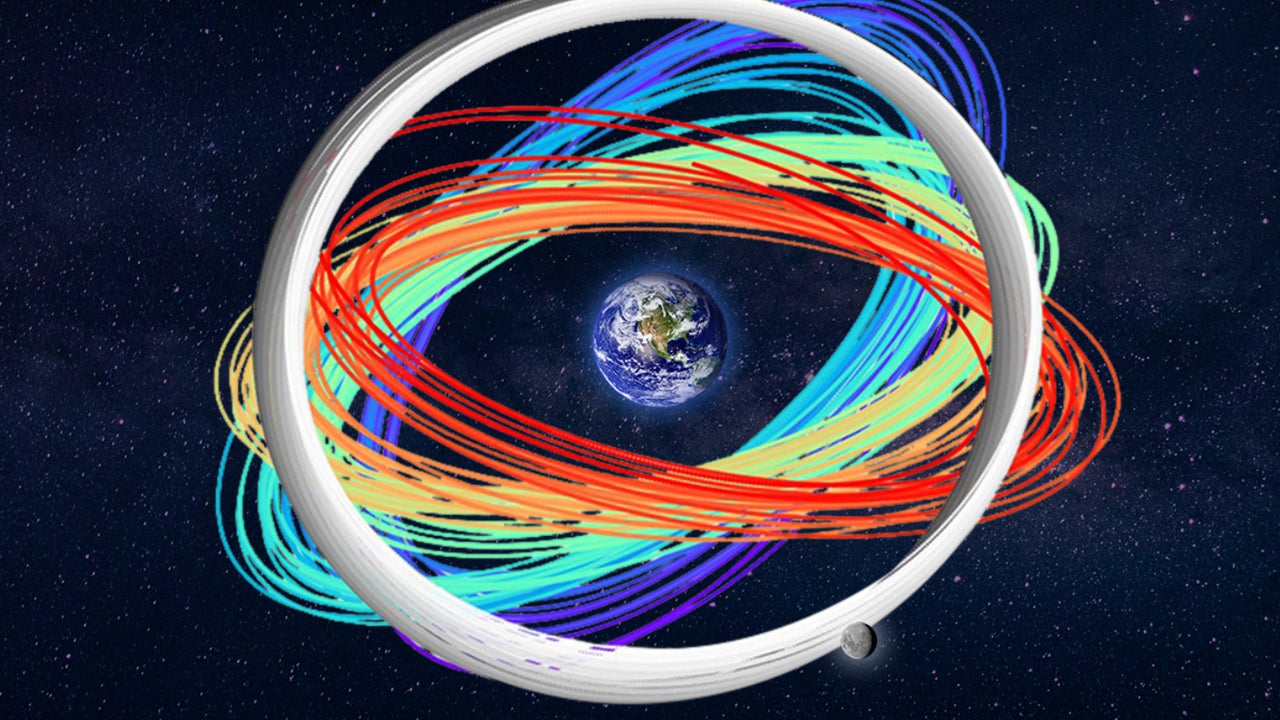
The authors, scientists at the Lawrence Livermore National Laboratory (LLNL), used two extremely powerful supercomputers (named Quartz and Ruby) to simulate the movements of approximately one million virtual satellites in different positions within cislunar space. The simulations were so complex that, according to the laboratory, They used the equivalent of 1.6 million CPU hours: without this computing power, they would have taken almost two centuries to complete on a conventional computer.
The results make it clear that this territory does not behave like low orbits close to Earth. While in LEO the trajectories of satellites can be relatively predictable and stable, the space between the Earth and the Moon is subject to a constant gravitational battle. Not only terrestrial and lunar gravity intervene here, but also the influence of the Sun. This interaction means that orbital calculations do not have simple formulas that “say where an object will be in a week”; Instead, models must advance in very small steps to accurately simulate the forces acting on each object.
The result was surprising: although about half of the trajectories (54%) remained stable for at least one year, only 9.7% of them remained stable over a period of six years, which was the entire duration of the simulation. That is to say, Less than one in ten virtual satellites would have remained in a useful orbit for any length of time.
Much of the explanation lies in gravitational complexity. In the space between the Earth and the Moon, small variations in the Earth’s gravitational field, for example, because the Earth is not a perfectly spherical body, and variations in lunar and solar gravity can alter the trajectories of objects over time. This makes many simulated orbits become unstable: some virtual satellites ended up getting too close to the planet or the Moonlosing altitude, or even remaining on trajectories that would expel them towards less useful regions.
The study’s authors point out that learning which orbits work and which don’t is as valuable as knowing what doesn’t work. Simulations make it possible to create a map of probable trajectories and understand what factors make an orbit last years instead of months. This type of analysis is essential when planning real missions, since a satellite out of position not only loses its functionality, but can also become an uncontrolled object that complicates future operations in space.
Furthermore, although the probability of long-term survival was less than 10%, that number still provides a basis for thinking about how to design sustainable cislunar orbital systems. With proper trajectory control algorithms, efficient propulsion, well-chosen gravitational libration points, or even “orbital refueling stations,” it is possible that useful constellations could be maintained beyond LEO. The simulation leaves open the door to future research to optimize these systems.