
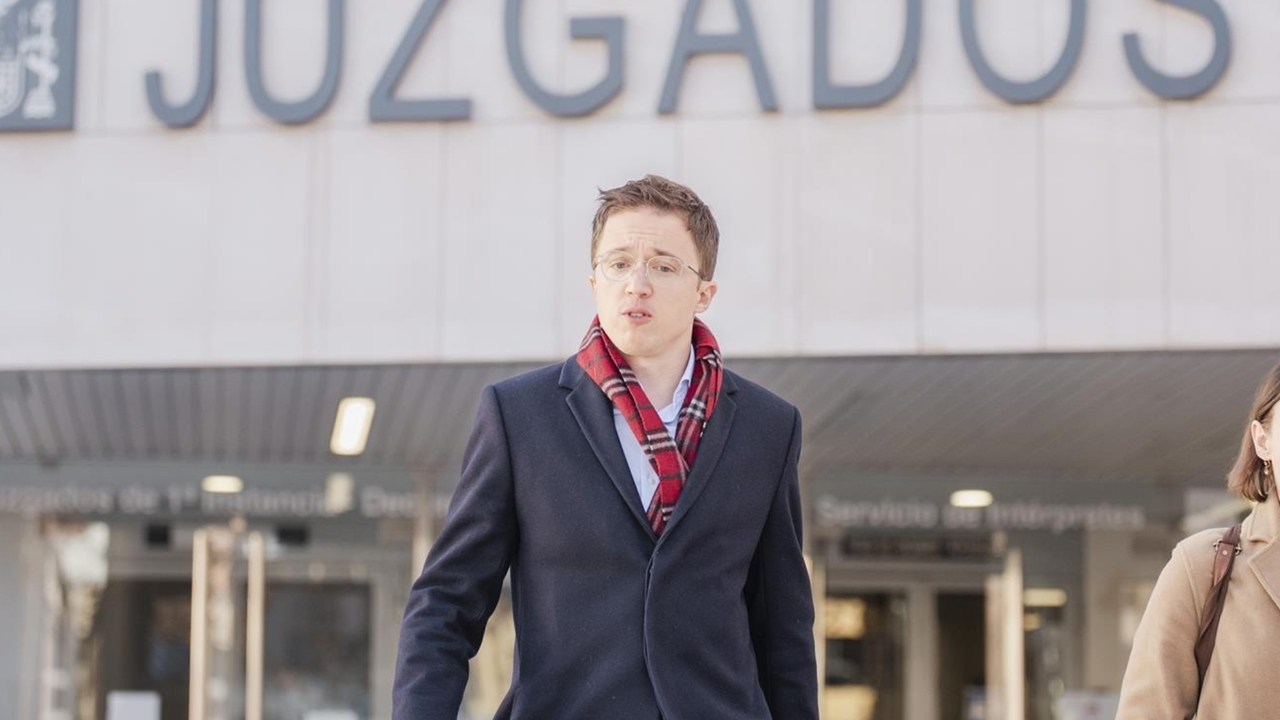
The State Attorney General’s Office (FGE) refuses to direct any “disciplinary reproach” to its representative in the “Errejón case”, after Elisa Mouliaá filed a formal complaint against the prosecutor for her actions in the procedure, as LA RAZÓN has learned for the first time.
On January 14, the actress accused the prosecutor of the sexual assault case against the former politician of having demonstrated a “procedurally incongruent position, contrary to the accusatory principle and deviating from the institutional criteria” of the FGE itself.
Through his lawyer, Alfredo Arrién, he attributed, before the Tax Inspection, to having acted in an “objectively contradictory” manner. Specifically, for having appreciated, first, that Judge Adolfo Carretero acted “correctly” and in a manner “in accordance with the law” when prosecuting the former spokesperson for Sumar, also recognizing the “existence of rational indications of criminality.” And then, “simultaneously”, request the investigator to file the case, thereby not granting the prosecutor her support for Errejón to sit on the bench.
The complainant’s lawyer understands that “it is legally unacceptable and violates the accusatory principle” that the Public Ministry “recognizes that the testimony (of Mouliaá) is credible and credible, persistent and coherent, but at the same time requests that the procedure be archived.”
And finally, he defends that he would have failed to comply with “the principle of enhanced protection of the victim,” which Arrién assures is the responsibility of all prosecutors.
On February 26, the chief prosecutor inspector of the FGE, María Antonia Sanz Gaite, spoke out and dictated the fate of the complaint. Within the Public Ministry they consider that the procedural intervention of their partner “responds to the usual way” in which they proceed in a case of sexual crimes.
Although he admits that it may “surprise”, he does not see a major problem in that “while recognizing the seriousness, coherence and persistence of the victim’s (Mouliaá) testimony, and considering the content of the abbreviated procedure order (equivalent to prosecution) to be correct, the Prosecutor’s Office demands, on the contrary, that the provisional dismissal be agreed” of the proceedings against Errejón for sexual assault.
This lies, for the Tax Inspection, in the requirement that weighs on prosecutors – as they consider to be the case – to “explicitly oppose claims that they consider unfounded or of insufficient quality” to formulate an accusation through a qualifying document and request a conviction for the co-founder of Podemos.
“There is no violation of the accusatory principle,” the chief inspector of the Attorney General’s Office also responds to Mouliaá, and then adds that this basis “has little to do with the interpretation given to it” in the complaint analyzed.
In short, the Prosecutor’s Office supports the criteria that is shown in the procedure directed by the head of the Court of Instruction number 47 of Madrid and reminds the legal representation of the complainant that its institution “does not have the obligation to accuse when there are indications of a possible crime, if these are insufficient to present the accusation with a minimum seriousness.”
Elaborating on what the position of the Public Prosecutor’s Office should be in procedures like this, the FGE emphasizes that it cannot be understood that they must “always support complaints that affirm the existence of crimes against sexual freedom, necessarily giving precedence to the testimony of a possible victim over the story of the accused.”
If not, precisely, he understands that his duty has to be to “ensure that the law is complied with with respect to the rights of the different parties involved or affected in the process, not exclusively of the party making accusations”, as he understands that this is what has happened in the case in question.
At the end of its decree, of more than five pages, the Prosecutor’s Office qualifies the complaint filed by the presenter’s lawyer as “disproportionate”, compared to what it claims was a “mere expression” by the prosecutor of “a legal criterion expressed objectively and with apparent support for the law”, in addition to being “sufficiently argued” by her “colleague”, and, therefore, it rejects initiating any internal disciplinary measure against her.
The prosecutor demonstrated “brilliance”
The Prosecutor’s Office flatly denies that the prosecutor involved in the “Errejón case” has violated her duty of impartiality and to act objectively. But in the decree, known to this newspaper, the Tax Inspection takes the opportunity to ensure that this professional from the Provincial Prosecutor’s Office of Madrid “assessed the actions in extreme detail that was not lacking in brilliance” and “analyzed the documents” that make up the summary to adopt a “procedural position that appears to be in accordance with the law.” The legal sources consulted indicate that Mouliaá can still appeal the rejection of his complaint for reconsideration and it is expected that he will do so.