
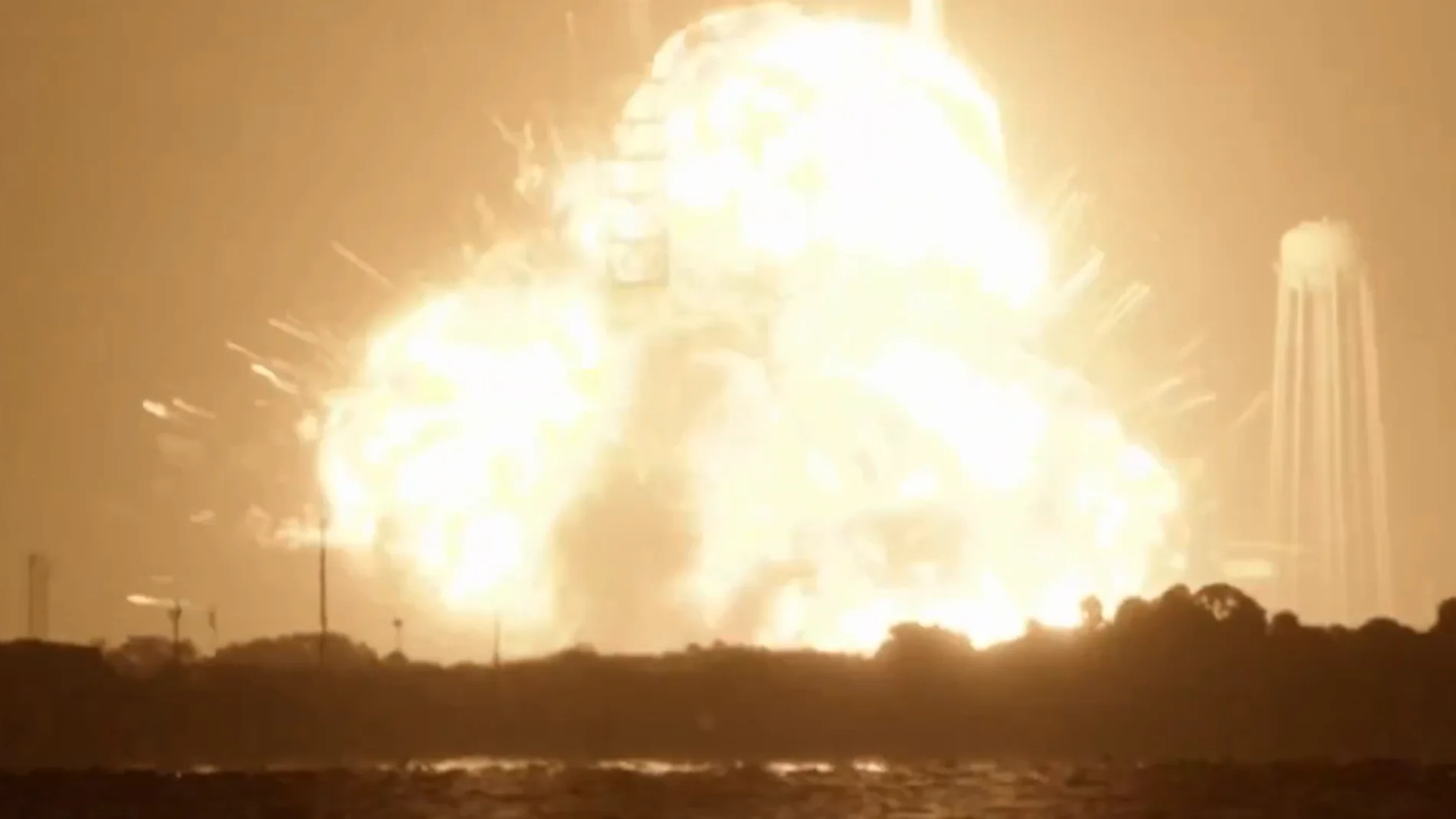
This morning, the sky over Cape Canaveral lit up for a few seconds with a huge fireball. The New Glenn rocket from Blue Origin, the space company founded by Jeff Bezos, had just exploded on the launch pad during an engine test prior to takeoff.
Because this is a test, There were no astronauts on board and no payload. But the accident represents one of the biggest setbacks suffered by the company in years and threatens to delay some of its lunar and commercial ambitions.
The explosion occurred during a hot fire test. a static test in which the rocket motors are ignited while the vehicle remains attached to the platform. These types of tests are common before a launch because they allow checking fuel systems, pressures and engine behavior under real conditions.
Images recorded from the vicinity show how the base of the rocket is engulfed in flames before it A massive explosion partially destroys the Launch Complex 36 platform in Florida. The shock wave was visible for kilometers away. Fortunately, there were no injuries.
Blue Origin described the incident with a carefully chosen word: anomaly. In a statement, the company assured that all personnel had been evacuated correctly and confirmed the start of an internal investigation to determine the exact causes of the failure. Jeff Bezos also reacted publicly by stating that the company will “rebuild and move forward.”
All personnel are accounted for and safe. It’s too early to know the root cause but we’re already working to find it. Very rough day, but we’ll rebuild whatever needs rebuilding and get back to flying. It’s worth it.
— Jeff Bezos (@JeffBezos) May 29, 2026
For now there is no official cause, but the first images of the incident suggest that the failure originated in the engine section of the vehicle, where the New Glenn’s seven BE-4 engines are located. although Blue Origin has not yet detailed which system caused the explosion. These tests work with enormous amounts of liquid oxygen and methane at extreme temperatures; A leak or pressure disturbance can trigger catastrophic explosions in a matter of seconds.
The reality is that the engines were already experiencing difficulties. In April, during his third flight, The rocket successfully reused the main booster, but the second stage placed a satellite in the wrong orbit. The United States Federal Aviation Administration (FAA) then opened a formal investigation and demanded corrective measures before authorizing new flights.
That means the current explosion comes at the worst possible time for the company. The New Glenn is no small project. This is Blue Origin’s large orbital rocket, designed to compete directly with the Falcon Heavy and, in the future, with SpaceX’s Starship. The vehicle was to launch commercial satellites, military missions and essential components of NASA’s Artemis lunar program. And there appears the main concern: delays.
The destroyed platform was currently the only operational launch base for the New Glenn. Although There is still no official repair schedule; several analysts consider it likely that upcoming missions will suffer delays of months.
Among the missions potentially affected is Amazon’s deployment of satellites for its space internet network, a project designed to compete with SpaceX’s Starlink. The destroyed rocket, in fact, It was preparing to transport 48 satellites of that constellation. But the impact could go beyond the commercial market.
NASA had recently selected Blue Origin for several missions related to future US lunar infrastructure. The New Glenn was also listed as one of the vehicles capable of supporting future operations of the Artemis program and the transport of components for the future lunar base at the south pole of the Moon.
The explosion does not necessarily mean the failure of the program. But it does make something uncomfortable clear for Bezos’ company: building a gigantic reusable rocket remains one of the most difficult technological tasks on the planet. AND In the modern space business, time can be as important as fuel.