
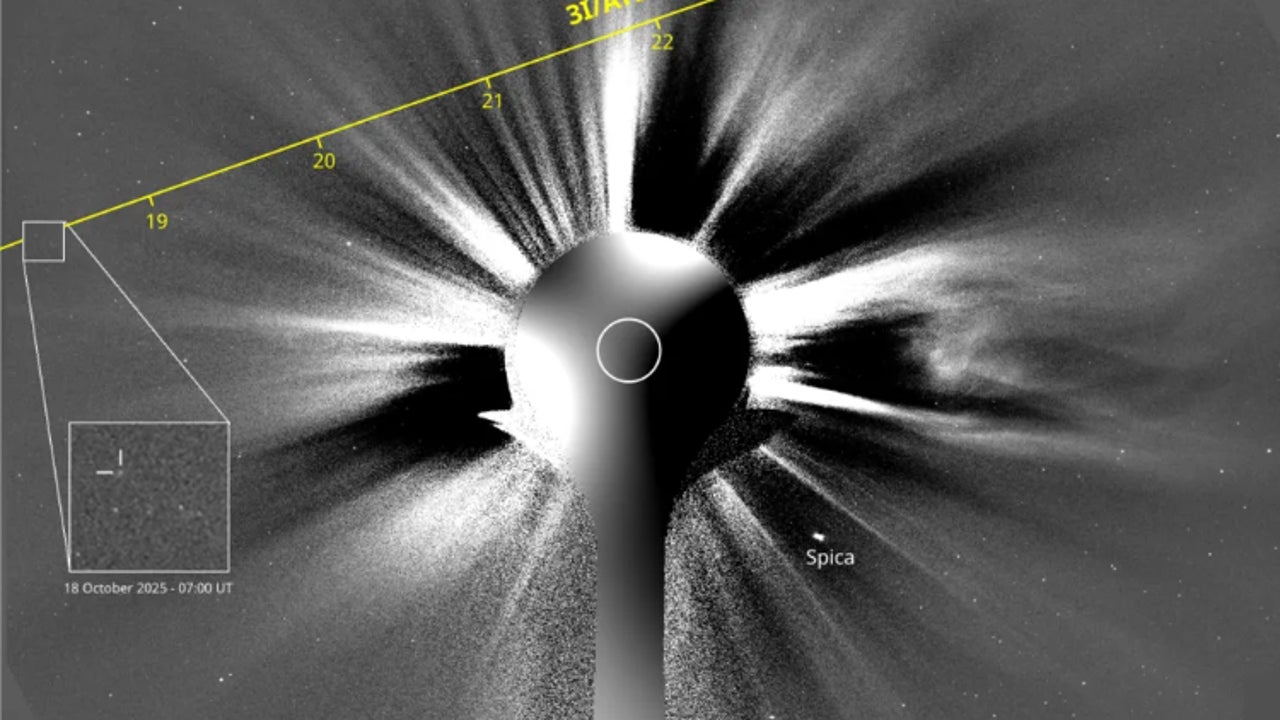
When an interstellar visitor briefly passes through our solar system, each flash, each change of light, can tell us something about its origin, its composition and, ultimately, about worlds that may seem very distant. That just happened with 3I/ATLAS: a sudden brightness was observed while it was “hiding” behind the Sun, and the finding raises important questions.
3I/ATLAS is not just any comet. Classified as “interstellar”, that is, originating from another star system, it moves at a speed greater than 210,000 km/h. Its passage close to the Sun (perihelion) makes it a natural laboratory to study how ice, volatile gases and radiation react under extreme conditions. And at that critical moment, When it was hidden from terrestrial eyes behind our star, something stood out: its brightness increased noticeably.
Images from solar satellites such as GOES-19 and SOHO made it possible to follow the comet during its hidden trajectory and discover some features. As you approach the Sun, the ice of the comet’s nucleus (water, carbon dioxide, other volatiles) sublimes strongly: they go from solid to gas, releasing dust and particles that increase their reflectivity.
But the most intriguing thing is that a more bluish tone than usual was observedwhich suggests that it is not only “turned on” by heating, but that there is emission of ionized gas that enhances the brightness.
That type of behavior could indicate that 3I/ATLAS contains volatiles or internal structures very different from “typical” comets in our Kuiper belt or the outer solar system.
What is the importance of this finding? This sudden brightness is not just a visual spectacle. For example, if an interstellar comet can behave differently from local comets, That opens the door to a chemistry and dynamics of frozen bodies that we had not yet considered.
Coming from outside, 3I/ATLAS provides us with information about the formation of planets, protoplanetary disks, and remnant bodies in another system. Every surprise it shows is like reading an unknown chapter of our universe.
Finally, it also gives us “local” information: Using solar satellites to track occulting comets (behind the Sun) shows that our tools can capture the unexpected. It is a reminder that astronomy not only observes the visible, but innovates to observe the hidden.
But there are still things we don’t know. Although the brilliance is clear, the exact “why” still has missing pieces. Scientists need to determine the proportion of gases released, the mass of the comet (or at least a better approximation than the current one), the specific elements responsible for the change in light and how that behavior compares to other interstellar objects, such as 2I/Borisov or ʻOumuamua.
In addition, 3I/ATLAS will begin to be visible again from Earth after its occultation. This will allow both professional and amateur telescopes to capture more datapossibly at different wavelengths, to complete the puzzle.
When we look at an interstellar comet firing up behind the Sun, we’re not just seeing a space-faring body: we’re getting a glimpse of the diversity of the universe and our ability to track it. AND to ask ourselves new questions. And try to answer them.