
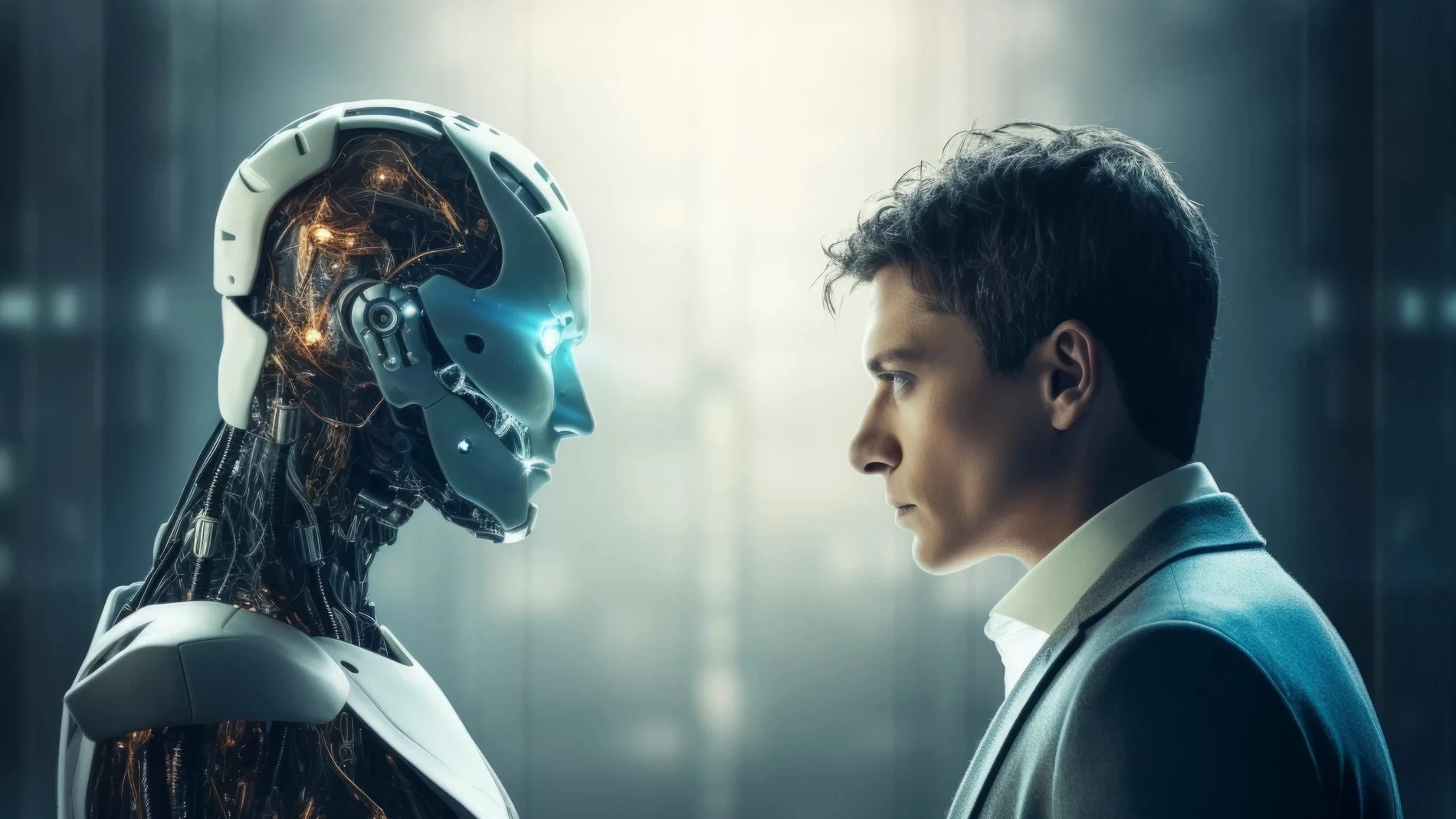
In 1997, a machine defeated the world chess champion. In 2016, another beat the best Go player on the planet. Today, artificial intelligence systems write texts, generate images, program software, translate languages and answer questions at a speed impossible for anyone. With each new advance the same question reappears: what do we have left?
Perhaps the first thing to clarify is the difference between knowledge and intelligence. An AI answers the distance between Madrid and New York in one second. And it takes the same amount of time to complete a 20-page paper.substantiated and with quotes and references, about Mudejar architecture in northern Europe. It does not distinguish or differentiate between both tasks.
One of the most curious findings of the latest studies on artificial intelligence has to do with something we continually do without realizing it: interpret social contexts. Psychologists call it “reading the room.”
We walk into a meeting and sense tension. We detect a joke that has made someone uncomfortable. We understand that a technically correct answer can be emotionally disastrous. AIs can analyze words. They can even recognize facial expressions. But They still find it extraordinarily difficult to understand the invisible layers of human interaction: ironies, silences, hierarchies, double meanings, previous relationships or changing emotional states.
“It is not enough to see an image and recognize objects and faces – explains Kathy García, from Johns Hopkins University -. That was the first step, which took us a long way in AI. But real life is not static. We need the AI to understand the story unfolding in a scene. “Understanding the relationships, context and dynamics of social interactions is the next step, and our studies point out that there could be a blind spot in the development of the AI model.”
Much of our intelligence occurs precisely in that ambiguous territory. Machines excel when the rules are clear. We humans shine when we don’t exist. Human judgment arises from a complex mix of experience, intuition, values, emotions, culture and context. It is imperfect, but also extraordinarily flexible. The history of our species is, to a large extent, the history of solving problems for which no instruction manual existed. We could call it the creativity of bad ideas: while bad ideas are excellent at finding patterns, humans are surprisingly good at breaking them.
“AI has difficulty with subjective beliefs, which scientists characterize as decisions based on a range of outcomes that differ from what the data suggests,” adds Isabella Loaiza of MIT. Some of the most transformative decisions in human history have been driven by beliefs that defied the status quoeven when prevailing data seemed to support them, such as women’s suffrage and the civil rights movement. Humans sometimes make decisions not because the data tells us it is possible, but because, as a matter of principle, it must be done.”
Examples? Many of The great innovations were born from ideas that initially seemed absurd or counterintuitive: that the Earth revolves around the Sun, that diseases can be caused by invisible organisms, that a device heavier than air could fly.… Machines, for their part, often generate plausible combinations based on existing knowledge. Human beings, on the other hand, have a curious ability to pursue improbable intuitions, personal obsessions, and seemingly useless questions. It is true that sometimes they fail, but other times they change the world.
Another obstacle that seems insurmountable for AIs is trust. At all professional levels and at all ages, trust is something that cannot be stored in a database. We trust doctors, teachers, friends, co-workers and leaders. It is a quality that does not arise solely from technical competence. It also depends on empathy, honesty, vulnerability and responsibility.
Perhaps the greatest irony of the current revolution is that machines are forcing us to better understand what it means to be human. For decades we associated intelligence with calculation, memory or the ability to solve logical problems.
Now that machines perform many of these tasks better than us, we begin to value other capabilities: empathy, judgment, creativity, cooperation, curiosity or the ability to find meaning in the midst of uncertainty. Artificial intelligence will continue to improve, probably much faster than we imagine. But we must be clear that it will never be about who calculates faster, but rather who decides which values are worth putting into the equation.