
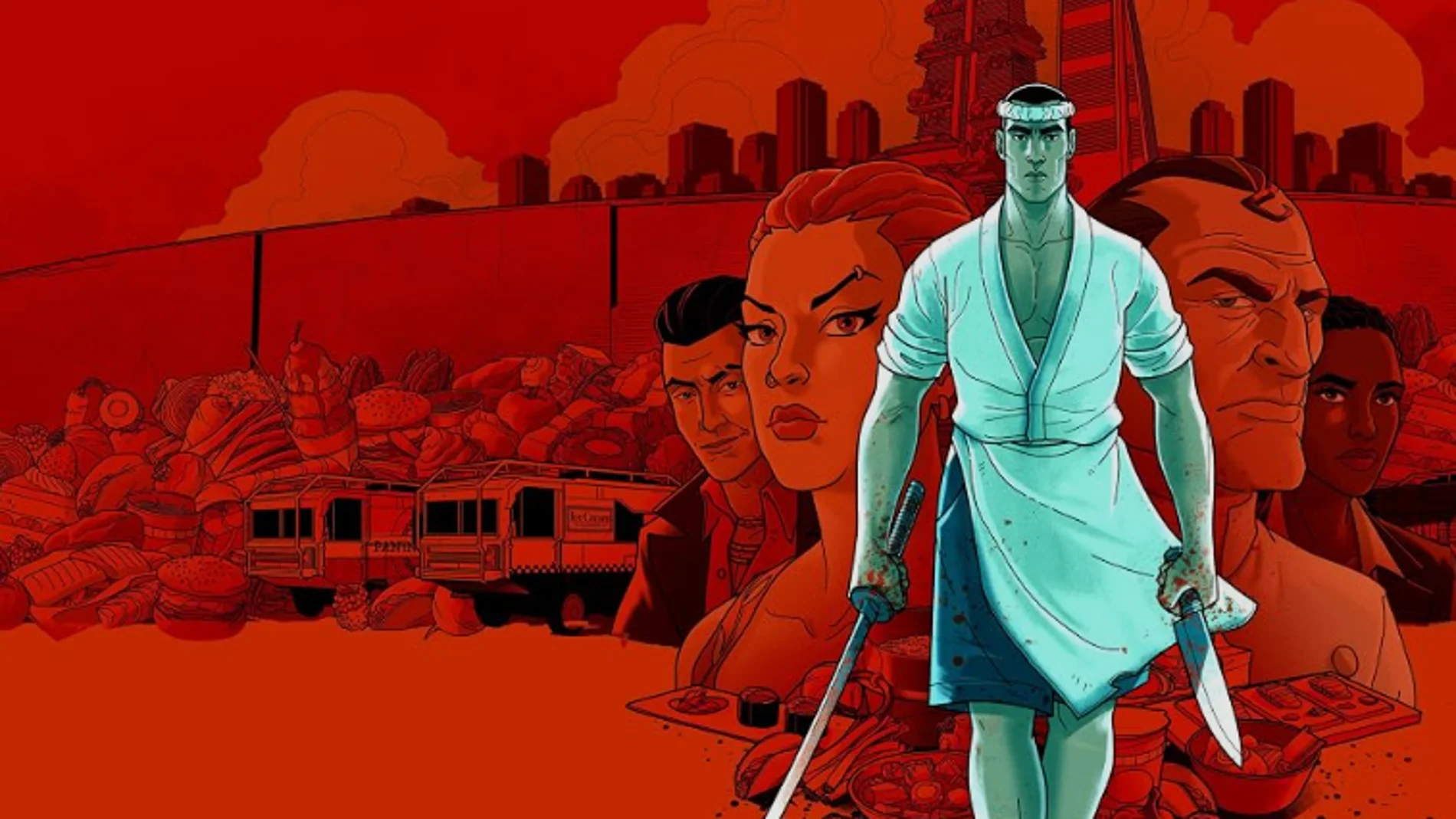
Imagine a world where chefs rule cities, food is worth more than money, and ordering soy sauce to accompany a nigiri can cost you your head. It seems like a gastronomic nightmare, but it is the universe of Get Jiro!an animated series that turns cooking into a war for power. Behind is Anthony Bourdain, the chef who made gastronomy a way of telling the world and found the inspiration for his deadliest protagonist in a sushi master.
In Los Angeles, the future doesn’t look like blade runner. It looks like a kitchen with too many knives and a few chefs convinced that their recipes should be the law. The economy has collapsed, food has become currency and The most powerful chefs control the ingredients, the restaurants, and even what is allowed to be eaten. In the middle of this landscape appears Jiro, a sushi master with a non-negotiable rule: if someone despises his work, they can end up on the chopping board.
Get Jiro! It was born as a graphic novel in 2012, written by Anthony Bourdain and Joel Rose, and now comes to animation from Adult Swim and Warner Bros. Animation, in collaboration with DC Studios. Its world mixes grotesque violence, black humor and gastronomic culture, but it also shoots against something very recognizable: culinary elitism, the obsession with authenticity and the ease with which a passion can become a tool of domination. AND is available on HBO Max, with three chapters already online and a new one every Sunday.
The personality of Jiro, the protagonist, is not only the axis of the novel, it also has a real root: Naomichi Yasuda, a sushi master whom Bourdain deeply admired. Born in a fishing town in Japan, Yasuda spent his career between Japanese kitchens and New York, where he opened Sushi Yasuda in 1999. But what fascinated the writer/chef was not just his skill with fish. Yasuda practiced karate, had large hands hardened by training and an almost physical, totally mystical relationship with his craft. Bourdain remembered the look of pain that would appear on his face when he saw a customer treat sushi without respect. From that frustration arose a question as absurd as it was revealing: what if a chef could punish someone who ruins his food?
The answer is Jiro. It is not a literal portrait of Yasuda, but a deliberate exaggeration of his rigor and his devotion to cooking. And it is best not to confuse him with Jiro Ono, the famous protagonist of the documentary Jiro Dreams of Sushi. Bourdain himself pointed out Yasuda as one of the character’s inspirations. In the universe of the series, a small lack of etiquette can become a deadly sentence. The joke works because there is a gastronomic truth behind it: in traditional sushi, the quality of the fish is as important as the temperature of the rice, the cut, the dressing and the balance of each piece.
That respect for technique coexists with a war between two factions and characters. Bob represents a French culinary tradition; Rose advocates plant-based cuisine and local ingredients. They both want to control the city’s food system, and their differences are resolved as if they were feudal lords. Independent restaurants are trapped between the powerful, while food stops being sustenance or pleasure and becomes a political and economic instrument.
Among the most striking references is the ortolán, a small bird that was traditionally prepared roasted and eaten whole. The custom of covering one’s head with a napkin while tasting has been associated with shame before God for enjoying the sin of gluttony so much. Bourdain had recounted his own experience with this dish in Medium Raw. Your presence connects fiction with a real, exclusive and controversial gastronomic tradition: in France, the capture and commercialization of this bird is prohibited for the protection of the species.
There is also room for classic dishes such as pot-au-feua French meat and vegetable stew that requires time and balance. So that the kitchen was not a simple decoration, the team had Matt Goulding, Bourdain’s friend and former collaborator, who reviewed the scripts and oversaw the selection of dishes and its representation. The violence is cartoonish because the respect for the product had to be authentic.
The relationship with DC Comics completes the unlikely mix. Get Jiro! It comes from a graphic novel published under the Vertigo imprint, but there are no superheroes saving the world here. There are codes of honor, revenge and chefs who act like gunmen from a western or warriors from a samurai movie. Bourdain took his passion for cooking to an extreme that allows him to laugh at the rules without forgetting why they exist.
The famous chef died in 2018, before this adaptation reached the screen. He is not, therefore, the producer of the finished series, although his work and his view on gastronomy constitute its starting point. Those responsible for the adaptation have expanded that universe without losing their central question: At what point does defending a job stop being about love for what you do and become a form of power?
In Get Jiro!a dish can nourish, identify a culture or demonstrate the superiority of the person who serves it. It can also be a weapon. Bourdain knew that eating has never been just about eating. To demonstrate this, he imagined a world in which the most heated gastronomic discussion no longer ends with the bill, but with a knife on the table. Or on the neck of the offender. A must-see series for fans of all genres.