
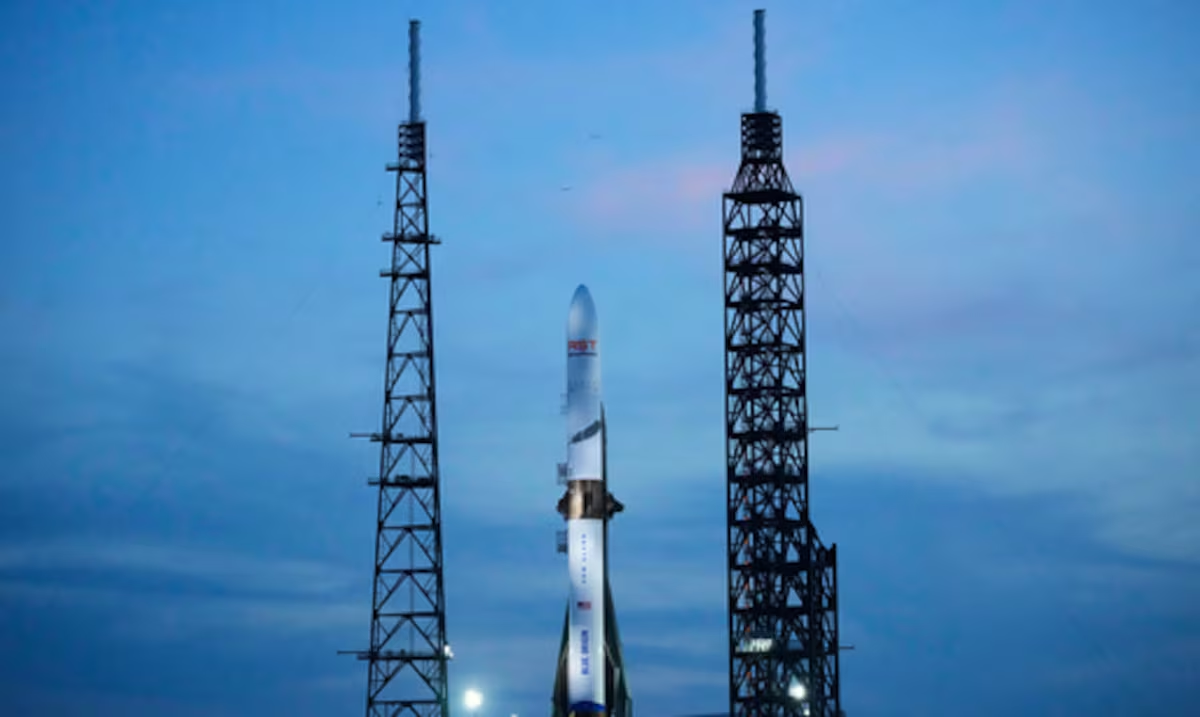
The American company Blue Origin plans to launch its New Glenn rocket “before the end of this year,” despite the explosion recorded last Thursday during a test in Florida, ensuring that much of the platform’s critical infrastructure has survived without significant damage.
The aerospace company, founded by Jeff Bezoshas detailed that it has already regained access to the launch pad at Complex 36 in Cape Canaveral, Florida, and is maintaining an active investigation into the “anomaly” presented during a firing test.
According to the company’s CEO, Dave Limp, several of the most important components of the infrastructure remain no significant damage.
Limp notes in X’s account that the propellant storage complex, including liquid oxygen, liquid hydrogen and liquefied natural gas (LNG) tanks, are in good condition, as is the water tower.
Some LC-36 updates. Now that we’ve had access to the pad and integration facility we can share a bit of good news. The propellant farm, oxygen, liquid hydrogen and LNG tanks are all in good shape. This is good luck because these are very long lead items. The water tower is also…
— Dave Limp (@davill) June 2, 2026
The company highlights that these equipment have long manufacturing times, so its conservation represents an advantage for reconstruction plans.
The main support structure has suffered damage, although The company assures that it can be repaired in place without the need to be dismantled and replaced.
The manager has also indicated that the booster called “Never Tell Me The Odds” and three GS-2 upper stages stored at the integration facilities appear to have been intact.
Limp has dismissed “some speculation” about an acceleration of a transition to a future configuration of nine engines in the first stage and four in the second.
The executive explained that production of the current configuration of seven engines in the first stage and two in the second continues as planned and that the manufactured vehicles will be stored for future launches.
“Serial manufacturing of the 7×2 configuration is progressing well and we will continue with that plan at the planned pace, storing the stages for later use,” Limp noted.
Blue Origin has also confirmed that it will permanently abandon plans to use a new transporter-elevator for the rocket. The company was already working on a vertical integration alternative before the accident and will now move directly towards that system.
While the cleaning work on the platform continues, the company has warned that fragments generated by the explosion could reach nearby coasts in the coming days or weeks.
In that sense, Blue Origin has asked the public not to touch or approach any remains that may appear for safety reasons.
Despite the damage suffered by the facility, the company has reiterated that it maintains the goal of flying the New Glenn again before the end of the year.
The initial launch, which was scheduled for this Thursday, was scheduled to place 48 satellites amazon in low Earth orbit, within the framework of the Kuiper project with which the e-commerce giant wants to provide high-speed internet to any part of the planet and compete with Starlink, from SpaceX, Elon Musk’s company.
This was going to be Amazon’s largest deployment to date, which has completed more than a dozen launches with Blue Origin, to form a constellation of more than 3,200 satellites.
Since a test was going to be carried out last Thursday, the satellites were not on board the rocket that exploded.