
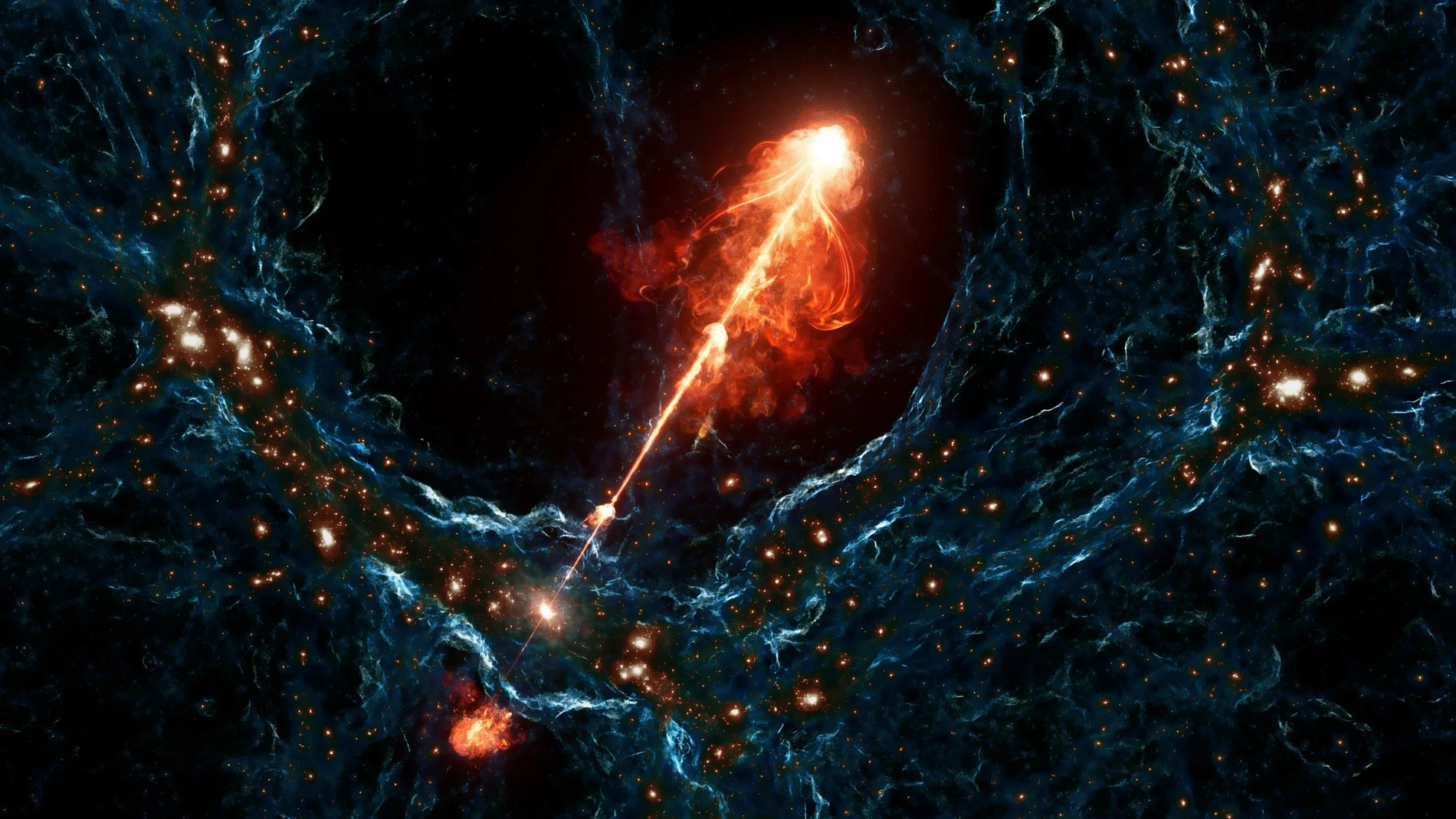
There are scientific discoveries that answer questions. Others explain the everyday and then there are those who do something much more uncomfortable: destroy answers that seemed reasonable. That’s exactly what just happened with a black hole observed by the James Webb Space Telescope (JWST). Due to the distance at which it is located, The object is visible as it was when the cosmos was a teenager, just 700 million years old, less than 5% of its current age.
But the interesting thing is not that we travel to the past through a black hole, but that this object seems to challenge one of the most accepted ideas in modern astrophysics: that galaxies appear first and giant black holes grow later. The protagonist of this story receives the unpoetic name of Abell2744-QSO1. It is part of a category of objects recently discovered by James Webb known as Little Red Dots (“little red dots”), tiny extremely distant galaxies whose reddish glow comes from the enormous expansion of the universe. The results of this analysis have been published in two different studies: one in Nature and another in Monthly Notices of the Royal Astronomical Society.
At first glance the galaxy did not seem particularly extraordinary. Its size is only around 1,300 light years in diameter, a tiny scale compared to the Milky Way, which exceeds 100,000 light years. But when astronomers began to measure what was happening inside it, the problem arose. In the center of that small galaxy hides a black hole of approximately 50 million solar masses. The figure alone is surprising. But we go by steps.
The black hole at the center of our galaxy is about 4 million solar masses. Which means that the object discovered by JWST is approximately twelve times more massive than the black hole in our galaxy. However, it is not the best known either. For its part, andthe black hole of the galaxy Messier 87 has about 6.5 billion solar masses. And some of the greatest monsters known exceed 20,000 or even 40,000 million of solar masses.
Thus, the black hole discovered by the James Webb space telescope is not the largest, but it is the most distant (in time at least) and that makes it unique: This object is like a five-year-old child who is 1.80 meters tall. He’s not the tallest person in the world, but he reached average height when the rest of humans are just starting to grow. To understand the importance of this “anticipated growth,” it is worth remembering how we believe these cosmic monsters are born.
The classic story begins with massive stars collapsing at the end of their lives. Those first black holes, with a few dozen solar masses, would slowly grow, devouring gas and merging with other black holes. In parallel, galaxies would also grow through collisions and mergers. After billions of years, the giants that we observe today in the galactic centers would emerge. The problem is the clock.
Seven hundred million years after the Big Bang there seems to have been too little time to build such a large black hole using traditional mechanisms. Astronomers have been finding surprisingly massive black holes in the early universe for years, but this case is especially puzzling because they have now been able to measure their mass directly.
And the measurement revealed something even stranger, according to the study published in Nature. The black hole represents a huge fraction of the entire mass of the host galaxy. In the current universe there is a fairly stable relationship between the size of a galaxy and the size of its central black hole, a kind of “golden ratio” observed in thousands of systems. And Abell2744-QSO1 completely breaks that rule.
According to the authors, led by Ignas Juodžbalis of the University of Cambridge, the black hole is approximately ten times more massive than would be expected even compared to the most extreme cases detected so far by the James Webb. It’s like finding a seed bigger than the tree.
For his part, Roberto Maiolino, leader of the second study, He described the discovery as “a paradigm shift” that forces us to review the classic scenarios for the formation and growth of black holes. The expression may sound exaggerated, but it reflects a real problem: how did it manage to grow so quickly?
One possibility is that it was not born from normal stars. Some models propose the existence of “direct collapse” black holes: enormous clouds of primordial gas that would have collapsed almost suddenly, forming gigantic seeds from the beginning. That would allow us to skip a large part of the slow growth process that traditional models require.
Another possibility is that the black holes of the early universe were capable of feeding much faster than what we consider normal today, exceeding for long periods the theoretical accretion limits usually used by cosmological models. Therefore, It is not just a strange black hole, but a window into an era of the cosmos that we are only beginning to observe in detail thanks to JWST.
For decades, astronomers built theories about the early universe from extremely weak and distant signals. Now the JWST is showing objects that no one expected to find so soon after the Big Bang. Some seem too bright. Others too big and others too mature for their cosmic age. And anomalies are interesting for science, but dangerous for established theories.