
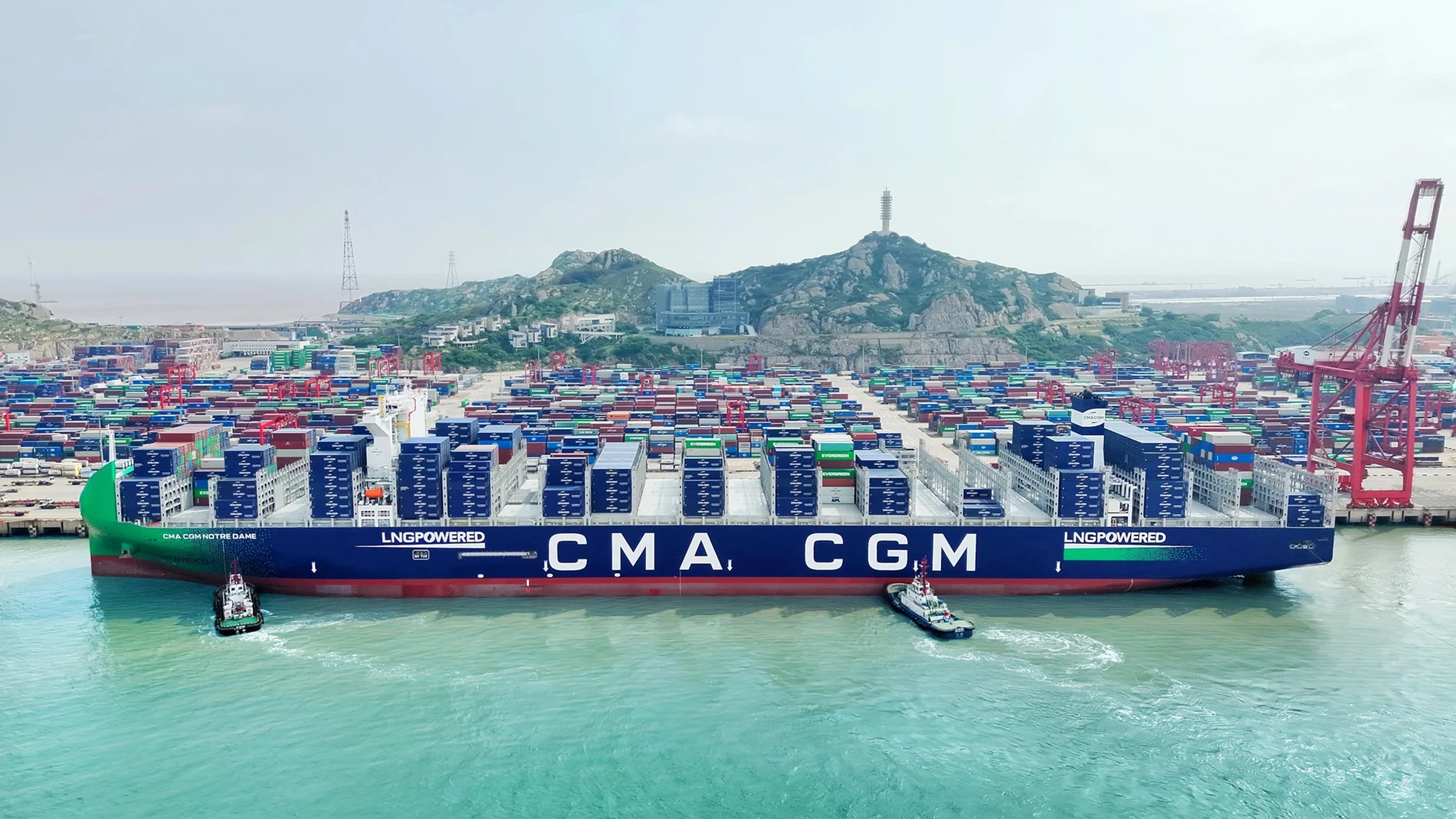
For decades, large cargo ships seemed doomed to an uncomfortable paradox: they are the invisible backbone of global trade, but also one of the most difficult industries to decarbonize. More than 80% of the planet’s goods travel by sea and moving such floating machinery requires enormous amounts of energy: more than 300,000 liters of fuel per day. Therefore, every small technological advance in this sector has a gigantic impact. And that is precisely what the new CMA CGM Notre Dame represents, considered the largest container ship in the world powered by liquefied natural gas (LNG).
The first thing that impresses is not its fuel, but its size. The ship, built by the Hudong-Zhonghua Shipbuilding shipyard in China for the French shipping company CMA CGM, belongs to the gigantic “Explorer” class. It measures about 400 meters long, approximately the same as four football fields lined up. Its beam, that is, the maximum width, exceeds 61 meters and has a height of 75 meters, like a 25-story building. And its capacity reaches 24,000 TEU, the standard unit used in maritime transport. Translated: it can transport about 24,000 6-meter containers at the same time.
To visualize it, just imagine a floating city dedicated exclusively to the movement of goods. Inside these containers, everything from mobile phones and clothing to vehicles, industrial machinery or food can travel. And yet, despite its size, The ship can navigate at speeds close to 22 knots, about 40 kilometers per hourpowered by engines capable of developing tens of thousands of horsepower.
But the real protagonist of Notre Dame is not its size, but the fuel it uses. Traditionally, most freighters have been powered by heavy fuel oil, one of the most polluting fossil fuels on the planet. It is dense, cheap and extremely efficient at moving enormous masses, but it generates very high amounts of carbon dioxide, sulfur oxides and polluting particles.
Liquefied natural gas attempts to become a transition between that classic model and a cleaner maritime future. The system works by cooling natural gas to about -162 degrees Celsius, at which point it transforms into a liquid and drastically reduces its volume: about 600 times. This allows it to be stored in huge cryogenic tanks inside the ship.
The advantage is important: compared to traditional marine fuels, LNG reduces sulfur and sulfur emissions to practically zero. significantly reduces fine particles and nitrogen oxides. In addition, it can reduce CO₂ emissions between 15% and 25%, depending on the type of operation and engine used.
In the case of Notre Dame, the system also incorporates technologies to reduce methane leaks, one of the main problems with LNG. And there appears one of the most interesting debates about this technology: Although natural gas emits less CO₂ than fuel oil, methane is a much more potent greenhouse gas in the short term. For this reason, part of the industry considers LNG an intermediate solution rather than a definitive one.
Even so, for a sector where electrifying gigantic ships remains practically impossible with current technology, the leap is already enormous. A container ship of this size can spend weeks crossing entire oceans without touching port. Powering something like this solely with batteries would require enormous weights and volumes.
And the ship’s figures help to understand the energy challenge. The CMA CGM Notre Dame can transport more than 220,000 tonnes of cargo (about 150,000 cars) and operate complete intercontinental routes between Asia and Europe. Its autonomy is enough to cross half the planet without refueling, something that requires storing immense quantities of fuel in specialized tanks.The name of the ship is not coincidental either. The Notre Dame is the first in a series of 10 ships ordered from Chinese shipyards whose names will pay tribute to French history.
Beyond symbolism, the ship also represents a technological and geopolitical race. China has become one of the world’s great centers of advanced shipbuilding, while Europe tries to maintain leadership in designlogistics and maritime energy transition. The result is ships that are no longer just means of transportation: they are floating technological platforms.