
Behind every aerospace mission National Aeronautics and Space Administration (NASA, for its acronym in English), in addition to the astronauts, a large team of engineers works in charge of ensuring the efficiency of the systems to ensure the success of the task.
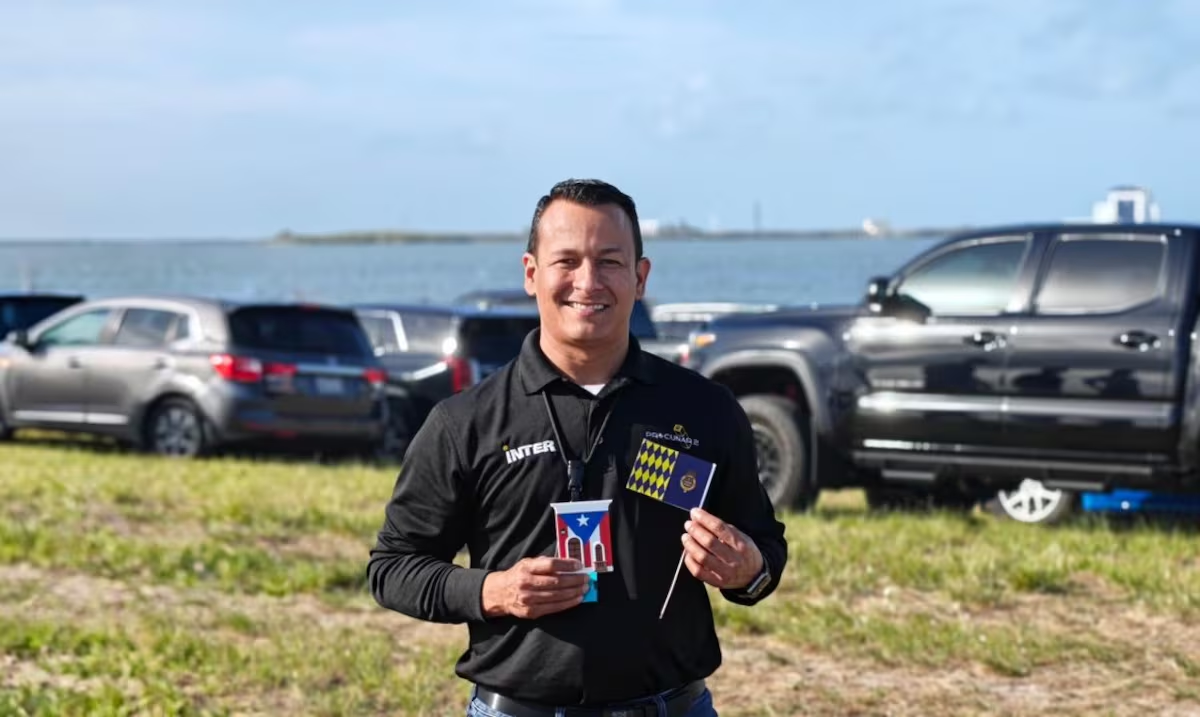
The Puerto Rican Christian Núñez Vélezgraduated from the Interamerican University of Bayamónis one of them, and this Monday he shared his experience in the development of one of the most important missions of NASA’s lunar exploration program before the university community of the institution where he trained professionally.
Núñez Vélez was one of the design engineers who was part of the work team in the development of the mission’s pneumatic systems Artemis II.
As part of the operations related to the rocket launch, The Puerto Rican engineer dedicated himself to developing pneumatic and breathing air systems to prepare astronauts before the mission.. Systems are tested continuously, while in operation, for pressure, purity and stability.
“That quality of air, which must be 99.999% pure, is what they will be able to breathe in the capsule for the next 10 or 11 days. If their body is not accustomed to that type of quality, there may be dizziness or disorientation. That is very important: that these systems are designed as they have to be so that, when the astronauts are walking with the suit and the tanks, they attach the body before reaching the capsule. And when they arrive at the capsule, they also make a transition,” explained Núñez Vélez.
His work also deals with the fluid and gas systems used in rocket operations. Many hydraulic and propulsion systems require inert gases for pressurization processes and safe fluid handling.
A critical stage, the engineer explained, is the Wet Dress Rehearsal (WDR), which is a complete pre-launch simulation, in which systems, fluids and operational sequences are tested exactly as they would occur on the day of takeoff. He emphasized that this phase is essential because it allows certifying that all systems are working correctly before authorizing the launch of the rocket.
“There are no words to express the joy and pride I have to be part of this”expressed Núñez Vélez, when reflecting on his work in the aeronautical and space organization.
1/12 | This was the return of the Artemis II mission to Earth. The Integrity capsule landed in the Pacific Ocean without incident, as scheduled. – Capture
From Inter Bayamón to Artemis II
During the conversation at the university institution, Núñez Vélez shared that he owes his success and development to his alma mater. In addition, he said that working at NASA was always a dream, and it took him 10 years to achieve it.
“(The) 90% of what I am today, of my structure as a professional, was thanks to the teachers and the institution of the Interwho did an excellent job with me and many other students as well. In fact, there are other Inter students who are also at NASA today,” he declared.
Núñez Vélez was part of the initial team that designed the first Puerto Rican satellite, the PR-CuNaR2, made by students from Inter de Bayamón to reach space and NASA.
“The achievement of our graduate is not a coincidence. It is the result of a solid, rigorous and relevant training, of a university ecosystem that promotes curiosity, innovation and excellence, and of an educational community that believes in the unlimited potential of its students,” said the rector of the Bayamón campus, Carlos Olivares Pacheco.
In the same Faculty of Engineering from which he graduated in 2009, upon completing a bachelor’s degree in Mechanical Engineering, Núñez Vélez met with university students to advise future engineers who aspire to follow a similar career.
Besides, He anticipated that he will continue his work on the systems for the next space mission, Artemis IIIwhich will be the second crewed mission of NASA’s Artemis lunar exploration program, which is expected to launch in late 2027.
“Puerto Ricans have what we need to get to where we are. The essence of the Puerto Rican cannot leave the root of the heart”concluded Núñez Vélez.
1/21 | PHOTOS: The stunning views of the Moon and Earth captured from Artemis. In the image, provided by NASA, the Artemis II crew captured this view of an Earth sunset on Monday, April 6, 2026, while flying around the Moon. NASA via AP) – The Associated Press