
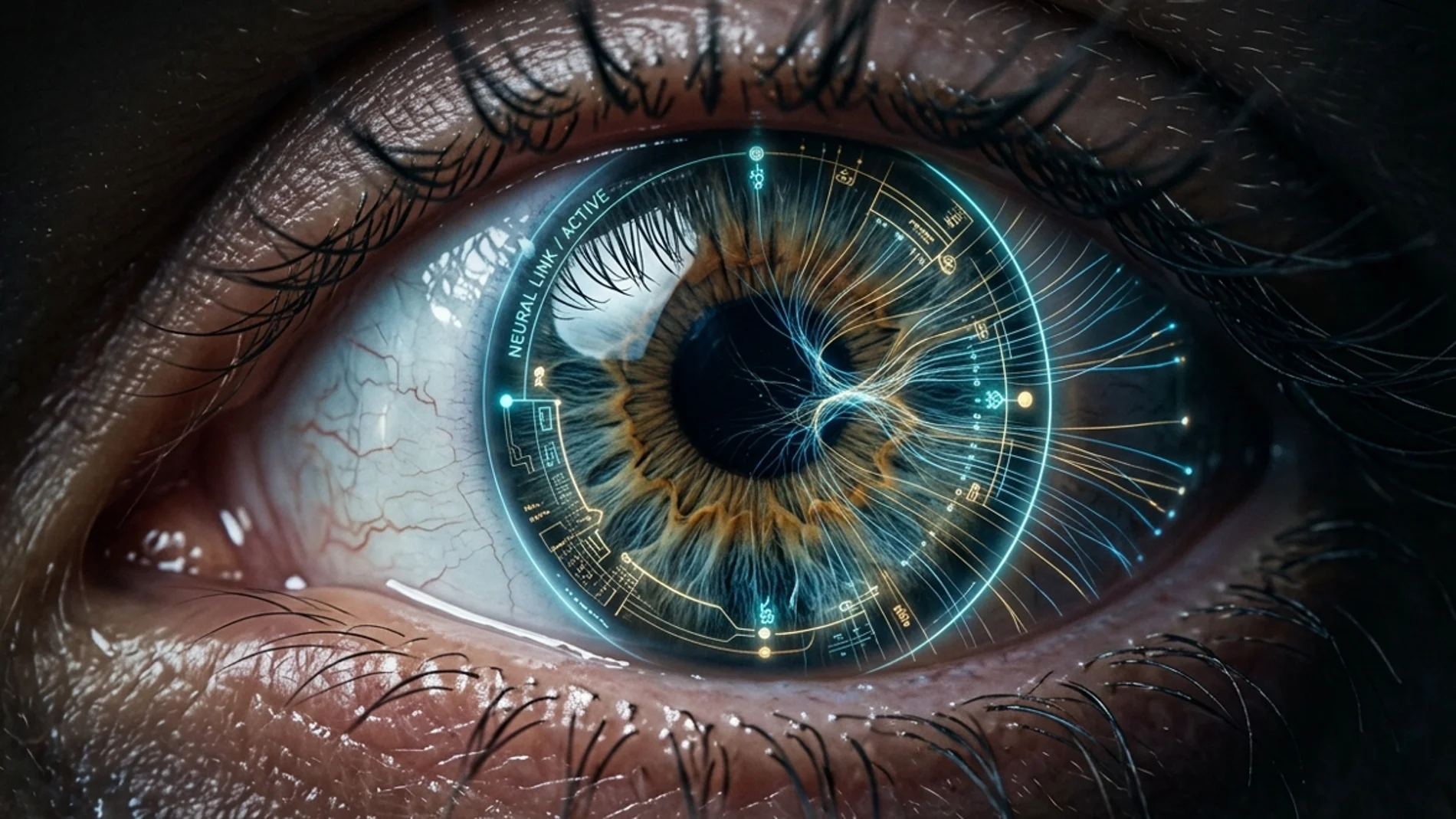
“Enter by sight.” This phrase is usually linked to love and food, but not to mental health. And there is something almost counterintuitive about the idea: treating a mood disorder… through the eye. And yet, it is precisely there where a team of scientists has found a new door to the brain. Not with drugs or implants, but with a contact lens.
A group of experts led by Jang-Ung Park, from Yonsei University (South Korea), has developed contact lenses capable of stimulating brain regions linked to depression through mild electrical impulses. In animal models, the result is striking: after three weeks of treatment, the mice showed improvements comparable to those obtained with fluoxetinethe active ingredient of the well-known antidepressant Prozac. The results have been published in Cell Reports Physical Science.
The idea is based on an anatomical fact that often goes unnoticed: the retina is not just a sensory organ, it is literally an extension of the brain. It is directly connected to neural circuits involved in mood regulation. If this pathway could be stimulated precisely, perhaps it would be possible to modulate these circuits without needing to intervene directly in the brain. And that’s what Park’s team did.
The contact lenses incorporate ultra-thin electrodes, made with layers of gallium and platinum oxide, which generate very soft electrical signals. But the real genius is in how those signals are applied. They use a technique called “temporal interference,” which consists of emit two low-intensity electric currents that, separately, have no effect. Only when they cross at a specific point on the retina do they generate a signal intense enough to activate neurons.
The analogy proposed by the authors themselves is simple: two flashlights whose light, weak separately, creates a bright spot right where they overlap. That point can be located in a specific region, allowing much more precise stimulation than other non-invasive methods.
In practice, this means that the electrodes can remain on the surface of the eye, while The real activation occurs in deeper areas of the visual system and, through its connections, in brain circuits related to depression.
The experiment was carried out in mice with induced symptoms of depression. For three weeks, they received daily 30-minute stimulation sessions. The results were not limited to a single indicator. At the end, The rodents showed improvements in their behavior, changes in neuronal activity and alterations in biological markers associated with depression.
Among the latter, Park’s team observed a significant reduction in corticosterone (a stress-related hormone) and an increase in serotonin levels, one of the key neurotransmitters in mood regulation. In addition, communication between the hippocampus and the prefrontal cortex, two regions whose disconnection is associated with depressive disorders, was partially restored.
Perhaps one of the most interesting data does not come directly from biological experiments, but from computational analysis. When a machine learning model classified the animals based on their behavior, brain activity and biomarkers, systematically grouped the mice treated with the contact lenses together with the healthy, and not with the untreated depressed.
That does not mean that we are facing an immediate alternative to antidepressants. The authors themselves are clear: the technology is in a very early phase. Before reach human patients, it must pass safety studies, clinical trials and tests in more complex animal models. Technical challenges will also need to be resolved, such as making the lenses completely wireless and tailoring stimulation to each individual. But the conceptual change is already there.
Until now, treatments for depression have followed relatively familiar paths: chemistry (drugs), direct electricity (electroconvulsive), or surgical intervention (implants). This proposal opens a different path: using soft, portable and non-invasive interfaces that take advantage of the body’s natural connections. It is not just a new tool, but a new way of thinking about access to the brain.