
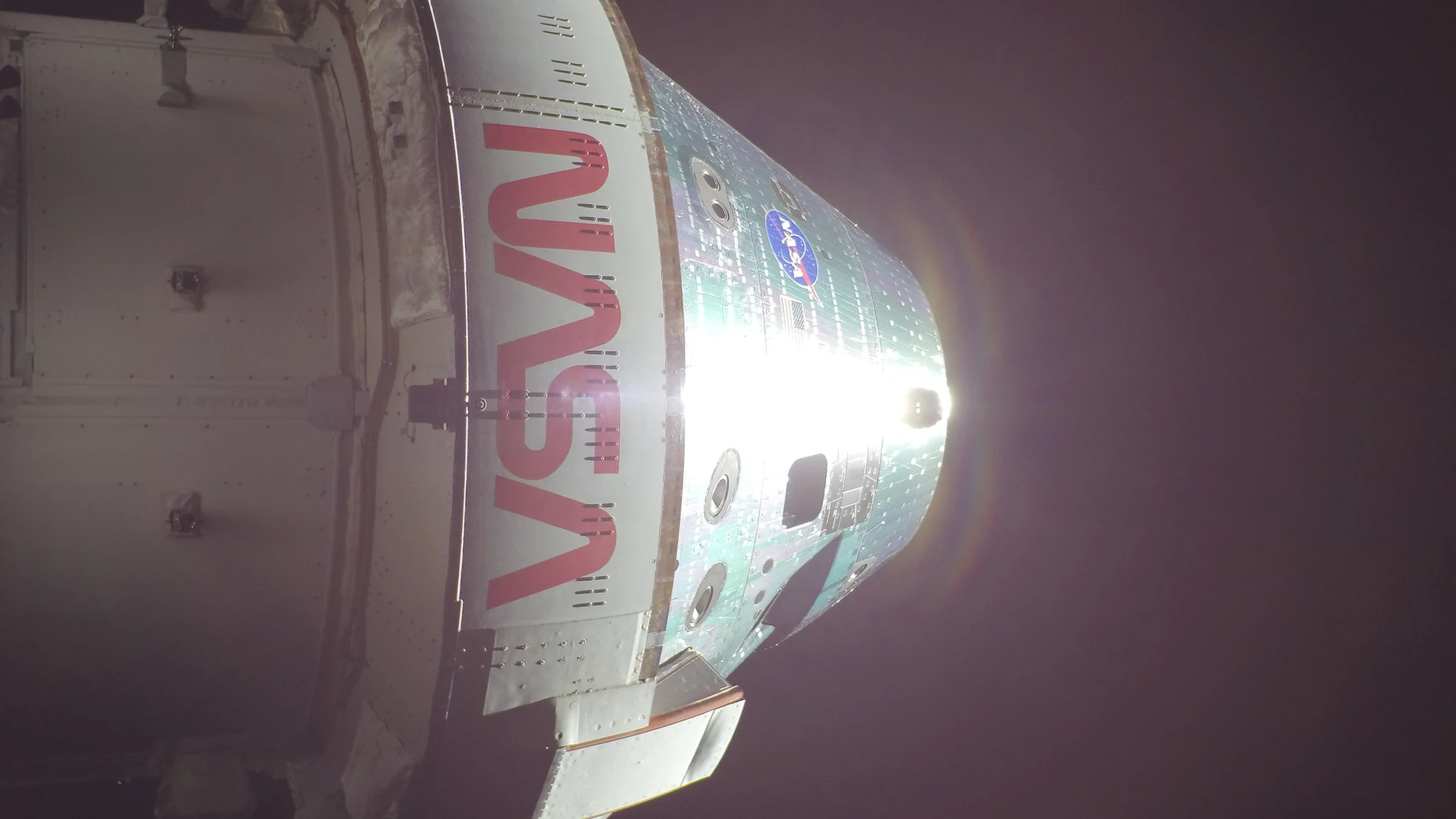
The POT this Wednesday offered new details about Artemis IIIthe manned mission that will rehearse rendezvous and docking operations with one or more lunar modules near Earth. ‘Although it is a mission to Earth orbit, it is an important intermediate step to successfully land on the Moon with Artemis IV. Artemis III is one of the missions most complex that NASA has undertaken‘, he stated in a statement Jeremy Parsonsacting assistant deputy administrator for Moon to Mars in NASA’s Exploration Systems Development Mission Directorate.
Artemis III will use the rocket Space Launch SystemSLS, from NASA to send four astronauts to orbit aboard the spacecraft Orion. Afterwards, Orion will find and dock with one or both lunar modules developed by private companies for the Artemis program. good with Starship of SpaceXwith Blue Moon of Blue Origin or with both.
This, which was announced last February, represents a major change from the original Artemis III plan, which would have used one of the landers to take astronauts near the south pole of the Moon.
NASA continues working to define Artemis III, but the agency has advanced other details. For example, that astronauts will spend more time aboard Orion on Artemis III than on Artemis II‘which will allow further progress in the evaluation of life support systems’.
Artemis II, which sent four astronauts on a trip around the Moon, lasted about ten days, from April 1 to 10. He release does not offer an estimate of how long Artemis III will last.
NASA has also revealed that the Artemis III SLS will use a ‘spacer’ instead of a functional upper stage.
‘The spacer will maintain the same overall dimensions and interface connection points as the upper stage located between the Orion stage adapter and the launch vehicle stage adapter.’notes NASA. ‘Design and manufacturing’ of the spacer is underway at the Marshall Space Flight Center in Alabama.
This makes sense from a cost savings point of view. The upper stage of the SLS, known as the interim cryogenic propulsion stage or ICPSpropels Orion out of Earth’s orbit and toward the Moon. And Artemis III will not go to the Moon.
Another novelty is that it has confirmed that Artemis III will head to low Earth orbit, instead of following more distant trajectories around our planet.
‘After the rocket launches Orion into orbit, the spacecraft’s European-made service module will provide the propulsion necessary to circularize Orion’s orbit around the planet in low Earth orbit. This orbit increases the overall probability of mission success by allowing more launch opportunities for each element compared to a lunar mission.: the SLS with Orion and its crew, SpaceX’s Starship human landing system demonstrator, and Blue Origin’s Blue Moon Mark 2 human landing system demonstrator,’ NASA says.
The statement also notes that Artemis III will use a new improved heat shield for Orionsomething that was already known, and that the astronauts of the mission ‘could enter at least one test prototype of a landing module.’
It is not yet known which lander will fly on the mission, Starship or Blue Moon, or perhaps both. Other details also remain to be worked out, including the final lifespan of Artemis III, which astronauts will ride on it, what scientific experiments they might conduct, and how the mission will test the new Artemis spacesuits the company is building. Axiom Spacebased in Houston.
‘NASA has asked industry for input on possible solutions to improve communications with the ground during the mission, as The Deep Space Network will not be used‘, adds NASA.
‘The agency is also canvassing both international and domestic interest in the possibility of transporting cubesats (small, standardized, low-cost satellites, typically used for technology demonstrations, research or in-orbit testing) to be deployed in Earth orbit, and could announce other opportunities as the mission concept of operations is further defined‘, says the space agency.