
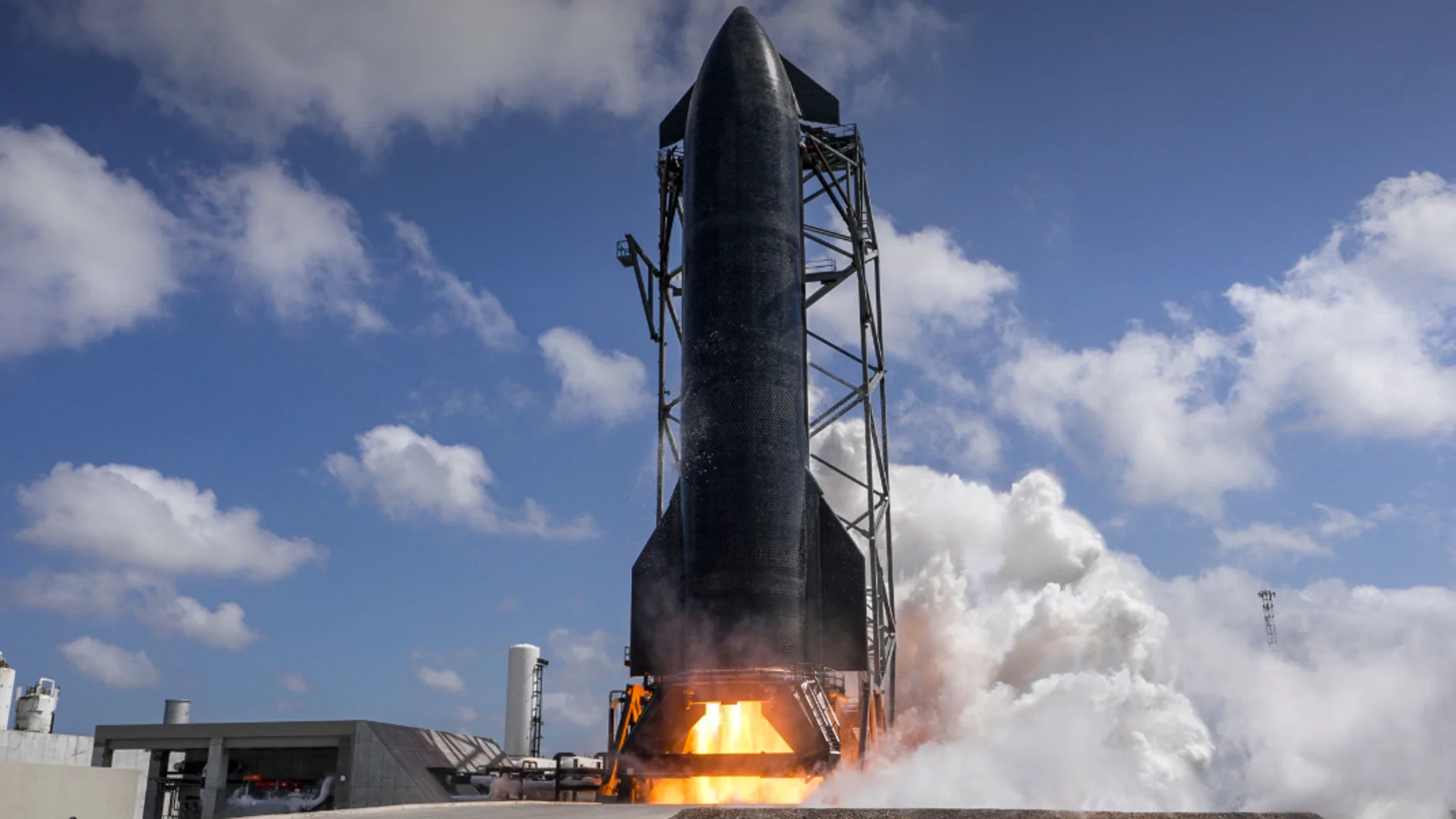
Since the beginning of the space race, rockets have grown following a relatively simple logic: more fuel, more height, more power. But SpaceX’s new Starship V3 bucks that trend. It’s not just a bigger version of the biggest rocket ever built. It is, above all, the first real attempt to transform space into an operational, frequent and almost industrial environment.
Because the objective was never just to launch satellites. SpaceX has been pursuing something much more ambitious for years: build a system capable of moving massive amounts of cargo (and eventually people) between Earth, Moon and Mars with a frequency comparable, overcoming distances, to aviation. And for that, the most powerful rocket in history needed to change again.
The Starship was already huge (120 meters) in its previous versions. But the V3 takes that scale to another level: in full configuration, the system could approach 150 meters in height, clearly surpassing the historic Saturn V (11 meters). However, the height is almost the least important thing.
What really changes is the load capacity. SpaceX proposes that Starship V3 will be able to transport more than 100 tons to low orbit in completely reusable mode, and up to 200 tons in non-recoverable configurations. To understand the magnitude: a reusable Falcon 9 is around 22 tons. NASA’s lunar system, the SLS, moves in figures close to 95 tons. Starship V3 doesn’t just compete with them: it surpasses them.
But one of the most important advances of the V3 cannot be seen from the outside. The new Raptor 3 engines not only increase thrust by around 20% more than previous versions, but also radically simplify their design. SpaceX has removed piping, intermediate components and auxiliary systems to make them more robust and faster to maintain.
Until now, rocket engines were extremely complex, almost artisanal pieces, designed to operate only once under extreme conditions. The Raptor 3 seeks the opposite: to become a repeatable, almost routine engine.
And yet, the most revolutionary element of Starship V3 is not on Earth, but in orbit. The system is designed around one key idea: orbital refueling. Until now, Each space mission was limited by an almost brutal rule: all fuel had to take off from the Earth’s surface. That turns each additional kilo into an exponential problem.
Starship breaks that logic. The idea is to launch several “tanker” versions, transfer fuel in orbit and, only then, send a fully loaded ship to the Moon or Mars.This change transforms the rocket into something much closer to a logistics system than to a punctual vehicle, it turns it into a supply chain.
As in previous versions, both the Super Heavy booster and the ship are designed to fly multiple times. But here comes one of the most striking elements of the system: capture using mechanical arms in the launch tower. Instead of landing conventionally, the booster can be caught directly in the air by the tower.The image is spectacular, but the goal is deeply practical: reduce the time between launches to a minimum and take space travel to an industrial scale.
Mars remains the narrative horizon of the project. But the most immediate impact of Starship V3 will be much closer. Its payload capacity can transform the deployment of satellites, the construction of space stations, the launch of telescopes or even the creation of entire orbital infrastructures.NASA has already selected a version of Starship for its Artemis program, bolstering its role in the next generation of lunar missions.
Launching hundreds of tons into space remains one of the most difficult tasks humanity has attempted. Starship tests have demonstrated spectacular progress, but also explosions, failures, and physical limits that are still far from fully resolved.