
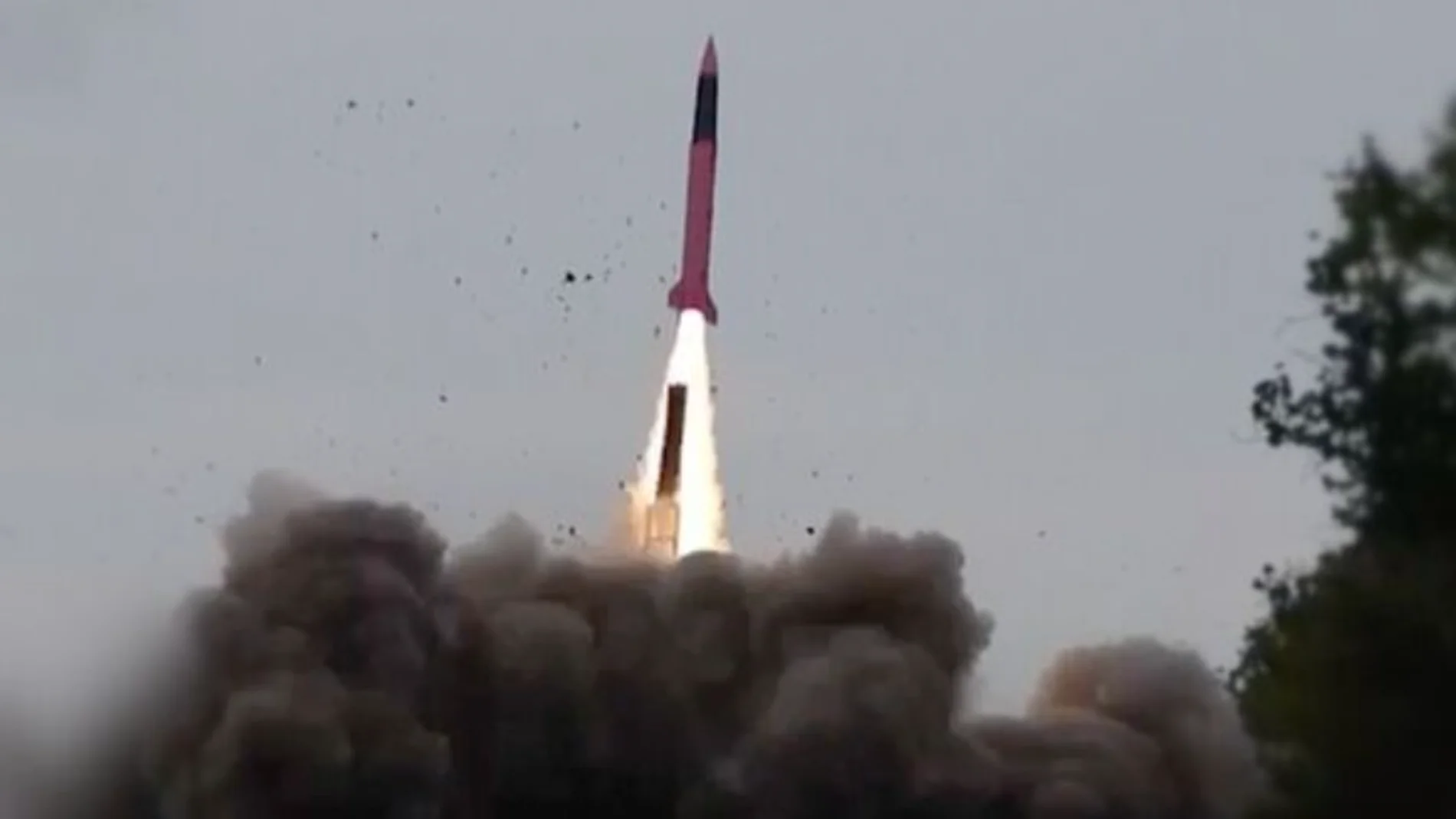
A missile can travel tens or hundreds of kilometers guided from the ground, but there comes a time when it needs to see for itself. This is when the finder comes into operation, the sensor located at the front that allows you to locate the target and orient it during the last seconds. Ukraine has just changed precisely that element in the FP-7.x, the missile that aims to become the heart of a new European defense system against ballistic missiles.
According to a statementthe Ukrainian company Fire Point has updated the specifications of its interceptor and now incorporates a combined infrared and radar seeker. The version presented in August only included an infrared image sensor, capable of locating the target based on its thermal signature. The company has not explained the reason for the change nor has it yet identified the supplier of the radar component.
The modification may seem like a technical detail, but in an antiballistic interceptor the seeker is one of the fundamental elements. The missile needs to locate a target that is moving at high speed and correct its trajectory in a very short time interval. An infrared sensor looks for the heat emitted by the target; A radar, on the other hand, uses radio waves reflected from the target to determine where it is located. Combining both methods allows you to have two different ways of following it and can provide greater robustness when conditions make the operation of one of them difficult.
The change comes as Fire Point develops the FP-7.x within Freyja, a multinational project designed to create a European defense against ballistic missiles at a lower cost than the US Patriot system. Ukraine and nine other European countries signed a declaration in July to launch the initiative. Fire Point acts as the main integrator and has established agreements with European companies such as Hensoldt, Thales, Diehl Defence, Saab, Kongsberg, Leonardo, MBDA and Safran to provide radars, guidance systems, seekers and command and control elements.
System architecture is important because FP-7.x is not intended to do everything on its own. For much of the flight it uses inertial navigation and receives radio corrections from the ground. The system’s radars detect and track the target and transmit information to the interceptor. In the final phase, the search engine located in the nose must take charge of the precise location of the target. It is a kind of relay: first the external sensors intervene and then the missile itself needs to find the target.
The announced figures explain the difficulty of the problem. The FP-7.x measures 7.25 meters in length and 53 centimeters in diameter. Fire Point places its current maximum speed between 1,500 and 2,000 meters per second, approximately between 5,400 and 7,200 kilometers per hour. The company expects a future evolution to reach about 2,200 meters per second, around Mach 6.5. According to Janes, an arms company, the initial interception objective is located at an altitude of between 20 and 25 kilometers.
For now, however, the FP-7.x does not use the same kill principle as the Patriot’s PAC-3 MSE interceptor. The current version carries a fragmentation warhead, designed to detonate near the target and launch fragments at it. Fire Point has recognized that aims to evolve towards a system hit-to-killin which the interceptor destroys the enemy missile through a direct hit. The difference is relevant: against a ballistic missile, it is not necessarily enough to damage it; It is necessary to prevent your cargo from reaching its destination.
The underlying reason for developing this system is economic as well as military. Fire Point intends to manufacture each interceptor for less than one million euros and reach a production of up to 2,000 units per year. The company maintains that figure would be a fraction of the cost of a Patriot interceptor. It does not mean that the FP-7.x is already equivalent to the PAC-3 or that it has demonstrated a comparable anti-ballistic capability: the project is still in development and its first interception against a ballistic target is scheduled for approximately July 2027.
In fact, the history of the project itself shows the extent to which there is still work to be done. The FP-7.x performed its first guided and maneuvered flight in June, but has yet to complete the integration of its different components and demonstrate that it can locate and destroy a real ballistic missile under the conditions for which it has been designed. Janes also points out that the program contemplates progressively expanding its benefits.
The new dual-technology seeker may be an important piece of that evolution, but we still don’t know exactly how the sensor combination will work or what radar component Fire Point will use. Some specialized publications have pointed to possible connections with European technologies, including Diehl Defense’s IRIS-T familya company that participates in Freyja. It is a reasonable hypothesis due to the structure of the program, but not information confirmed by Fire Point.
What is clear is the change in philosophy. Ukraine needs interceptors capable of dealing with ballistic threats, but it also needs them to be able to be manufactured in much larger quantities than currently available. The FP-7.x tries to solve both issues by combining its own design with European components and technologies. Now, in additionyour “eye” will no longer be only infrared: you will see the heat of the target, but you will also be able to search for it using radar. And in a race where a ballistic missile can travel miles in seconds, having two ways to find it can be as important as getting the interceptor to fly faster and faster.