
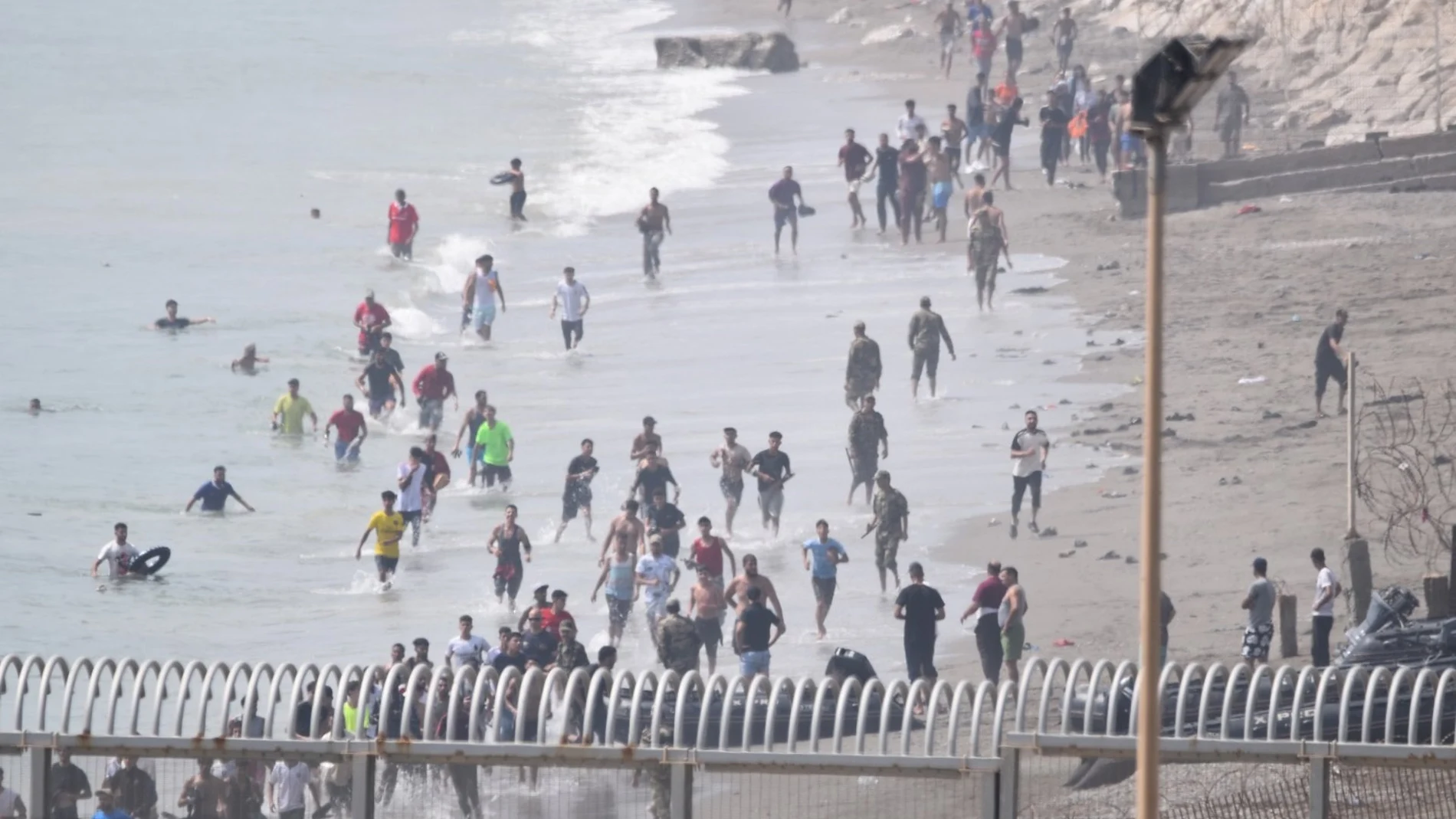
The judicial investigation of the massive assault in Ceuta has already managed to identify more than twenty “initiators” who were in charge of organizing on the ground the irregular entry of migrants into the autonomous city at the end of last July. As LA RAZÓN has learned, all of them – who acted without uniform – are part of the Moroccan Police or its secret services. But according to those same sources, the number of “initiators” – as the judge of the National Court María Tardón refers to them in the resolution in which she assumes jurisdiction to investigate the facts – is around thirty.
In that document, the instructor confirmed the presence at the El Tarajal border – after police analysis of the numerous videos and photographs taken during the migratory avalanche – of uniformed members of the Moroccan Security Forces, on the one hand, and of “stimulating agents on the ground” who were in charge of giving “instructions” to the former in some cases. Hence, the investigations point to the Moroccan Security Forces as being responsible for the “intellectual” responsibility for the massive and irregular entry of immigrants.
The investigation is now trying to determine what role each of them played and, above all, whether they acted following instructions from even higher authorities. The investigations are not limited, therefore, to the actions on the ground of the Moroccan agents or these intelligence agents, but also seek to reconstruct the chain of decisions that could have preceded the events of July 30 and 31 in order to also identify the “material” authorship of the invasion suffered by the autonomous city.
However, the scenario that arises now is ambiguous. Above all, because, although the judge accuses these “initiators” of participating in an operation considered an “attack” against the “territorial integrity of Spain” and a “violation” of national sovereignty, the Moroccan authorities do not seem willing to issue an extradition order against any of them.
A “hit on the table”
It was precisely Tardón who, with the objective of knowing whether the National Court was “competent” to investigate the clarification of the facts, agreed that the agents of the General Commissariat for Immigration and Borders issue a report assessing what happened. The sources consulted point out in this regard that despite the successive “pressure” from the leadership of the National Police to leave Morocco out of the migratory assault, the police unit has hit the table “by linking the Rabat Security Forces with that invasion, distancing itself from the story of the Government of Pedro Sánchez.
The report that the agents sent to the magistrate revealed that it was not a habitual migratory flow nor a merely “spontaneous” episode, but that there was an “intentionality” to attack the State as a method of “hybrid warfare”, since “the majority of immigrants did not seek to remain in Spanish territory.”
In the order in which, after receiving the reports from the Police and Civil Guard, Tardón assumed the authority to investigate the events, the magistrate refers to those “initiators.” Thus, it refers to “the interaction of uniformed agents with other individuals who energize the mass of people” during the illegal entry of migrants into Spanish territories. And I added that they responded to “identical physical, clothing and behavioral profiles”, being in charge of guiding “the movements and itineraries of the people who entered.”
Video analysis
This can be seen in several videos recorded on the ground during that migratory avalanche that has caused an unprecedented crisis in the autonomous city. In the images you can see the presence of certain people in civilian clothes who direct the migrants.
Thus, the statements of the immigrants interviewed agree “practically unanimously” – the judge of the National Court emphasized in that resolution – that the police officers not only remained in a “passive attitude”, but also offered them “indications to access through the water through the area of the Espigón de El Tarajal and not through other accesses.” A task in which they were helped by these “initiators” now unmasked thanks to police work.
Tardón also alludes to the “initiators of the message” who summoned thousands of migrants through social networks, whose task was the “promotion, dissemination and viralization of the call” and who were the ones who guaranteed the mobilization of such a huge number of people. The investigation will also run in this direction to try to identify all of them, for which it will be necessary to track hundreds of messages on social networks and investigate multiple profiles.
While the investigation progresses, the judge yesterday accepted the participation of the Government of Ceuta in the investigations, considering that the autonomous city and its inhabitants have been “victims” of the massive and irregular entry of immigrants.
Tardón recognizes his right to pursue criminal action as a private accusation due to the “serious events” that have affected the “freedom, the exercise of their rights and the integrity of people and their property.”